Ninja Crispi vs Crispi Pro: Which Glass Air Fryer Fits Your Kitchen?
Both cook on glass, both store leftovers in their own dish, and they share a cooking surface. The split is portability: one packs the cooker with the meal, the other stays on the counter and adds volume, functions and a temperature dial. Match the machine to how you actually cook.
The question is not which one is better
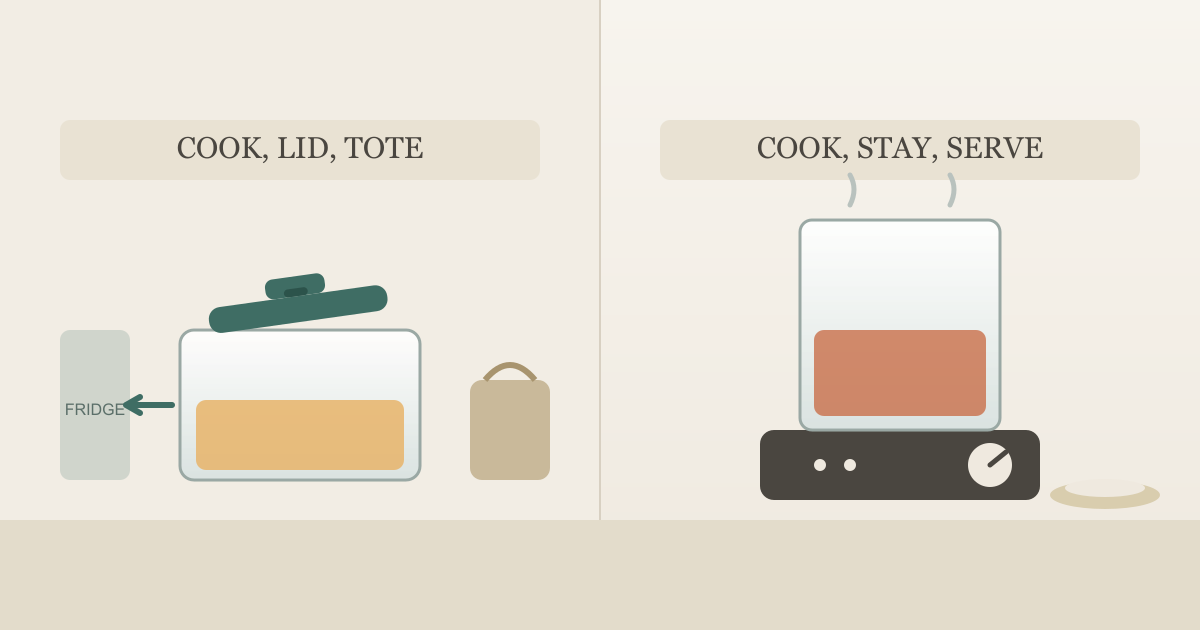
This guide compares the two glass-basket air fryers Ninja sells in this line in the US: the Crispi 4-in-1 and the Crispi Pro 6-in-1. They are closer to two different answers than to one product with a size dial. The Crispi 4-in-1 is a portable cooking system: the heating pod lifts off, the glass containers nest for the cabinet, and Ninja sells a tote bag so the dish can travel. The Crispi Pro 6-in-1 is a countertop appliance that happens to cook in glass: its base stays put, it holds more, and it gives you a temperature dial the portable does not have. Which one fits depends on how your kitchen runs, so this guide is organized around decisions, starting with the one that does most of the work.
Everything below comes from Ninja's own US product pages for the two models, read on October 11, 2026, and from two independent reviews we name when their numbers appear. Where a figure is someone's measurement rather than Ninja's claim, the sentence says whose.
Start with the workflow, not the specs
The standard Crispi ships as a PowerPod plus two glass containers, a 6-cup and a 4-quart, each with a crisper plate and a storage lid. The pod sits on top of whichever container you are cooking in, and when the food is done you can swap the pod for a lid. That is a cook-and-carry workflow: the cooker is the size of the dish, the containers nest for storage, and Ninja sells a tote bag for carrying a filled container. It is the model built around the idea that the meal leaves the kitchen.
The Crispi Pro cooks the same food in the same kind of glass, with a different arrangement: the heating element lives in a fixed base, and the glass inserts into it from the top. A 6-quart and a 2.5-quart container come in the box, each with a storage lid, and Ninja's own how-it-works guide describes the same cook-store-recrisp loop in one vessel: save leftovers with the lids, then revive the crisp in the same container. The containers themselves lift out; what stays home is the base, and the heating element is in the base. Bring the filled container to a potluck and it arrives lidded, not reheated, because the heating element never left your kitchen.
If you have ever carried a covered dish to a friend's kitchen, you already know which of those two descriptions sounds like your week. Both models cover the cook-serve-store loop at home; the standard also packs the cooker into the same bag as the meal.
Two different kinds of capacity
This is where the comparison most often goes wrong, because the two models measure capacity on different axes. Prudent Reviews, an independent review site that cooked over 100 meals in the standard Crispi, measured both models' cooking surface and found the same 8-by-8-inch plate in each: 64 square inches of food in a single layer, the same on both. That is the number that decides how many chicken wings you can crisp at once, and the Pro does not buy you more of it.
What the Pro buys is vertical volume. Its 6-quart container is deeper than anything the standard Crispi holds, which is why Ninja advertises that it fits a 7.5-pound chicken serving up to 10 people, against a 4-pound chicken serving up to 4 for the standard. Those are Ninja's marketing figures for whole, tall foods, not independent measurements, but the geometry behind them is checkable: a deeper vessel takes a taller roast. The Pro holds more food in total and taller food in one piece. On the horizontal axis, Prudent Reviews' comparison found the single-layer cooking area the same 8-by-8 inches on both, which is the basis it gives for the two machines holding a like amount of food arranged in one layer. How much fits in practice still depends on the food and how you load it.
Presets versus a temperature dial
The standard Crispi runs on four preset functions: Max Crisp, Air Fry, Bake, and Recrisp, up to 450 degrees Fahrenheit. You pick a preset and a time; there is no temperature to set. Ninja's own comparison chart describes it as preset cooking modes up to 450 degrees. Prudent Reviews measured where those presets actually land, between 375 and 450 degrees depending on the function, and found no way to set anything lower.
The Pro adds Roast and Dehydrate, widens Bake to Bake/Proof, and trades the presets-only panel for a precision dial up to 450 degrees. The dial matters for more than precision theater: dehydrating runs far below air-frying temperatures, and a proof setting only means something if the box can hold a yeast-dough warmth for an hour. If you want one machine that also does low-and-slow, the Pro is the one of the two that can. If you air-fry, reheat, and bake frozen things, the presets cover it, and the simpler panel is not a compromise you will meet every day.
Counter space, storage, and the habits that decide it
Ninja publishes dimensions for the Pro: 11.8 by 12.2 inches of footprint, 11 inches tall. Ninja does not publish the standard's dimensions on its product page. Prudent Reviews measured the standard at roughly 11.5 by 9.75 inches of footprint. Take that as one reviewer's figure rather than Ninja's, but the shape of the choice holds: the standard presents a smaller face to the counter, and its containers nest inside each other for cabinet storage.
The deeper question is whether either machine lives on the counter at all. The standard Crispi is designed to be put away: pod off, containers nested, pod in a drawer. The Pro, with its fixed base, reads as an appliance you assign a spot to. Australia's CHOICE, which tested the Australian variants of both, described the portable as very compact, with a small footprint that packs away relatively easily. If your counter is already spoken for, that difference will make the decision for you. One storage note applies to both machines: Ninja's safety instructions for its glass air fryer line warn that sudden temperature change can break glassware, and say to let glassware cool before washing it or putting it in the refrigerator or freezer; give a hot container that pause before it goes anywhere cold. No cooling time is published, and we will not invent one.
The glass, the plates, and what the non-toxic claims actually say
Both models cook in Ninja's CleanCrisp borosilicate glass, and both product pages describe that glassware as designed for non-toxic cooking and storing without PFAS and PTFE, the so-called forever chemicals. The Pro page adds that the glassware is thermal shock resistant and freezer-to-air-fryer safe.
Read the claims closely, because the wording is doing real work. The standard model's page attaches the free-from language to the glassware specifically; its crisper plates appear in the box list with no material claim attached. The Pro's FAQ goes further: it says all food-contact surfaces, not just the glass, are designed without PFAS and PTFE, and the same FAQ names the crisper plates as aluminum with a nano-ceramic coating. So on the Pro, Ninja's no-forever-chemicals design claim covers the plates too.
Two limits belong next to that. First, these are Ninja's design claims about its own materials; they are not independent laboratory testing of what the products contain, and Ninja's FAQ says it works with third-party labs for regulatory compliance without publishing results. Second, the coatings are coatings either way: CHOICE's testing advice on the Australian variants is not to dishwash the coated crisper plates, while Ninja's US pages call all the accessories dishwasher safe. We do not have testing that settles that disagreement, so we present both positions and note that neither is ours.
A decision guide by household
Four questions sort most buyers. Answer them in order and the right machine falls out.
- ▸Do you cook for one or two, mostly flat foods? Fries, wings, reheated pizza, two fillets: the standard Crispi's 4-quart container holds a single-layer batch on the same 8-by-8-inch surface the Pro offers, and the whole cooker is small enough to travel with the meal. This is the workflow the product was built around.
- ▸Do you roast tall foods for a table? A whole bird, a layered casserole, a big cut: the Pro's 6-quart vessel is the deeper box, and its advertised 7.5-pound-chicken capacity is the difference that matters here. If Sunday roast is a habit rather than an exception, the Pro is the glass fryer that fits it.
- ▸Does your cooking need low temperatures? Dehydrating fruit, proofing dough, holding a warm reheat without scorching: the standard's lowest preset is Bake, which starts at 375 degrees on Prudent Reviews' measurements, while the Pro's dial reaches down to low dehydration ranges. Precise low-temperature control exists on only one of these two machines.
- ▸Where does the cooker itself live? If a permanent spot on the counter is fine, the Pro earns its footprint with the dial and the volume. If the appliance needs to disappear into a cabinet, the standard Crispi is the one built for that, with two nesting containers and a pod that lifts off.
The two-cooks household is the interesting edge case: one person wants a lunch that travels to the office, the other wants a roast on Sunday. The standard Crispi carries its cooker with the meal; the Pro's cooker stays home. A conventional oven covers the roast either way, so the purchase decides which of you gets the appliance, and no configuration of these two products does both workflows equally.
What independent reviewers found
The hands-on findings below belong entirely to the outlets that produced them. Prudent Reviews, whose standard-Crispi review describes more than 100 meals cooked against six other air fryers, measured the preset temperature floors, the noise at 62 dBA on the standard and 67 dBA on the Pro, and the matching 8-by-8-inch plates cited above; their review also relays user reports of startup errors on early Pro units, which we cannot verify. CHOICE tested the Australian variants and found the portable cooked more slowly than the Pro, which its reviewers attributed to the portable's lower temperature ceiling, and rated the Pro's crumbed-chicken result excellent against the portable's good. Both findings are worth knowing; both are other people's testing, on variants that in CHOICE's case are not the US SKUs this guide describes.
What this guide cannot tell you
We did not cook with either appliance; this guide reads what Ninja publishes and what two named independent reviews measured, and nothing here should be read as first-hand use. Of the sources evaluated for this guide, Prudent Reviews' work is the only hands-on US-published testing of either SKU we found, durability over months of use is unknowable from spec pages and first-impression reviews, and our findings are limited accordingly. The published weights for the Pro disagree: Ninja lists 11.4 pounds, Prudent Reviews measured 17.5, and the two figures appear to describe different things. Because those measurement bases are unresolved, conflicting weight figures are excluded from the buying recommendation above; both figures are disclosed here rather than printed as a settled number. We also make no claim about chemical composition beyond Ninja's own design statements, because no independent lab results are published to cite.
This guide quotes no prices. They move weekly, and a comparison written around a sale date goes stale before the warranty does.
Sources
The primary and independent sources behind every claim above, read on October 11, 2026.
The verdict
These two products are one wager on glass-basket cooking, made twice. The standard Crispi bets your cooking travels, and packs the cooker into the same bag as the meal; the Pro bets you have a spot on the counter and a use for the extra depth and the dial. Ninja will happily sell you either, the 1-year warranty is the same on both, the containers store leftovers the same way on both, and the cooking surface is the same, so nothing in the spec sheet outranks your own answer to the portability question. Decide whether the cooker should leave your kitchen, and the choice makes itself.