YOSE POWER E-Bike Conversion Kits: Front vs Rear, Cassette vs Freewheel
A conversion kit goes on the bicycle you already own, so the bike picks the kit. This guide walks the four measurements that decide it - front or rear hub, freewheel or cassette, dropout width, wheel size - then covers what each YOSE POWER kit ships with, what the manuals say to do, and what the speed figures mean legally.
The order you have to decide in
A conversion kit goes on the bicycle you already own, so the bike decides the kit and not the other way round. Four of those decisions can be settled before you spend anything, three of them with a tape measure: does your frame have a front or a rear hub already, what holds your gears on, how wide is the gap between your dropouts, and what diameter is the wheel you are replacing. Get one of those wrong and the kit does not fit, however good the motor is.
Everything below was read from YOSE POWER's own product pages, its installation manuals and its policy pages on October 21, 2026. Nobody at JellyReviews has ridden one of these kits or fitted one to a bicycle, so no sentence here reports how any of them performs. Where a number is the seller's, the sentence says so. Every figure is in euros and can change.
Affiliate disclosure: JellyReviews may earn a commission when an eligible purchase is correctly attributed through an affiliate link. Attribution is handled by the store's own systems and can change, so no guarantee is implied here. JellyReviews is a participant in the YOSE POWER affiliate program, which runs on the GoAffPro Affiliate Program platform - an affiliate advertising program designed to provide a means for sites to earn advertising fees by advertising and linking to the partner site, yosepower.com. The product photographs here are YOSE POWER's own listing images, used under that program's limited, revocable content licence; YOSE POWER does not endorse this guide, and its ownership of the images is unchanged.
Measure four things before you read any listing
- ▸Dropout width. Measure the inside gap between your fork tips, front and rear, with the wheel out. YOSE POWER publishes 100 mm for its front kits and 138 mm for its rear ones, and those are the numbers your frame has to match.
- ▸Drivetrain. Look at the gears on your rear wheel. A screw-on freewheel is one threaded unit that comes off as a block; a cassette slides onto a splined freehub body. The two are not interchangeable, and the kits are sold to match one or the other.
- ▸Wheel diameter. Read the tire sidewall, not the frame. A 28-inch and a 700C are the same bead seat diameter in practice, which is why the listings print both, but a 27.5-inch and a 26-inch are different wheels.
- ▸Brakes. Cable-operated V-brakes and mechanical disc brakes work with the levers in these kits. Hydraulic brakes do not, and the seller says so on every listing.
Do not spread a fork or a frame to make a motor axle fit. If the gap does not measure what the listing asks for, the kit is the wrong kit for that bicycle. On a carbon frame or fork, or where the dropout measurement is unclear, ask the frame maker and a qualified bicycle mechanic before ordering anything.
Front hub or rear hub
A front kit replaces the front wheel and pulls the bike from the fork. That leaves the rear wheel, its gears and its chain untouched, which is why it is the simpler of the two to fit: the YOSE POWER front manual has you move the brake disc and the tire across from your old wheel, drop the new one into the fork, then fit the brake levers, throttle, display and pedal sensor. You end up with a bicycle whose driven wheel is still the standard one it was built with.
The trade-off is weight distribution. A front hub motor puts mass and drive force ahead of the handlebars, on a fork that was designed for neither, and that is a reason the manual devotes a page of photographs to the washer order and the order in which the axle nut, shim and washer go on rather than treating the wheel swap as trivial. A rear kit keeps the drive where a bicycle normally has it and leaves the fork alone, at the cost of a harder fitting job: the rear manual has you remove the freewheel or cassette from your old wheel and transfer it to the motor before the wheel goes back in.
YOSE POWER lists 100 mm between the fork tips for its front kits and 138 mm between the rear dropouts for its rear kits. Measure before you choose, because a 100 mm figure describes the gap, not the fork: two forks with the same gap can differ in material, in brake mounts and in how much torque the dropouts will take. The listing cannot see your bicycle.
Freewheel or cassette: the question that decides B and C
This is the question a listing cannot answer for you, and it has nothing to do with the motor. YOSE POWER's rear freewheel kit is listed as suitable for a 6, 7, 8 or 9-speed freewheel. Its rear cassette kits are listed as suitable for an 8, 9 or 10-speed cassette. Those ranges overlap at 8 and 9, but the mounting is different underneath, so the overlap does not mean either kit fits both.
The seller's manuals make the work explicit rather than hiding it, and the wording differs between the two kits for a reason. Both rear manuals have you take the rear wheel out and use a sleeve, an adjustable wrench and a chain wrench, but the cassette manual says to unscrew the freewheel cover and lift the unit out, and the freewheel manual says the same of the freewheel itself. Neither describes stripping sprockets one by one, and neither should be read that way: a typical 8, 9 or 10-speed cassette is held on a splined freehub body by a lockring that comes off with a cassette tool and a chain whip, after which the sprockets slide off as a stack, while a threaded freewheel is one piece that unscrews with its own tool. Which one you have decides the tool you buy before the motor ever arrives. Both manuals then tell you to reuse the brake disc and the tire from the wheel you took off, and the rear manuals add a warning worth repeating: use the screws that come with the motor to fasten the disc, because the wrong screws can stop the motor working.
If you cannot tell a freewheel from a cassette by looking at your own rear wheel, take a photograph of it and ask the seller before ordering. The difference is visible at the hub, and it is the one mistake here that a listing cannot help you avoid.
Wheel size, and the number the display forgets
The kits are sold as complete wheels with a rim and spokes already laced to the motor, so the wheel size is fixed at the point of order: 28-inch or 700C on the two front kits and the freewheel kit, 27.5-inch on one cassette kit, 26-inch on the other. Matching that to your bicycle is a tire-sidewall question, not a frame question.
One detail from the manuals deserves its own paragraph. The display ships set to a 26-inch wheel, and all three installation manuals tell the fitter to reset the wheel diameter, warning that leaving it alone will affect the speed reading. Fit a 28-inch kit and skip that step and the display will be telling you a speed that is wrong in the same proportion as the wheel size. It is a two-minute job in a menu, and it is the sort of thing that gets missed on the day the wheel goes on.
250W or 350W, and what the law says about it
Four of the five kits here are rated 36V 250W and the seller states a maximum assisted speed of 25 km/h, with the limit set in the display and, in its words, the limit that cannot be cancelled. The fifth, the 26-inch cassette kit, is rated 350W and the seller states 30-32 km/h.
In the European Union, Regulation (EU) No 168/2013 leaves pedal cycles with pedal assistance outside its scope only where the auxiliary motor has "a maximum continuous rated power of less than or equal to 250 W" and its output is "cut off when the cyclist stops pedalling and is otherwise progressively reduced and finally cut off before the vehicle speed reaches 25 km/h". The 250W kits match that description on paper. The 350W kit does not, and a listed 30-32 km/h exceeds the cut-off the regulation describes.
In the United Kingdom the gov.uk guidance is the same shape in different units: it puts the motor limit at a continuous rated power output of no more than 250 watts, and says the motor "must not be able to propel the bike when it's travelling at more than 15.5 miles per hour", which is 25 km/h. The same page adds a condition that matters for these kits: a bike can be propelled up to 15.5 mph without pedalling "but only if it's been approved", and the bike must carry markings showing its continuous rated power and its manufacturer. A kit does not supply those markings and does not supply an approval.
A 250W sticker on a motor is not a road-legal badge for the bicycle you build around it. The power and cut-off figures are conditions on the finished vehicle and its markings, and fitting a kit does not by itself meet them. That goes double for the 350W kit: as sold it states a speed above both the EU cut-off and the UK limit, so check your own country's rules, and the rules where you ride, before you order it.
The United States defines its own category, and the federal text is short enough to quote. 15 U.S.C. section 2085(b) calls a low-speed electric bicycle "a two- or three-wheeled vehicle with fully operable pedals and an electric motor of less than 750 watts (1 h.p.), whose maximum speed on a paved level surface, when powered solely by such a motor while ridden by an operator who weighs 170 pounds, is less than 20 mph". All five kits here are rated under 750 W, and the 350W kit's stated 30-32 km/h works out to roughly 18.6 to 19.9 mph. The listing does not state the test conditions the statute names, so that is an observation about the numbers, not a finding that the converted bicycle complies. State law is a separate layer: several states classify e-bikes in their own classes with their own equipment rules, and those are not uniform.
Two practical points cut across all three jurisdictions. The seller dispatches from Germany and its policy pages are written for European buyers, and its footer links a separate United States storefront at yosepowershop.com, which this guide has not audited and whose stock and terms may differ. And no kit listing text here carries a conformity statement to EN 15194 or any equivalent standard. One gallery image on the 27.5-inch kit does print the words EN 15194 in a speed callout, and that image is maker artwork rather than a certificate. So nothing on this page should be read as a certification of the finished bicycle in any market.
With a battery, or without
Two of the five kits here ship with an 18Ah battery and a 3A charger; two ship with a 13Ah battery and a 2A charger; one ships with neither. The box contents reflect that, but the listings differ in how loudly they say it, so it is worth stating plainly: the 28-inch front kit in silver at 249.00 euros is the motor kit on its own. It has no battery and no charger in the packing list, and the manual's last step, "install the battery and controller in the right position", assumes you have one.
That makes it a different kind of purchase from the other four. You are not choosing between two batteries; you are choosing to source a 36V battery yourself. The four kits that include one link the seller's 13Ah and 18Ah packs as replacements; this kit's own page links no battery at all, so there is nothing here to copy. Whether a pack you find matches the connector and the controller is a question for the seller, because the listing states no general battery compatibility rule.
The kit without a battery is not a shortcut to a finished conversion. It moves the battery, the charger and the question of whether they match the controller onto you. If you want the whole thing in one box, that kit is not it.
Pedal sensor, throttle and brakes: the three things that usually do not fit
Every one of these kits includes a pedal-assist sensor, a thumb throttle and a pair of cable brake levers that replace your existing levers. Three compatibility limits draw the most questions, and each one is a separate purchase if it bites.
- ▸The pedal sensor does not fit Hollowtech II or Octalink cranksets. The seller names its own alternative sensor for those, and the manual's fitting method, which involves pulling the left crank, is written for a square-taper crank.
- ▸The brake levers are cable levers and do not work with hydraulic brakes. The seller offers a hydraulic brake sensor instead, whose own instructions have you stick a sensor to the lever and set a magnet two to five millimeters away.
- ▸The throttle is a thumb throttle with its own limit. On the freewheel and 27.5-inch cassette kits the listing states a maximum throttle speed of 6 km/h, which is a walking-pace assist rather than a twist-and-go.
The controllers differ between kits as well: a 36V 15A Lishui unit on the two front kits, a 36V 15A JYT integrated unit on the freewheel kit and the 27.5-inch cassette kit, and a 36V 18A integrated unit on the 350W kit. The freewheel listing states that other controllers and displays are not compatible with that motor, so the parts are not freely interchangeable between kits even where the voltage matches.
The battery is the part to read the manual for
The battery manual is the most consequential document the seller publishes, and it is short. It forbids discharging through the charging port or charging through the discharge port, sets a charging temperature range of 0 to 45 degrees Celsius and a discharge range of minus 20 to 55, and says to use the matching charger because anything else will damage the pack. It also says the pack ships at roughly 60 percent charge and should be charged fully before use.
Two of its instructions are worth quoting rather than paraphrasing. It recommends charging with the original charger "in an environment without flammable materials such as a garage" and says it is recommended not to bring the battery into the room for charging. And it tells you to stop if the charger has not turned green after ten hours. Neither sentence is unusual for a lithium pack. Both are the kind of thing that gets read once and forgotten, which is why they are here rather than in a footnote.
The seller also publishes battery repair guides on its downloads page. Their presence is not permission to open a pack: the same manual gives 18 months of battery warranty and makes disassembly during that period a warranty-voiding act, and a lithium pack opened without the right equipment is a fire risk. Work inside one belongs with a qualified service.
What arrives in the box, and what does not
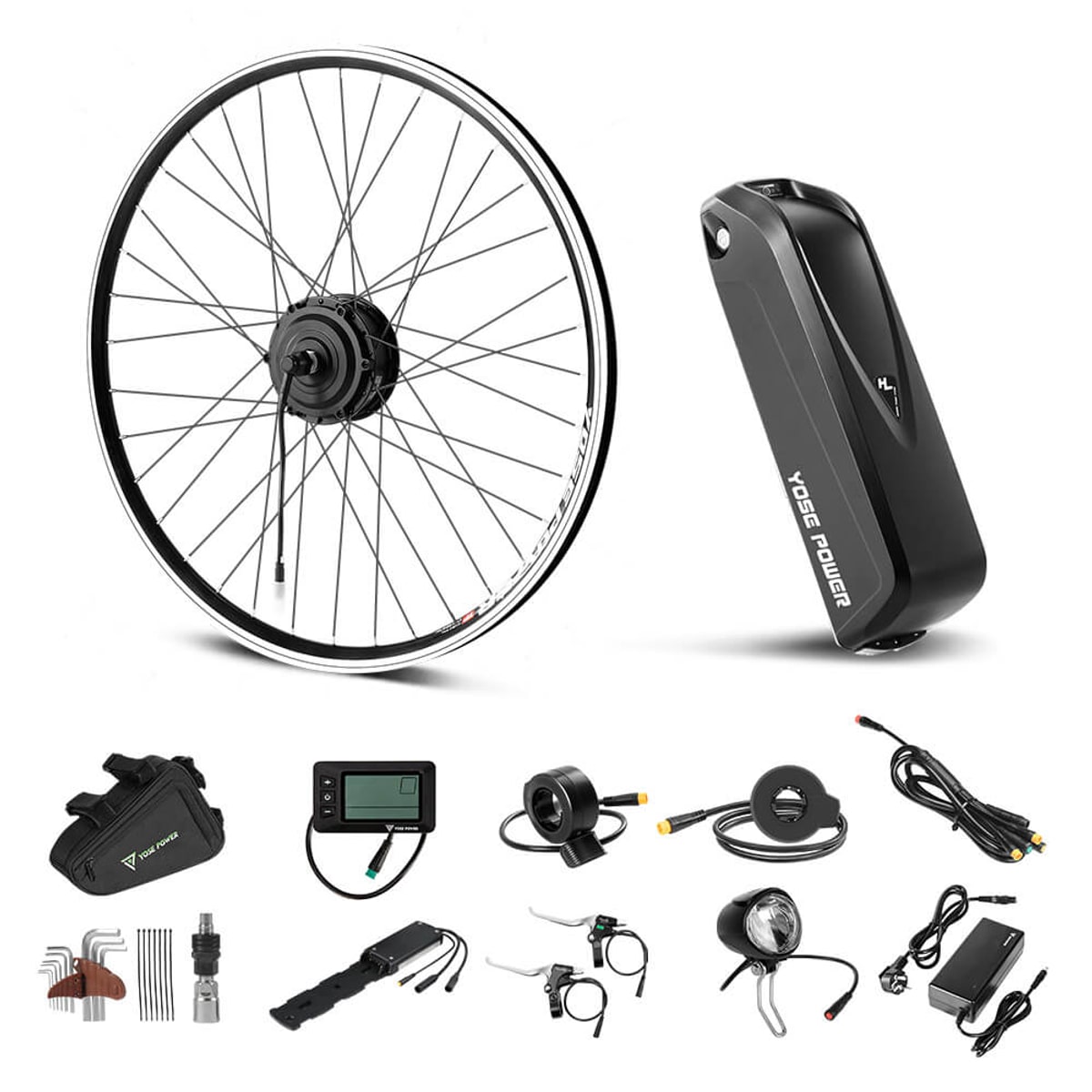
The packing lists are consistent across the five kits and worth reading closely, because several things people expect are not there. You get the motor built into a rim, the controller (separate on the front kits, integrated into the battery holder on the rear ones), the display, the pedal sensor, the thumb throttle, the brake levers, the main cable, a controller bag and a set of tools. The 28-inch front kits add a front light. You do not get a tire, an inner tube, a brake disc or the gears: the manuals have you move those across from the wheel you are replacing.
That last point is easy to miss and it changes the shopping list. The wheel arrives bare, so budget for a tire and tube if the ones on your old wheel are worn, and check that your brake disc bolts to the new hub with the screws the motor comes with, which the rear manuals specifically warn about.
The five kits
28-inch front kit with an 18Ah battery
This is the kit for a bicycle whose rear wheel and gears you want to leave alone. The seller lists a 36V 250W geared front motor with 43 Nm of torque, a 36V 18Ah battery in the HL1 down-tube format, a 42V 3A charger, a 100 mm fork gap and a 28-inch rim with 13G black spokes. The battery works out at 648 watt-hours from 36 volts times 18 amp-hours. The seller quotes a range of 60 to 65 km, which is its own figure under its own conditions and not a tested result.
It is the heaviest battery of the front options here at 18Ah, and it is the kit that most obviously wants a bicycle with a fork that can take a hub motor and a frame with room for a down-tube pack. The page gives no cable length for the motor, the display or the sensors, which matters on a bicycle with a long wheelbase. Fitting is the front manual: move the disc and tire across, set the washer order, tighten the axle nuts, fit the levers, throttle, display and pedal sensor, then reset the wheel size in the display.
YOSE POWER 36V 250W 28-inch front motor kit with HL1 36V 18Ah battery
- ✓36V 250W geared front motor, 43 Nm, 25 km/h stated limit (maker figures)
- ✓HL1 36V 18Ah down-tube battery with 42V 3A charger; 648 Wh by the published arithmetic
- ✓100 mm between the fork tips; 28-inch rim with 13G black spokes
- ✓36V 15A Lishui controller, KD21C display, PAS sensor, thumb throttle, mechanical brake levers, front light
- ✓Packing list has no tire, tube, brake disc or gears - the manual has you reuse your own
- ✓Listed at 459.00 EUR on the store, October 21, 2026
28-inch rear freewheel kit with an 18Ah battery
Same battery, same 250W rating and same 28-inch rim, moved to the rear and built for a screw-on freewheel of 6 to 9 speeds. Torque is listed at 40 Nm and the controller is a 36V 15A integrated JYT unit that lives in the battery holder, which is why that kit's packing list lists an integrated controller rather than a loose one. The seller's own question and answer section says other controllers and displays are not compatible with this motor.
The 138 mm rear gap is the number to check first, and the freewheel question is the second. If your rear wheel carries a cassette rather than a freewheel, this is not the kit, even if the gear count falls in the 6 to 9 range.
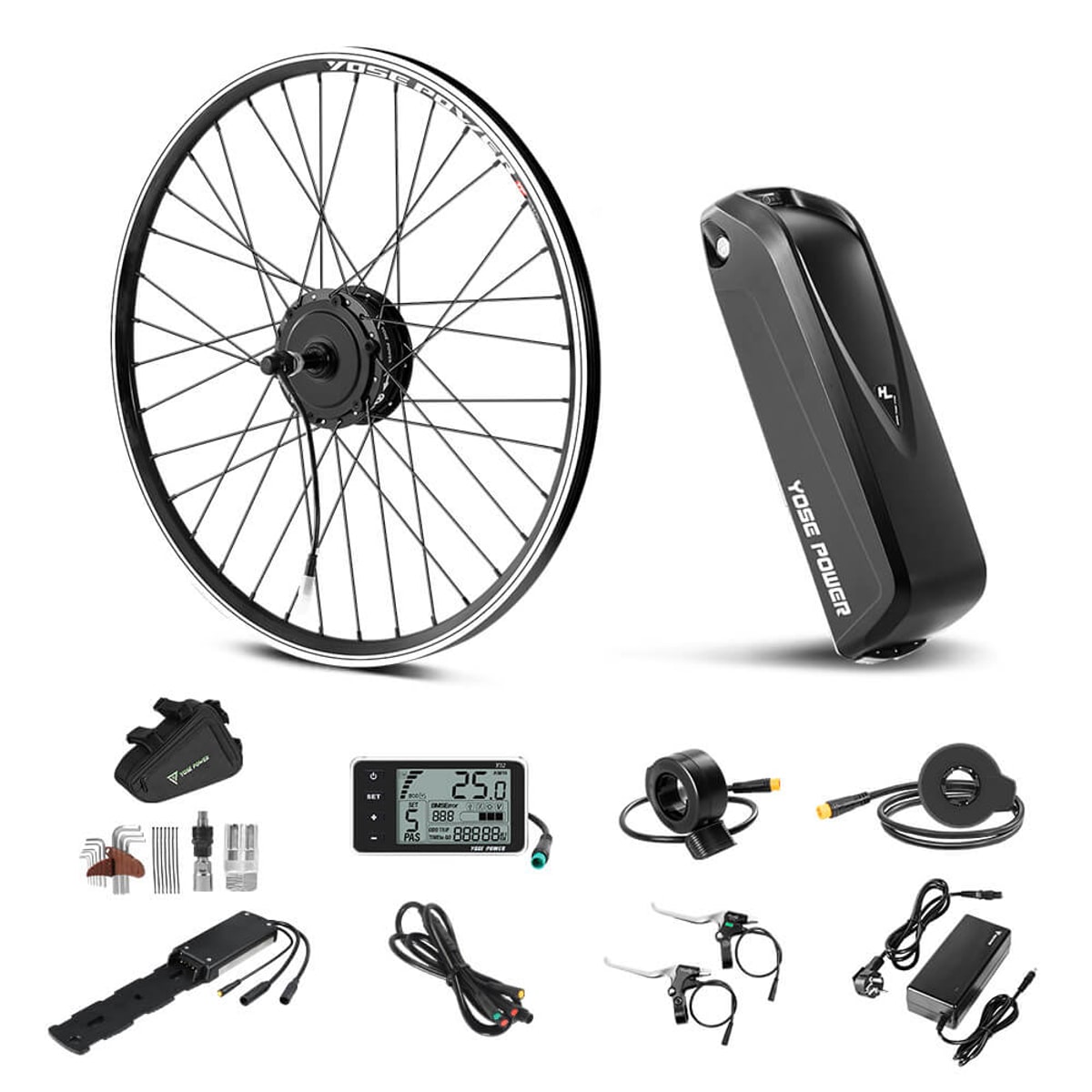
YOSE POWER 36V 250W 28-inch rear freewheel motor kit with 36V 18Ah battery and charger
- ✓36V 250W geared rear motor for a screw-on freewheel, 6 to 9-speed (maker listing)
- ✓40 Nm; 138 mm between the rear dropouts; 28-inch rim with 12G silver spokes
- ✓36V 18Ah down-tube battery with 42V 3A charger; 648 Wh by the published arithmetic
- ✓36V 15A JYT controller integrated into the battery holder; the packing list lists it as integrated, not loose
- ✓Maker states other controllers and displays are not compatible with this motor; throttle capped at 6 km/h
- ✓Listed at 450.00 EUR on the store, October 21, 2026
27.5-inch rear cassette kit with a 13Ah battery
The smaller battery and the cassette mounting together make this the middle of the range: 36V 13Ah, which is 468 watt-hours, a 42V 2A charger, a 36V 15A JYT integrated controller, a stated 58 Nm and a range figure of 40 to 50 km on the seller's conditions. The drivetrain is listed for an 8, 9 or 10-speed cassette.
Two things to weigh. The 2A charger on this kit will take longer to refill its pack than the 3A charger supplied with the two 18Ah kits, which matters if the battery is your only one. And the 27.5-inch wheel size is the narrowest fit here: it is a different diameter from both 26 and 28-inch, so it suits a bicycle that already runs 27.5-inch wheels and not much else.
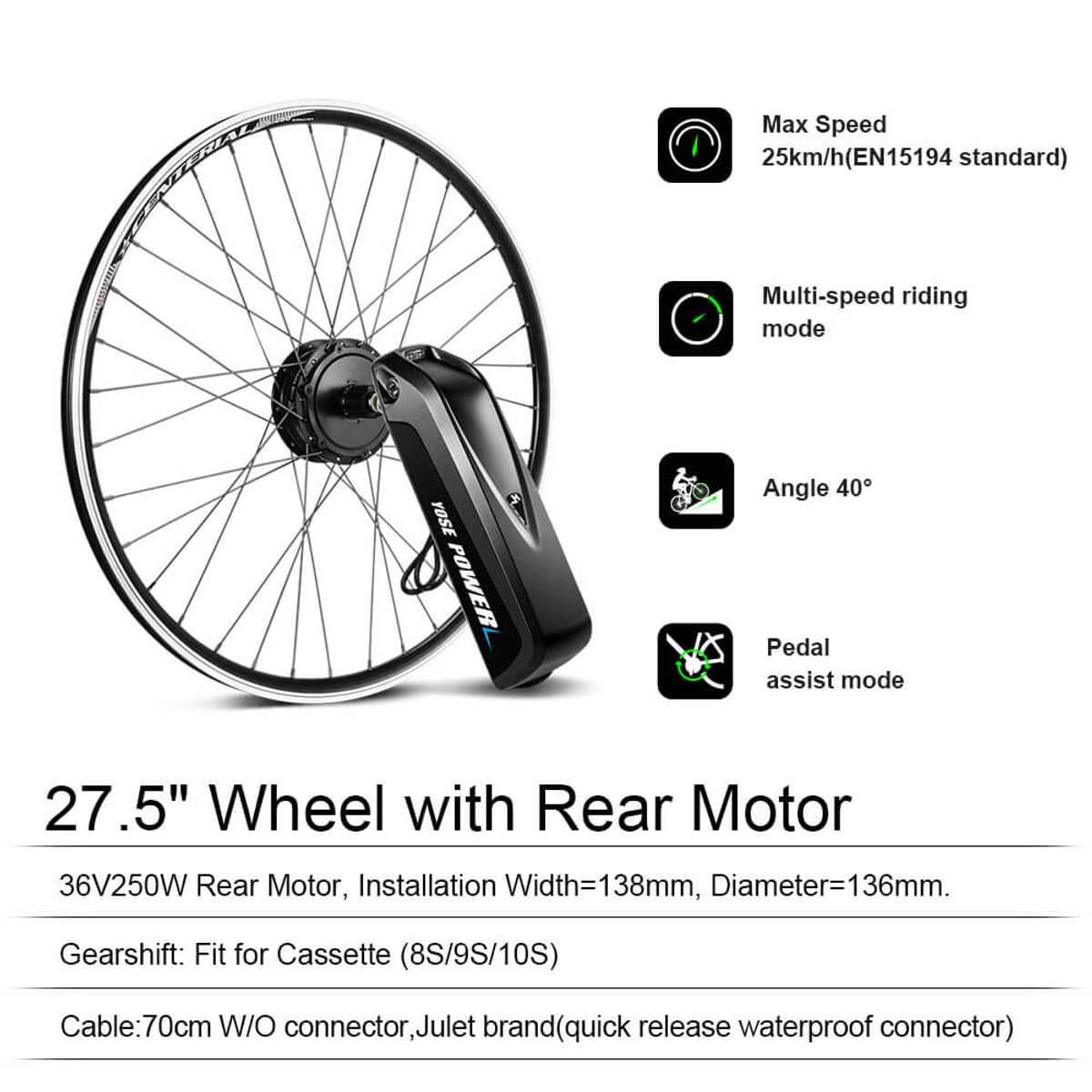
YOSE POWER 36V 250W 27.5-inch rear cassette motor kit with 36V 13Ah battery and charger
- ✓36V 250W geared rear motor for an 8, 9 or 10-speed cassette (maker listing)
- ✓58 Nm; 138 mm between the rear dropouts; 27.5-inch rim with 12G silver spokes
- ✓36V 13Ah down-tube battery with 42V 2A charger; 468 Wh by the published arithmetic
- ✓36V 15A JYT integrated controller, Dashi C500 display, PAS sensor, thumb throttle at 6 km/h, mechanical brake levers
- ✓Maker quotes 40 to 50 km of range on its own conditions - not a tested figure
- ✓Listed at 439.00 EUR on the store, October 21, 2026
26-inch 350W cassette kit with a 13Ah battery
The odd one out, and the one to be careful with. It is rated 350W rather than 250W, it states a maximum assisted speed of 30-32 km/h rather than 25, and it uses an 18A controller rather than a 15A one. Everything else follows the pattern: a 26-inch rim, a 138 mm rear gap, an 8 to 10-speed cassette, a 36V 13Ah battery, a 42V 2A charger and a stated 56 Nm.
As sold, that speed figure sits above the 25 km/h cut-off that both the EU regulation and the UK guidance describe, so this kit is the one in the range that cannot be presented as a compliant road bicycle without qualification. If your reason for converting is a legal commuter, this is not the motor to start from. If it is private land or a jurisdiction with different rules, read those rules first and treat the seller's speed as the seller's claim.
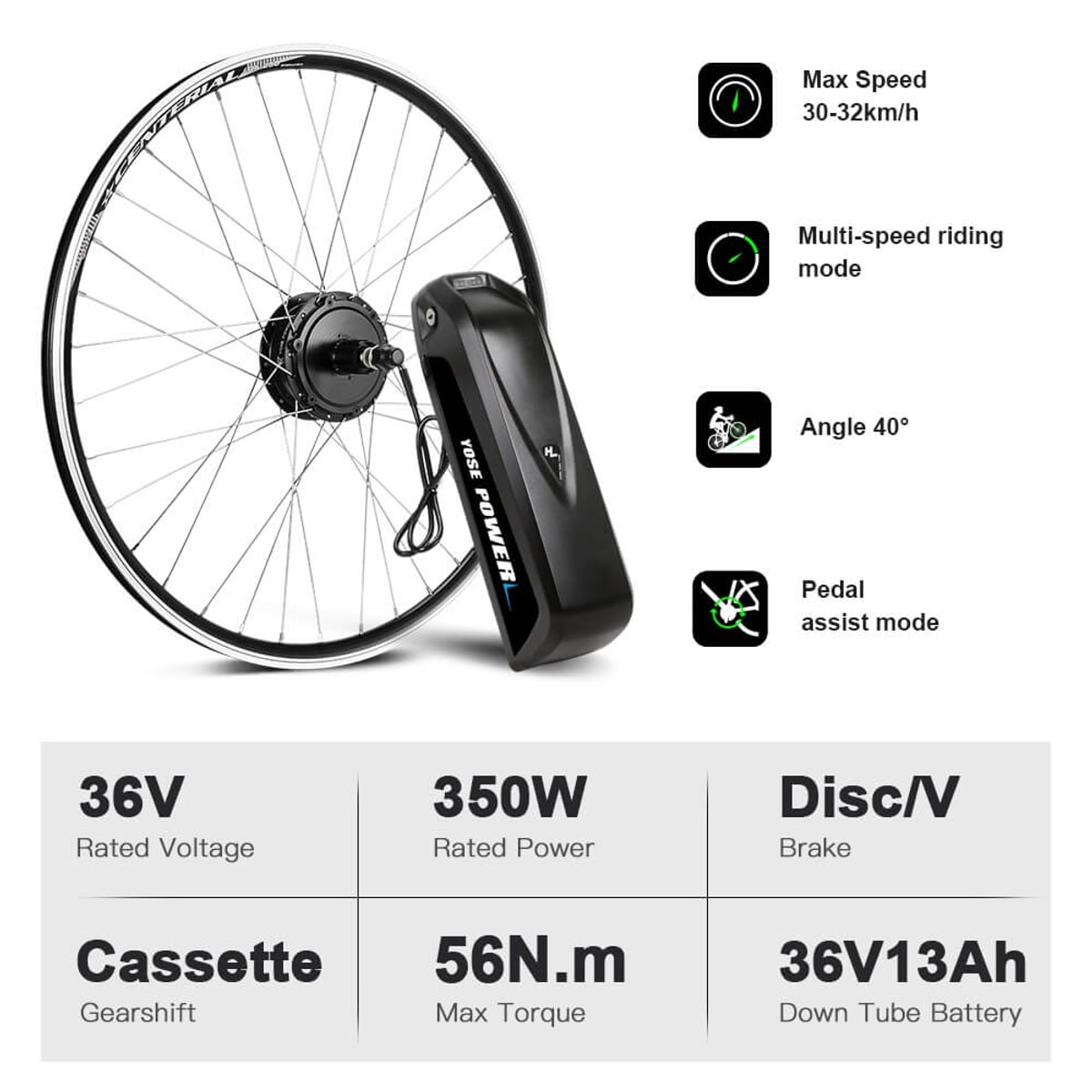
YOSE POWER 36V 350W 26-inch rear cassette motor kit with 36V 13Ah battery and charger
- ✓36V 350W geared rear motor for an 8, 9 or 10-speed cassette (maker listing)
- ✓56 Nm; 138 mm between the rear dropouts; 26-inch rim with 12G silver spokes
- ✓36V 13Ah down-tube battery with 42V 2A charger; 468 Wh by the published arithmetic
- ✓36V 18A Lishui integrated controller, Dashi C500 display, PAS sensor, thumb throttle, mechanical brake levers
- ✓Maker states 30-32 km/h - above the 25 km/h cut-off the EU and UK rules describe, so check your own local law first
- ✓Listed at 429.00 EUR on the store, October 21, 2026
28-inch front kit without a battery
The same front motor as the first kit, in silver rather than black, with 43 Nm, a 100 mm fork gap, a 28-inch rim with 13G silver spokes and a 36V 15A Lishui controller. What is missing is the battery and the charger, and the packing list says so by listing neither. It is listed at 249.00 euros, against 459.00 for the version with a battery, which reflects that.
Its listing still quotes 18 months of warranty for the motor and 12 for the other parts, but there is no battery warranty to speak of because there is no battery. It is a reasonable starting point if you already have a compatible 36V pack and can confirm with the seller that it matches the controller, and a trap if you assumed that figure bought the whole conversion.
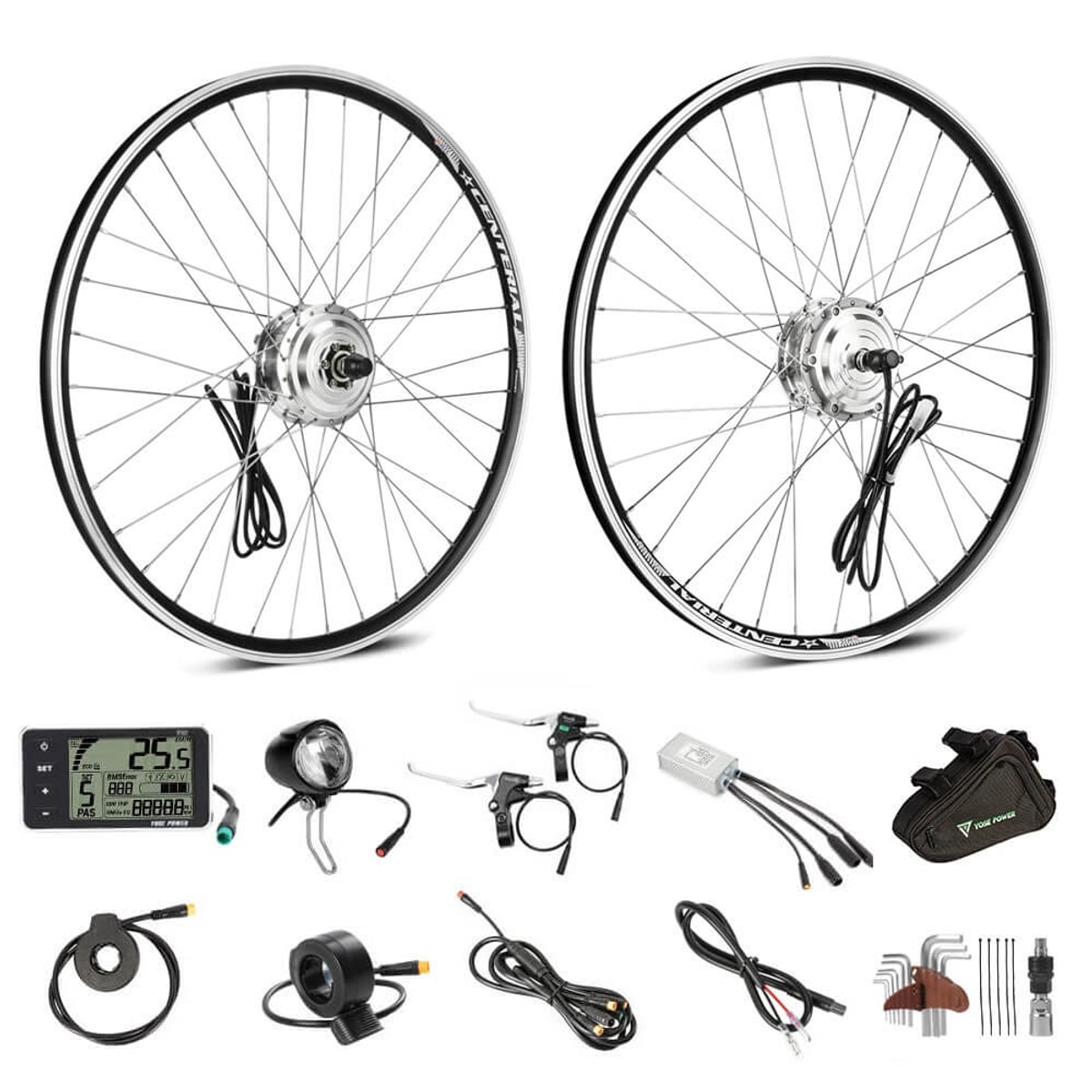
YOSE POWER 36V 250W 28-inch front motor kit in silver, sold without a battery
- ✓BATTERY NOT INCLUDED - the packing list carries no battery and no charger
- ✓36V 250W geared front motor, 43 Nm, 25 km/h stated limit (maker figures)
- ✓100 mm between the fork tips; 28-inch rim with 13G silver spokes; silver finish
- ✓36V 15A Lishui controller, Dashi C500 display, PAS sensor, thumb throttle, mechanical brake levers, front light
- ✓18 months motor warranty, 12 months other parts - no battery warranty because there is no battery
- ✓Listed at 249.00 EUR on the store, October 21, 2026
Returns, warranty and shipping, as the store prints them
The store runs three return documents and they do not say quite the same thing, which is worth knowing before you rely on any of them. Its 30-day page promises a full refund for any reason within 30 natural days of purchase, on an undamaged product in its original packaging, with the customer paying return shipping when the reason is not quality-related. Its separate refund policy says the same 30 days but adds an exclusion the 30-day page does not mention: sale items cannot be returned, and only items sold at the regular figure can be refunded. Its returns instructions add a second clock, asking you to send the product back within seven days of confirming the return address, and say a return label is provided where the item was wrong, damaged or defective.
The returns instructions add the step the other two pages leave out: send the product back within seven days of confirming the return address, and expect a return label only where the item was wrong, damaged or defective.
Read the returns instructionsWarranty is split, and only the product listings say how. The warranty page advertises 12 to 18 months across batteries, conversion kits and accessories; each kit's own page states 18 months for the motor and battery and 12 months for the other parts, and the battery manual repeats the 18-month figure and rules out disassembly during it. The warranty is not transferable and covers defects present at delivery, and the store asks for photographs or video before it will process a claim.
Shipping is European. The store ships battery and motor kits from Germany on the next working day after payment, quotes 2 to 4 working days inside Germany and 4 to 8 working days outside it, and says free shipping is available across European regions. Complete e-bikes are restricted to mainland Germany or France, which does not apply to these kits. Nothing on these pages offers delivery to the United States.
Fitting it, honestly
The manuals walk through the job with ordinary bicycle tools plus a puller for the crank and, on the rear kits, a freewheel or cassette tool and a chain wrench. The steps that catch people are the ones the manuals spend photographs on: getting the washer with the part bulge the right way round, pointing the motor cable down and covering its plug, and matching the splines on the pedal sensor to the crank.
The seller also publishes a YouTube installation video for the front kit and for the rear kits, linked from the bottom of each listing. They are the seller's own videos, and this guide has not watched them, so treat them as a second opinion on the manual rather than a replacement for it.
Frequently asked questions
Can I fit a rear kit to a bike that came with a front derailleur and a triple chainring? Yes. The drivetrain question is about the rear gears only, and none of these kits touches the front chainrings. Your left crank does come off to fit the pedal sensor, which is where the Hollowtech II and Octalink warning applies.
My bike has hydraulic brakes. The levers in the kit will not work with them. The seller offers a separate hydraulic brake sensor, and fitting it means positioning a sensor on the lever and a magnet two to five millimeters away, per its own instructions. Budget for that before ordering.
Can I use my own 36V battery with the kit that has none? Only if you can confirm with the seller that the connector, the voltage and the controller match. The listing does not publish a general compatibility rule, so this is a question for the store rather than something to assume from the voltage alone.
How fast will it go? The 250W kits state a 25 km/h limit that the seller says is set in the display and cannot be cancelled. The 350W kit states 30-32 km/h. Both are the seller's claims and both have legal consequences covered above. This guide has not measured either.
Does a US buyer get any of this from the same store? Not automatically. The seller's footer links a separate United States storefront, yosepowershop.com, and this guide has not audited it. The federal definition at 15 U.S.C. section 2085(b) is quoted above, and state classification is a separate layer again, so check both before ordering across an ocean.
Do I need to tell my insurer? That depends on your jurisdiction and your policy, and the answer is not on any page here. In the UK an approved EAPC needs no licence, registration, tax or insurance, but a converted bicycle that exceeds the power or speed limits is treated as a moped, which does. Ask your insurer before you ride, not after.
What happens to the warranty if I fit it myself? The warranty covers defects present at delivery and says nothing either way about who fits the kit, so it is worth asking before you start. The manual does make disassembly of the battery a warranty-voiding act, and the warranty page excludes damage caused by non-original parts and unauthorised changes to the circuit. Keep the parts you removed and the purchase receipt.
Where to go next
If you want to see the whole range, the seller's storefront and its downloads page are the two links worth having: the first lists every kit and the second has the installation manuals and display manuals as PDFs you can read before you buy. Both are below, and both carry our referral code.
Browse the full YOSE POWER store, where the conversion kits, the batteries and the policy pages quoted above all live.
Visit the YOSE POWER storeThe manuals are the better starting point. They are short, they are illustrated, and they tell you what the job involves in a way a product listing does not try to.
One honest exit. If the measurements rule out every kit here, the bicycle is not a donor and no amount of shopping fixes that. A complete electric bike is the other path, and this site covers one brand of them in its VIVI guide - different product, different set of trade-offs, and a poor substitute only if what you wanted was to keep the bike you have.
If a measurement still does not settle the question, ask the store before you order rather than after. The contact page is the route for a fork gap that reads oddly, a drivetrain you cannot identify, or a battery you want confirmed against a controller.