Garden of Life: Read the Word Next to NSF
Garden of Life appears on six of our ranking pages, more than any other brand, and has not finished first on one. Part of the answer is printed on the boxes. Two of the six carry an NSF Certified for Sport mark, two carry a different NSF badge that answers a different question, and which of its products reach a register at all turns out to follow a pattern worth knowing about.
The short version
Garden of Life turns up on six of our ranking pages: creatine, protein powder, multivitamins, vitamin C, turmeric and probiotics. That is more pages than any other brand on this site. It has not finished first on any of them, and second, on creatine, is as high as it gets.
Part of the explanation is printed on the packaging, and it is easy to walk straight past. Two of those six products carry an NSF Certified for Sport mark. Two more carry an NSF badge that is not Certified for Sport at all. The two badges answer different questions, and only one of them is about what is inside the container.
Follow that thread into the register and it stops being a fact about one brand. Which products a supplement company pays to certify lines up with something other than how much the certification would help the person swallowing it.
Where it lands on our pages
Six placements, read off our own rankings rather than off anything the brand says about itself:
- ▸Creatine: second of five, for Sport Creatine Monohydrate + Probiotics
- ▸Protein powder: fourth of five, and our plant-based pick, for the Sport Organic Plant-Based Protein
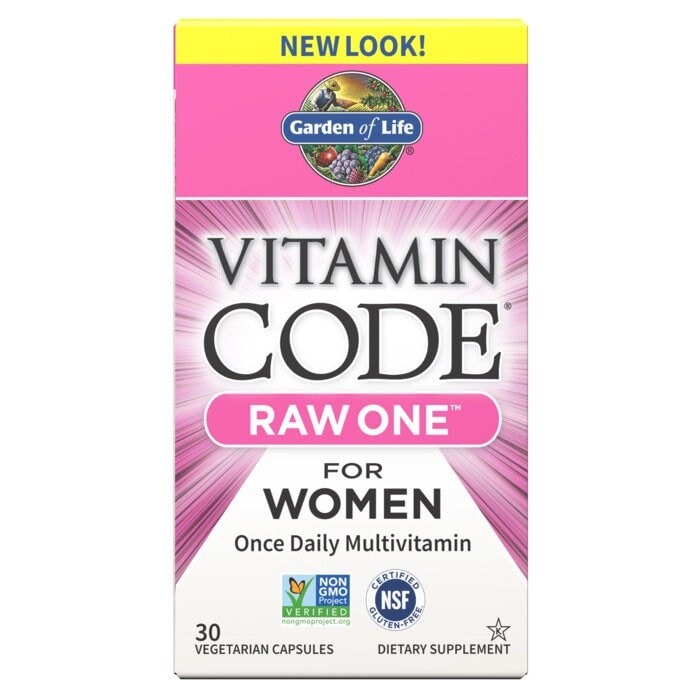
- ▸Multivitamins: fourth of five, for Vitamin Code RAW ONE for Women
- ▸Vitamin C: fourth of four, for Vitamin Code Raw Vitamin C
- ▸Turmeric: fourth of four, for Organics Extra Strength Turmeric
- ▸Probiotics: fifth of five, for RAW Probiotics Ultimate Care
Five of those six pages rank on a version of the same question: has an outside body checked the exact pack you are about to buy. The probiotics page is the exception, and it sorts on something else entirely, which is whether the label names the strain you are buying rather than just the genus. Ranks on six separate pages do not stack against each other either, so read that list as six separate verdicts rather than a league table.
The two marks, side by side
Along the bottom of the Sport Creatine pouch sit three marks: Non-GMO Project Verified, then a rectangle split in two, a blue half reading NSF and an orange half reading CERTIFIED SPORT, then a Kosher star sitting apart on the far right. Garden of Life also lists NSF Certified Gluten Free for this creatine, in its own images on the retail page, and the front of the pouch does not show it. The Sport protein tub carries the same rectangular mark, in a row with a USDA Organic seal and a Non-GMO Project Verified one.
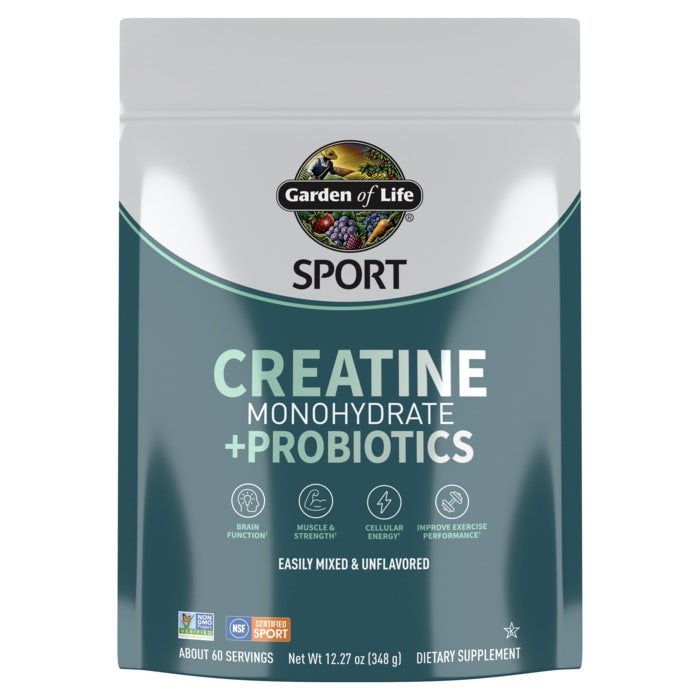
Garden of Life Sport Creatine Monohydrate + Probiotics
- ✓The pouch carries the split NSF Certified Sport rectangle, next to a Non-GMO Project Verified seal and a Kosher star
- ✓NSF lists it by name and by pack: Sport Creatine Monohydrate + Probiotics, Kosher, 60 servings
- ✓348 g, about 60 servings, unflavored
- ✓Second of five on our creatine page, which is as high as any Garden of Life product places on this site
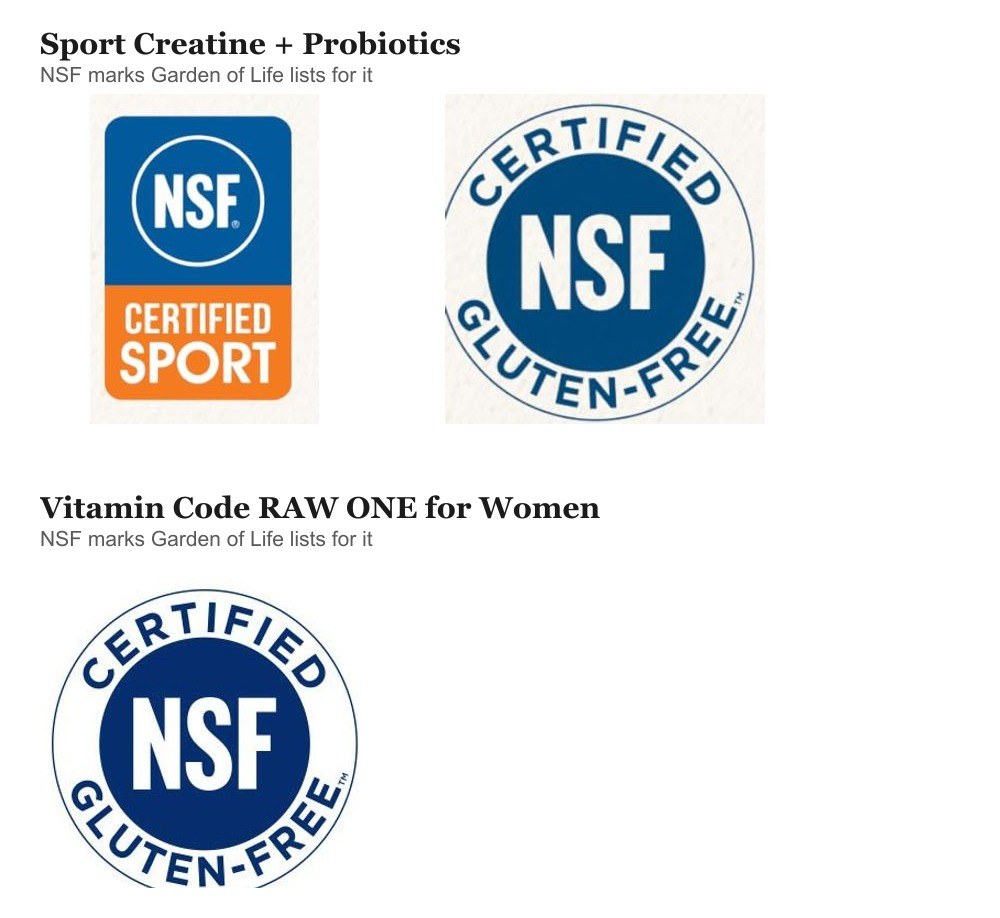
The Vitamin Code RAW ONE for Women carton carries three marks in the same arrangement: Non-GMO Project Verified, a round blue NSF badge, and a Kosher star off on its own. The words wrapped around that ring read CERTIFIED across the top and GLUTEN-FREE across the bottom. It is the only NSF mark on the front of the carton. The Raw Vitamin C carton carries the identical round badge.
NSF Certified for Sport screens a product for banned substances and checks that what the label promises is what the container holds. That is a claim about the whole panel. The gluten-free mark is a claim about one thing that should not be in there at all. Same organization, same three letters, different shape, different scope, and only the first of them speaks to whether the numbers on the back are right.
Turn the box over before you decide. A rectangular NSF mark reading CERTIFIED SPORT and a round NSF mark reading GLUTEN-FREE are two different certifications with two different scopes, and one does not stand in for the other.
What the register lists, and the near twin sitting beside it
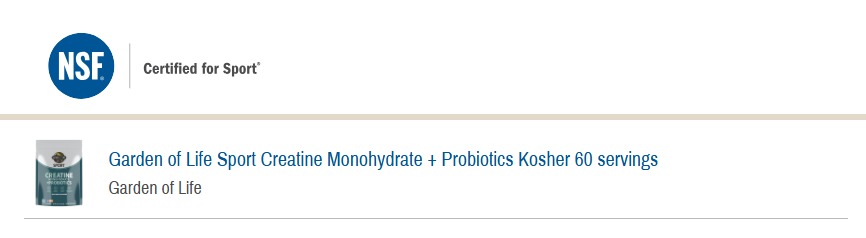
NSF publishes its Certified for Sport listings, so none of this has to rest on trust. The creatine is there under a name that includes its size: Garden of Life Sport Creatine Monohydrate + Probiotics Kosher 60 servings. The pouch says about 60 servings on the front. Those two match, which is the whole point of looking.
The protein needs more care, because two similar entries sit next to each other in the same register. The one you want is Organic Plant-Based Performance Protein, listed in Chocolate, Strawberry and Vanilla. Also in the register, under a name that drops the word Performance, are Organic Plant-Based Protein Chocolate 19 Serving Jar (Canada) and the Vanilla version of the same.
Now look at the tub sold in the United States. It says ABOUT 19 SERVINGS. So the serving count, the number your eye goes to first, is the one thing that does not tell the two entries apart. The word that does is Performance, and it is the kind of word that falls out when a product name gets retyped.
NSF also runs a second register, separate from the sport one, under the standard NSF/ANSI 173. It covers identity and contaminants rather than banned substances. Garden of Life holds 47 listings there: four softgels, 23 powders, five gummies, 14 capsules and a single tablet. The Sport creatine is one of them, so that pouch is in both registers.
The kids multivitamin is in the register. The adult one is not.
One name in those 47 is worth pulling out: Garden of Life Kids Multivitamin. Vitamin Code RAW ONE for Women, the adult multivitamin we rank fourth, is in neither of the two registers above.
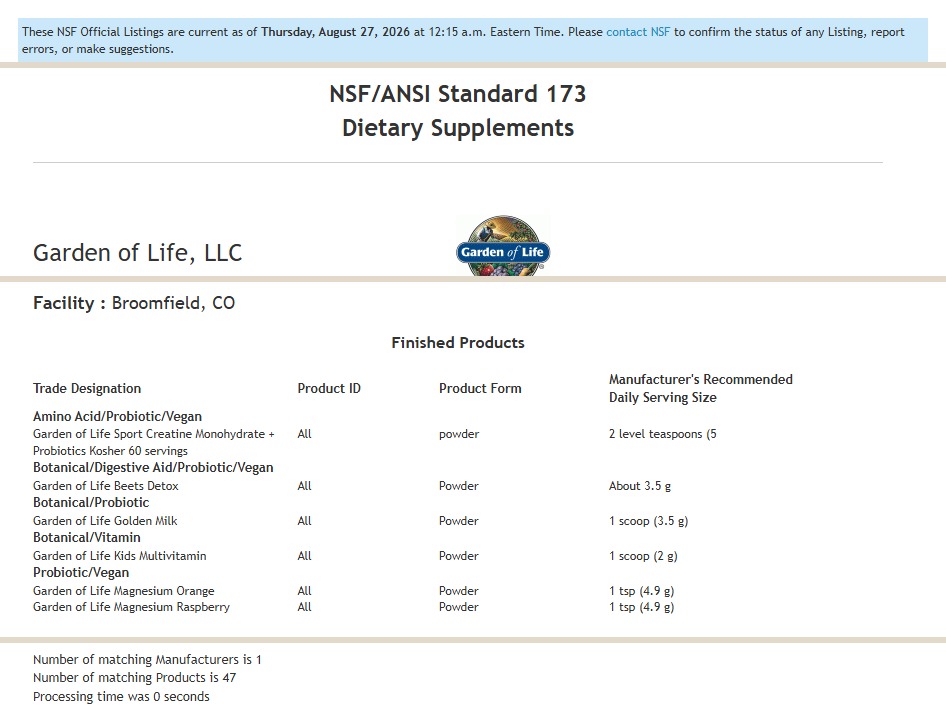
That looks like a story about who a product is sold to. Set it against the rest of the register and it stops working. Three prenatals and three kids products sit in a list that also holds a Beets Detox, a Golden Milk, two magnesium powders and fourteen probiotic capsules, one of them a prenatal itself. Nobody is being shielded from a traceable disaster by a golden milk latte.
What does hold across all 47 is duller and harder to argue with, and it is about product lines rather than about people. Every listing that is not a powder carries the Dr. Formulated name: the four softgels, the five gummies, all 14 capsules and the one tablet. The 21 listings outside that line are powders, without exception.
Now look at the four Garden of Life products we rank that appear in neither register, and read the front of each box. Vitamin Code RAW ONE for Women: 30 vegetarian capsules. Raw Vitamin C: 60 vegan capsules. RAW Probiotics Ultimate Care: 30 vegetarian capsules. Organics Extra Strength Turmeric: 60 vegan tablets.
None of those four is a Dr. Formulated product, and none of them is a powder. That combination does not appear once in the 47.
That is a choice, not a limitation
The obvious objection is that a capsule cannot be certified to this standard, and Garden of Life answers that with its own record. Fourteen of its 47 listings are capsules and one is a tablet. Across the whole register the totals are 689 capsule entries and 338 tablets. The standard covers both formats, this company already uses it on both, and these four are still outside it.
Why not is a question we cannot answer, and we are not going to invent a boardroom for you. Certification is bought per product, so any company selling a lot of them has to choose which ones. All we can tell you is which side of that choice your bottle is on. The Sport mark is printed on the front where you can see it. The 173 listing we found in the register, and the register is open to anyone.
There is one more thing worth saying, and it is about the everyday bottle rather than about this brand. You take a daily multivitamin for something you cannot feel. There is no morning where it visibly works and no morning where it visibly fails.
That invisibility is most of why you bought it. It is also why nothing is likely to force the question. A failed drug test produces an incident with a date on it; a daily multivitamin that is a little off produces a very quiet nothing. You can report a problem with a supplement to the FDA, and people do, but almost nobody has a reason to, because there is no moment that tells them to.
So the check tends not to arrive by itself. That leaves it as something you go and do, once, before you buy: look for the pack in a register you can open, or know that you are taking the company at its word.
The seals that are not NSF still mean something
The Organics Extra Strength Turmeric carton carries USDA Organic and Non-GMO Project Verified and no NSF mark at all. Both are real certifications audited by outside bodies. They cover how the plant was farmed and whether the ingredients were genetically modified.
Neither covers how much curcumin reaches the tablet, which is what our turmeric page sorts on. It is fermented whole turmeric rather than a standardized 95 percent extract, so there is no comparable figure to set beside the three ranked above it. Buy it for the organic whole-food format. Do not buy it expecting a curcumin dose you can compare.
The probiotic has a version of the same gap in a different place. The carton promises 100 billion CFU across 34 strains and names three of them: B. lactis, L. acidophilus and L. paracasei. The other 31 are a number with nothing attached. You cannot look up a strain that has no name, and a count you cannot check is not evidence.
Where the brand is strong
The creatine is our number two pick, and the trade it asks for is a fair one. The pouch holds about 60 servings at 5 g of micronized creatine each, which is the standard daily dose, plus 1 billion CFU of Bacillus subtilis DE111, a spore-forming strain that survives being sat in a warm cupboard. The register entry carries that same figure inside the product name, so the pack and the certificate are describing one container rather than a family of them. What you give up is bulk: 348 g here, against 1 kg from the pick above it.
The plant protein is our plant-based pick, and it is the only plant protein on that page, so read the badge as a description rather than as a contest won. The tub prints 30g PLANT PROTEIN on the front. Our protein page records where it comes from, which is peas, navy beans, lentils and garbanzo beans, and puts it against 28 g for the Transparent Labs whey isolate ranked second. The same page records 8 g of carbohydrate a serving against 3 g for the whey ranked first, because protein pulled out of a plant arrives with some plant still attached. Garden of Life prints the NSF mark on the retail page, rather than leaving you to go and find it.
Who should buy it
If you are drug tested, or you want the pack in your hand to exist in a public database, buy from the Sport line and open the register first. The creatine and the plant protein both clear that bar. Check the creatine against the servings printed on the pouch, because its entry carries them in the name, and check the protein against the word Performance, because its entry does not carry a size at all.
If what you want is a whole-food formulation, or organic farming, Vitamin Code and Organics are built for exactly that. Go in knowing what each of their seals covers. Non-GMO Project Verified is about genetic modification. USDA Organic, on the turmeric, is about how the plant was farmed. The round NSF badge on the two Vitamin Code cartons is a real outside check, and what it checks is gluten. None of the three is a check on whether the panel on the back is accurate.
The habit worth keeping is smaller than a verdict on a brand. Read the word next to NSF, not the letters. On this shelf the letters appear on both halves and the word beside them is doing all the work.