Which SVBONY Telescope Should You Buy? Moon, Planets or Deep Sky
SVBONY sells refractors, Maksutovs and one Petzval astrograph, mostly as optical tubes with nothing else in the box. This guide sorts the lineup by what you actually want to do - look at the Moon, chase planets, photograph nebulae - and counts what each setup still needs before first light.
SVBONY builds telescopes the way camera brands build bodies: most listings sell you the optical tube and expect you to already own the rest. The MK90 lists at 188.99 dollars on the store; the complete SV503 80ED setup with mount, tripod, diagonal, zoom eyepiece and finder lists at 898.99. Between those two figures sits the whole decision this guide maps: which glass for which job, and how much surrounds the tube when it arrives. Which SVBONY you should buy is therefore two questions: what do you want to point it at, and what does the box contain.
Six listings follow, sorted by the job they do: the SV503 80ED as the do-most-things ED doublet, its complete visual kit for anyone who wants one box that observes on night one, the SV550 80 APO triplet for buyers leaning toward serious imaging, the SV555 Petzval for wide-field deep-sky photography only, and the MK127 and MK90 Maksutovs for Moon and planets. The rest of the catalog is passed over deliberately: the SV503 70 and 102 are the smaller and larger siblings of a covered design; the SV48P is an achromat, a different optical class with a color-fringing tradeoff its own marketing does not hide; the SV550 122 and SV580 are step-up apertures at step-up money; and the SV520 and SV501P are beginner kits outside the optical-quality lane this guide covers. Every figure below is what SVBONY states on its own product and policy pages, all read on October 17, 2026. JellyReviews has not looked through any of these telescopes, owns none of them, and makes no optical judgment of its own; where a claim is the maker's, the sentence says so. Listed figures are what the store's buy boxes showed on that date and will move.
Affiliate disclosure: JellyReviews may earn a commission when an eligible purchase is correctly attributed through an affiliate link. Attribution is handled by the store's own systems and can change, so no guarantee is implied here.
Pick by what you want to do, not by aperture alone
The catalog splits cleanly along the viewing job. Magnification on any telescope is its focal length divided by the eyepiece's, so for Moon and planets you want a long telescope focal length to work with: the two Maksutovs carry 1,250mm (MK90) and 1,500mm (MK127) of it against 480 to 560mm for the refractors, on the maker's numbers, and the eyepiece you pair with it sets the final power. For wide-field deep-sky photography the number that matters is focal ratio, telescope focal length divided by aperture: a low f-number concentrates the light onto fewer millimeters of sensor and shortens the exposure a given target needs. It is an imaging trade, not a light-gathering contest between telescopes - a bigger aperture always collects more total light than a smaller one, whatever its ratio; the SV555 runs f/4.5 where the refractors run f/6 to f/7. For a first scope that does a bit of everything, the refractor path is the one with a complete kit sold as one listing.
Then ask the question the spec sheet will not answer for you: what else does this box need? Four of the six covered listings are optical tubes with no eyepiece, no diagonal and no mount. One is a complete kit. One is a camera lens in everything but the mount thread. The sections below count what each includes; the section at the end works the common missing pieces into the arithmetic at the store's own listed figures.
SVBONY SV503 80ED: the do-most-things doublet
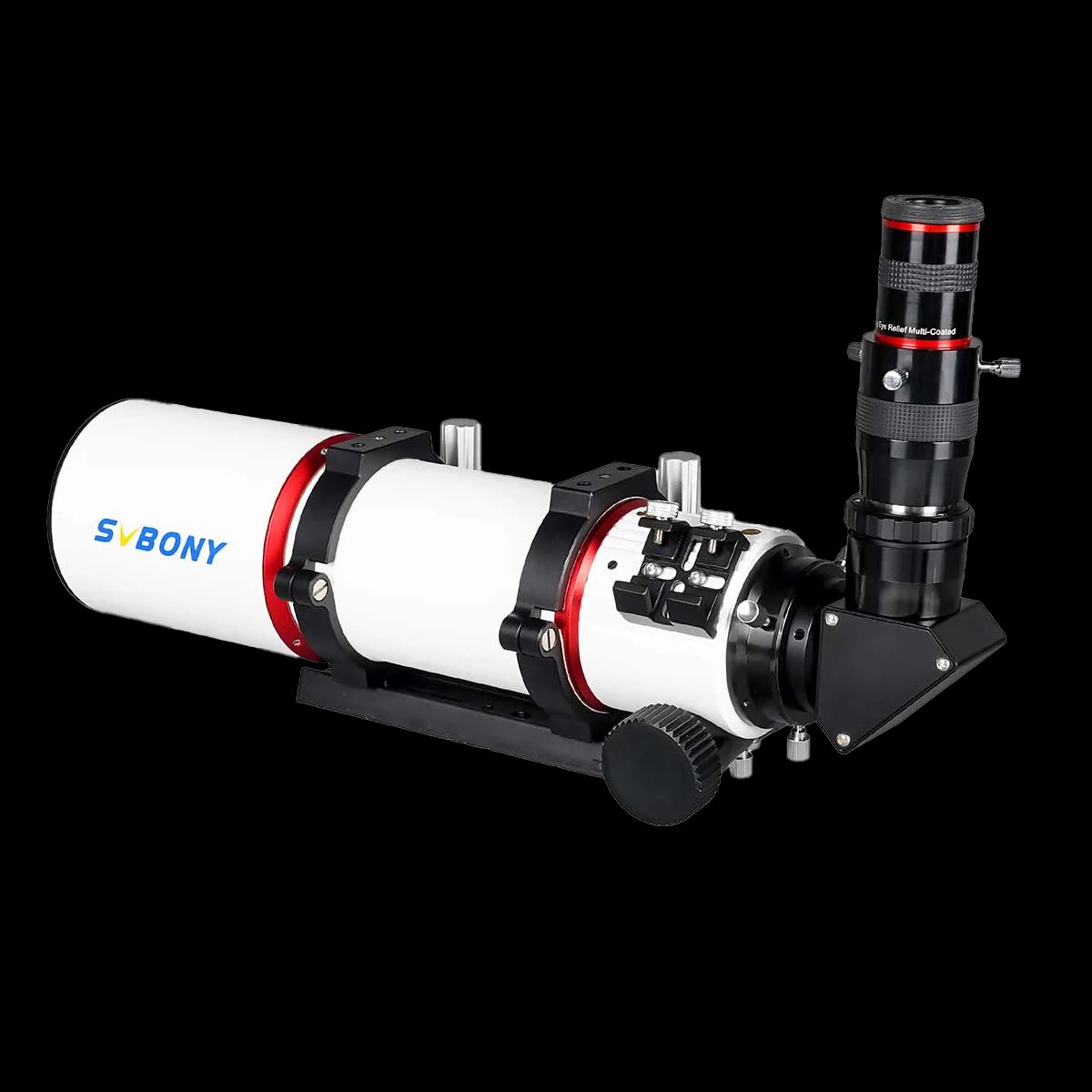
The SV503 80ED is an 80mm f/7 doublet with an S-FPL51 extra-low-dispersion element, which SVBONY credits with virtually eliminating chromatic aberration, and 560mm of focal length on the figures the maker prints. The tube carries a 2-inch dual-speed rack-and-pinion focuser with a 1:10 gear ratio, rotatable for camera framing. The store lists the OTA at 469.99 dollars as of October 17, 2026, and sells it in four styles: bare, with a 0.8x reducer, and with the reducer plus one of two finder options (SV211 handle or SV182 finder scope).
Read the package list before you imagine first light. The OTA package contains the telescope, a 2-inch to 1.25-inch adapter, the objective cover and a dovetail - no eyepiece, no diagonal, no mount. (The product photograph shows a finder scope and a 0.8x reducer beside the tube; those are the listing's sold-separately accessories, posed for the shot, and they are not part of the bare OTA configuration listed on the card below.) On a sturdy mount with a decent diagonal and eyepiece, an 80mm f/7 ED doublet is the classic do-everything aperture for Moon, clusters and brighter deep-sky targets; whether it fits your budget after those additions is the arithmetic the kit listing below takes up.
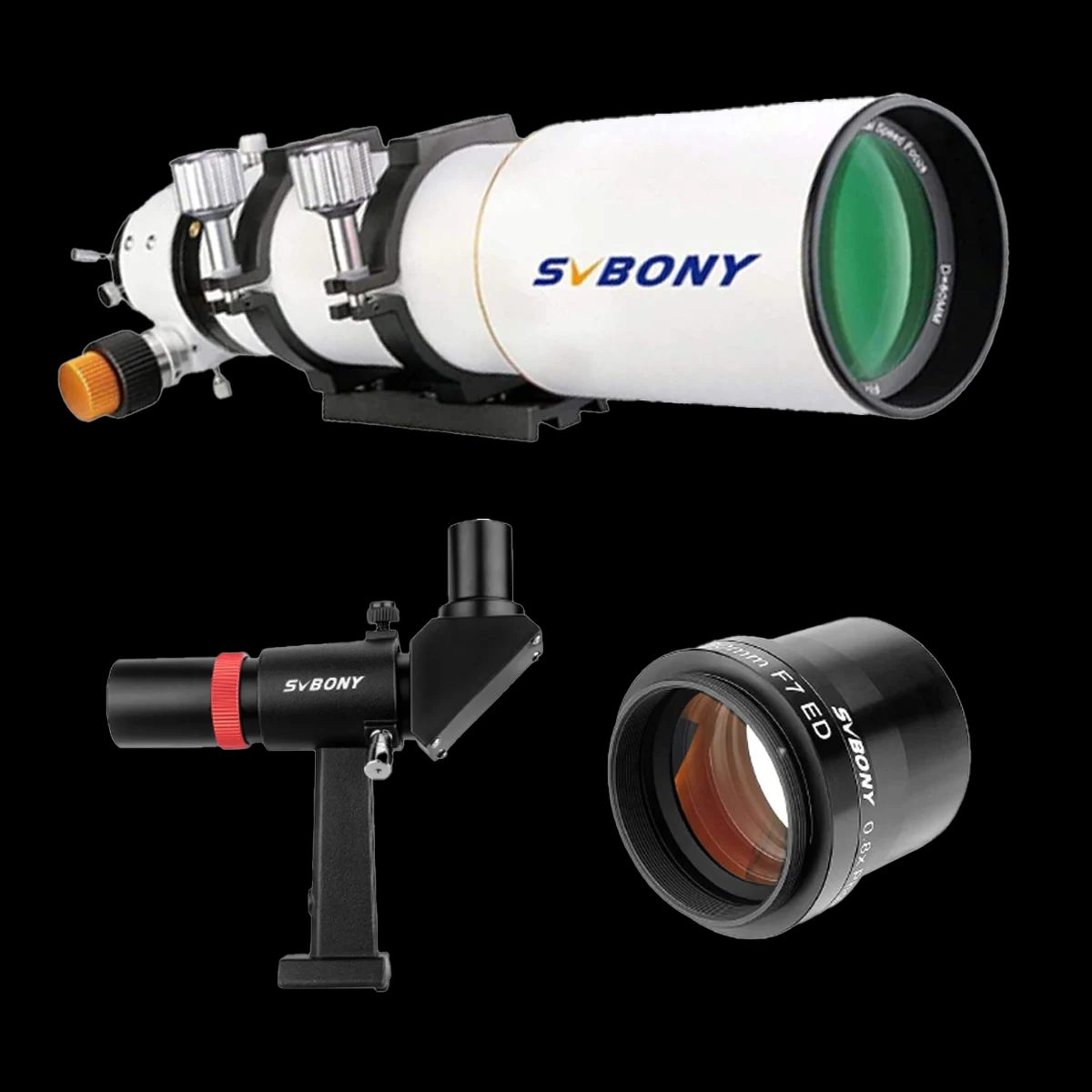
SVBONY SV503 80ED f/7 doublet refractor OTA
- ✓80mm aperture, 560mm focal length, f/7 (maker spec)
- ✓S-FPL51 ED doublet; 2-inch dual-speed 1:10 focuser
- ✓Package: OTA, 2-to-1.25-inch adapter, cover, dovetail - no eyepiece, diagonal or mount
- ✓Styles: bare, +0.8x reducer, +reducer with SV211 handle or SV182 finder
- ✓Listed at 469.99 dollars on the store, October 17, 2026
The SV503 80ED visual kit: one box, night-one observing
SVBONY sells the same 80ED tube as a complete beginner setup, listed as the SV503 80ED Refractor Telescope for Beginner Astronomy. The bundle list names every piece the OTA version leaves out: the SV503 80ED refractor OTA, the SV225 alt-azimuth mount with SV225T tripod, an SV188P 1.25-inch mirror diagonal, an SV135 7-21mm zoom eyepiece and an SV182 finder scope. That package list is the authoritative contents - the product photograph shows the tube, diagonal and eyepieces but not the mount or tripod, so read the list, not the shot. With the bundle assembled it is a complete observing rig: mount the tube, drop the diagonal and zoom eyepiece in, and the zoom covers a useful range of magnifications on the Moon and planets without buying anything else.
On these figures the kit does not save money, and this guide will not claim that it does. The kit lists at 898.99 dollars (October 17, 2026). The separate pieces at their own listed figures: the OTA at 469.99, the SV225 mount-and-tripod at 285.99, the SV188P diagonal at 47.99 and the SV182 finder at 56.69 - a subtotal of 860.66 before the zoom eyepiece. The included zoom is identifiable: the kit's own bundle SKU carries the component SKU W9105B, which is the SKU of the store's SV135 7-21mm zoom with the 52 to 36-degree field of view, listed at 36.99 (October 17, 2026). The complete separate-parts total is therefore 897.65 - about a dollar and a third under the 898.99 kit, before shipping, taxes or any promotion, and listed figures move. What the kit buys is the other thing: one order, one compatible set, no homework matching threads and clamps - and one page of the store currently describes the bundled zoom as an 8-24mm on the same listing that names it 7-21mm elsewhere, which is exactly the kind of mismatch buying the kit lets the store own. The tradeoff is that an alt-azimuth mount tracks by hand, which is fine for visual use and not what guided astrophotography wants.
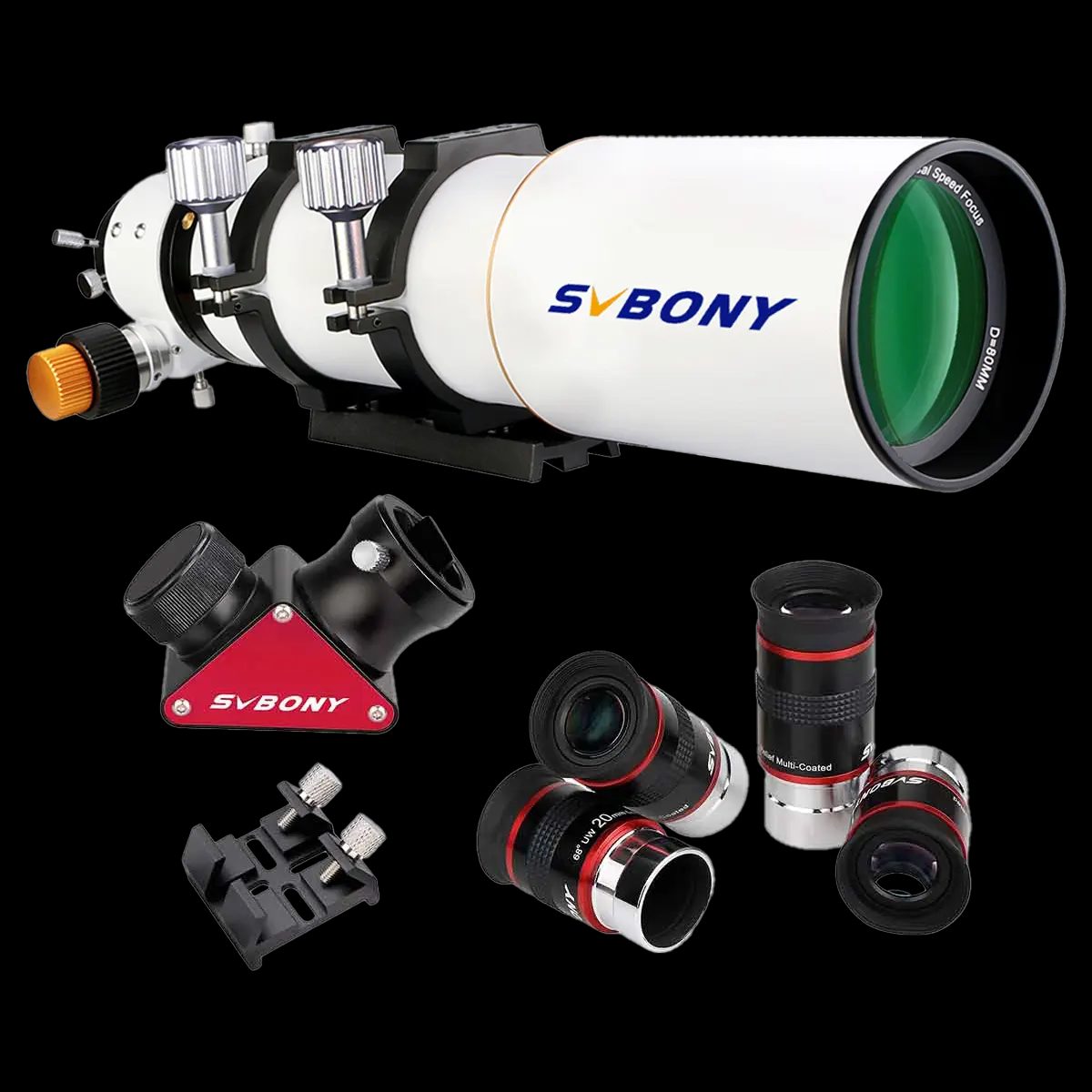
SVBONY SV503 80ED complete visual kit (mount, tripod, diagonal, zoom eyepiece, finder)
- ✓Same SV503 80ED OTA as above
- ✓Bundle: SV225 AZ mount + SV225T tripod, SV188P diagonal, SV135 7-21mm zoom, SV182 finder
- ✓Complete visual setup out of the box (bundle list, maker)
- ✓Hand-tracked alt-azimuth mount: visual use, not guided imaging
- ✓Listed at 898.99 dollars on the store, October 17, 2026
SVBONY SV550 80 APO: the step toward serious imaging
The SV550 80 moves from doublet to triplet: an 80mm aperture with 480mm of focal length at f/6, a three-element air-spaced apochromatic design built around an S-FPL51 ED element, on the maker's spec text. The focuser grows to match the imaging job: a 2.5-inch dual-speed unit at 1:10. The store lists the OTA at 683.99 dollars (October 17, 2026) against a 1,139.99 struck-through figure, and - like every refractor here - sells the imaging accessories as separate listings, not as package options. Note that the product photograph shows a star diagonal and eyepiece inserted in the focuser: the OTA listing includes neither, and the pictured accessories are sold separately.
One trap in this section deserves its own sentence. The flattener SVBONY sells for this family is the SV209, and the store's own pages disagree about it: on SV550 80 pages the SV209 appears in one product title as a 0.8x field flattener and in the body copy as a 1.0x flattener, while the SV209's own product page states plainly that it is a 0.8x reducer designed for the SV550 122mm f/7, converting its 854mm to 683.2mm at f/5.6. This guide reports the contradiction instead of resolving it: before you buy a flattener for an SV550 80, read the SV209 listing yourself and match the thread (M63x1 per the SV209 page) to your focuser. The SV550 80 also has a dedicated visual set listing with diagonal, barlow, eyepieces and finder for buyers who want the triplet for observing.
SVBONY SV550 80mm f/6 triplet APO OTA
- ✓80mm aperture, 480mm focal length, f/6 (maker spec)
- ✓Triplet APO with S-FPL51 ED element; 2.5-inch 1:10 dual-speed focuser
- ✓OTA package: no eyepiece, diagonal, flattener or mount
- ✓Separate visual-set and imaging-set listings exist; SV209 flattener factor conflicts across the store's own pages (see above)
- ✓Listed at 683.99 dollars on the store, October 17, 2026
SVBONY SV555: the wide-field astrograph, and what imaging-only means
The SV555 is not shaped like the others because it is not used like the others. SVBONY describes it as a Petzval astrograph - three groups, five elements - with a 44mm image circle that covers full-frame sensors, a flat field with the corrector built into the optical design, and an f/4.5 focal ratio adjustable to F22. It mounts to cameras the way a camera lens does: Canon EF and Nikon F bayonets, an M48x0.75 rear thread for 2-inch filters, an M72 front thread. The store lists it at 639.99 dollars (October 17, 2026).
Three spec holes matter here, and they are the maker's, not ours to fill. The 54mm aperture appears in the titles of SV555 kit listings but not on the astrograph's own page; no focal length in millimeters appears on any SV555 page; and no back-focus figure is published. Nothing on any SV555 page claims eyepiece use - every sentence is about cameras, sensors and imaging - and the product is named "Astro Camera Lens" in SVBONY's own copy. Treat it as what it is: a dedicated wide-field imaging optic that needs a camera, a tracker or equatorial mount capable of carrying it, and the usual imaging stack (power, guiding if you push exposure length, processing). It is the wrong first telescope and the right fourth purchase.
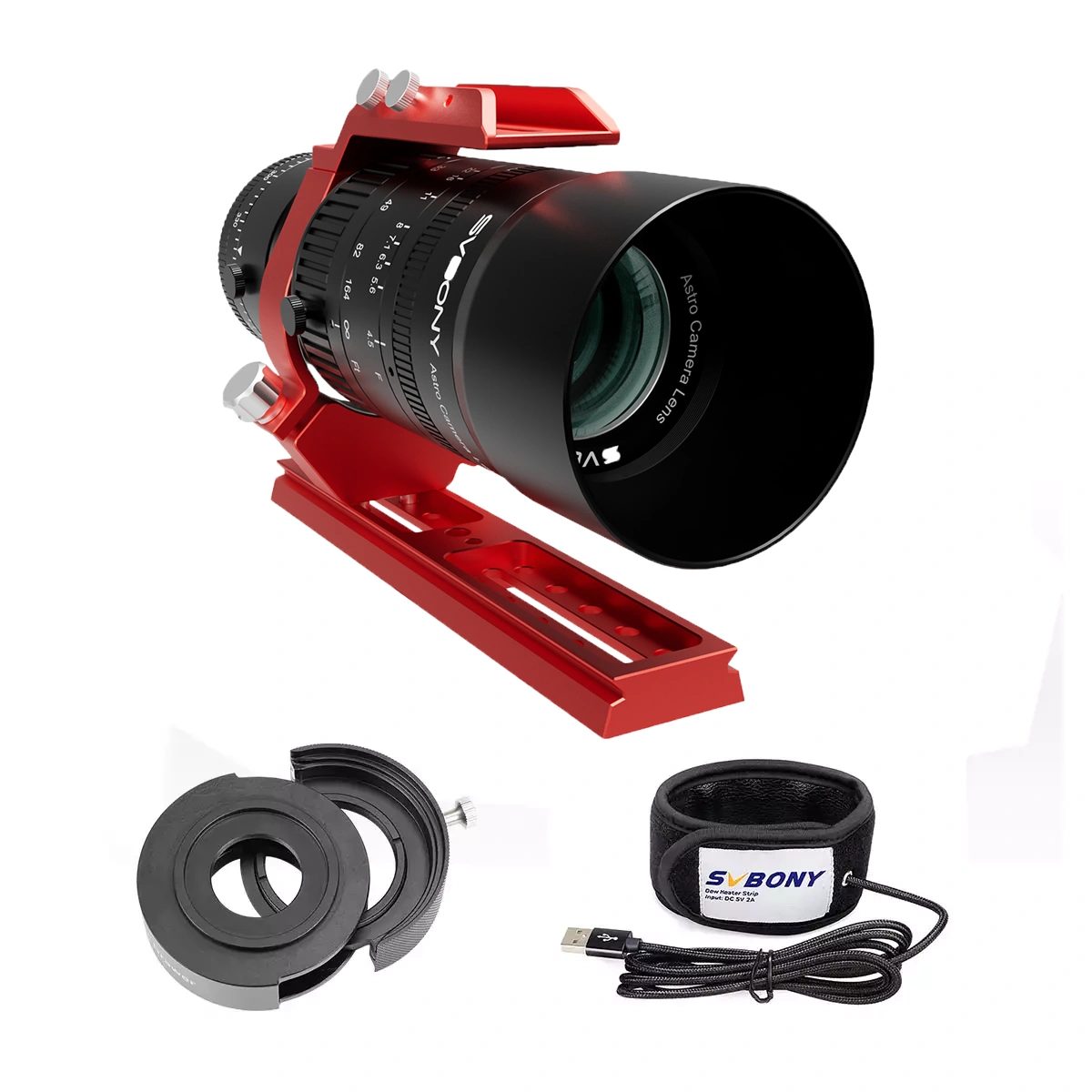
SVBONY SV555 f/4.5 Petzval astrograph
- ✓Petzval 3-group / 5-element design; flat-field, f/4.5 (maker spec)
- ✓44mm image circle for full-frame sensors (maker spec)
- ✓Canon EF / Nikon F mounts, M48x0.75 rear thread, M72 front thread
- ✓Aperture, focal length in mm and back focus are NOT stated on the maker's own pages
- ✓Imaging-only in the maker's own copy; no eyepiece use claimed. Listed at 639.99 dollars, October 17, 2026
SVBONY MK127: the planetary Maksutov
The Maksutov-Cassegrain design folds a long focal length into a short tube, and the MK127 does exactly that: 127mm of aperture with 1,500mm of focal length at f/11.8 on the maker's spec table, in a tube 2,934 grams. That ratio is the planetary recipe - high magnification on small, bright targets - and it is why this is the covered lineup's Moon-and-planets specialist. Unusually for the category, the package includes a 0.65x focal reducer that brings the system to f/7.68; SVBONY states the reducer is included as a standard accessory and is not sold separately. The package also carries an SCT-to-2-inch adapter, an SCT-to-1.25-inch adapter with T-thread, and a 210mm Vixen-style dovetail with two mounting bases.
What the box still lacks is everything that goes into the back: the MK127 ships with no eyepiece, no star diagonal and no mount or tripod. Its 2-inch and 1.25-inch eyepiece interfaces accept standard accessories, and the internal dual-speed focuser is built into the rear cell. Budget accordingly - at the store's own listed figures, the SV225 mount-and-tripod at 285.99, an SV188P diagonal at 47.99 and an eyepiece or zoom are the visible additions before first light. The store lists the MK127 at 549.99 dollars (October 17, 2026), with photography-set bundles above it.
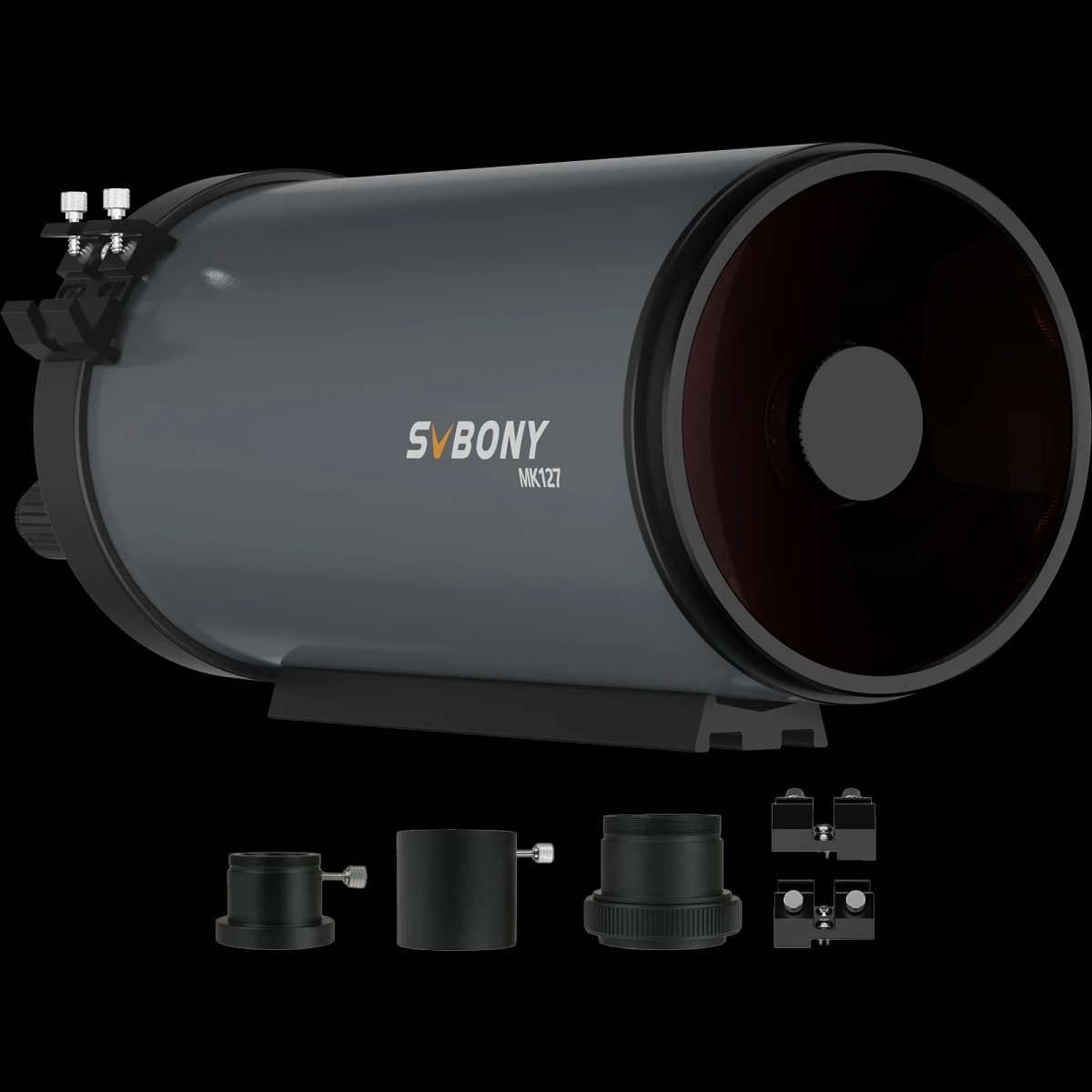
SVBONY MK127 127mm Maksutov-Cassegrain OTA
- ✓127mm aperture, 1,500mm focal length, f/11.8 (maker spec)
- ✓Included 0.65x focal reducer brings f/7.68; dedicated, not sold separately
- ✓Internal dual-speed focuser; 2-inch and 1.25-inch eyepiece interfaces; SCT 2-inch 24TPI thread
- ✓No eyepiece, diagonal, mount or tripod in the package; 210mm Vixen dovetail included
- ✓2,934 g; listed at 549.99 dollars on the store, October 17, 2026
SVBONY MK90: the compact gateway Maksutov
The MK90 is the same idea scaled down: 90mm of aperture, 1,250mm of focal length, 1,380 grams on the figures carried in SVBONY's own MK127 comparison table (the MK90 page itself does not print the focal ratio; the table gives f/13.9). No telescope covered here lists lower than it: 188.99 dollars (October 17, 2026), and the maker pitches it at lunar and bird-watching use, with a standard 1/4-20 photographic thread and a 70mm Vixen-style dovetail plate for mounting. SVBONY sells it in several configurations, including a visual observation set and an EAA set, on top of the bare OTA.
The honest framing for a 90mm Maksutov is that it opens two doors and closes one. The long focal length and small aperture suit the Moon, planets and terrestrial viewing; deep-sky objects will be small and faint. The bare OTA still needs a diagonal, an eyepiece and a mount before anything comes to focus - the same additions as its bigger sibling, on a tube that lists lower - so check the kit configurations if you want those in one order. And note what the store's own comparison table shows you get for stepping up: 37 more millimeters of aperture and the included reducer on the MK127, for 361 dollars more at the listed figures (549.99 against 188.99, October 17, 2026).
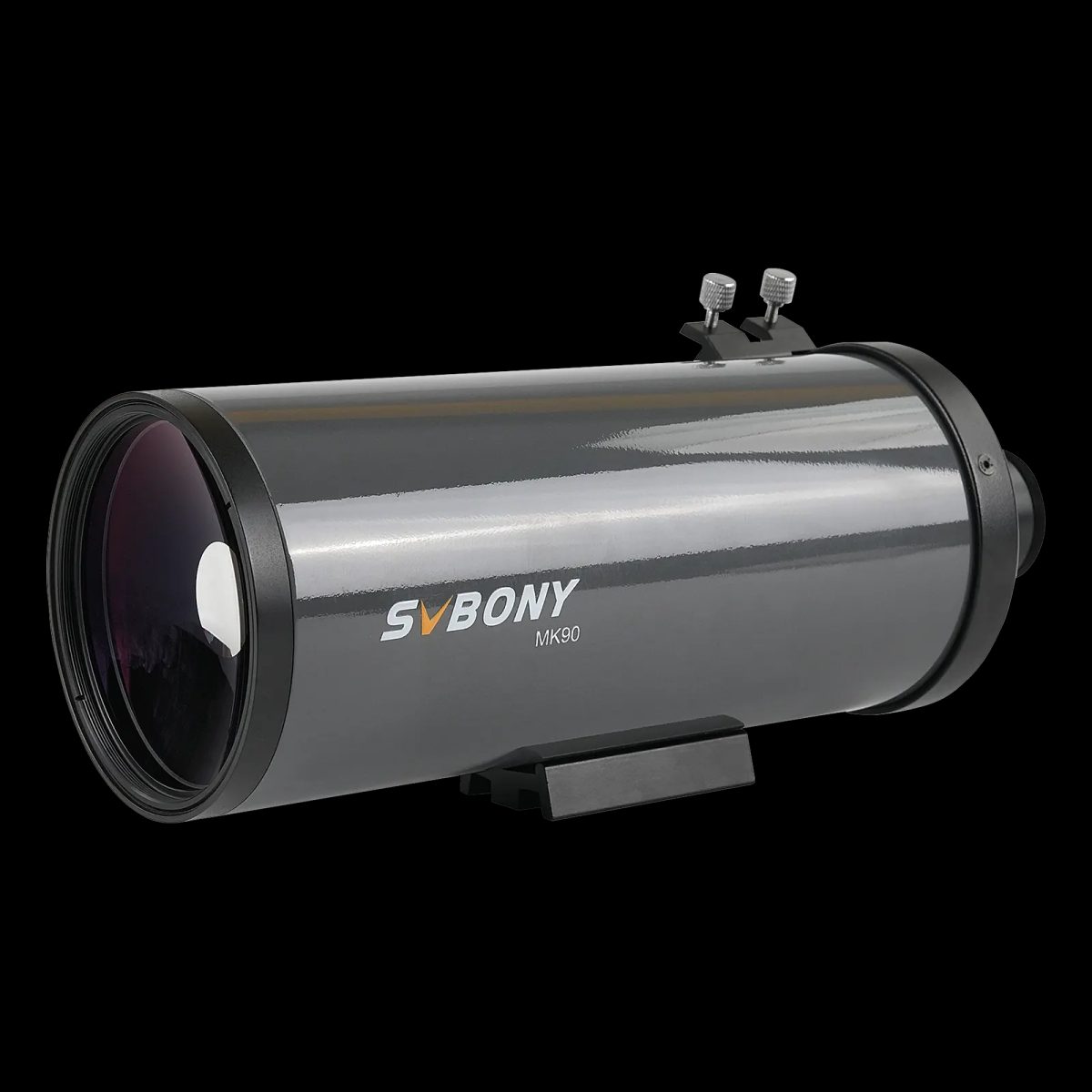
SVBONY MK90 90mm Maksutov-Cassegrain OTA
- ✓90mm aperture, 1,250mm focal length (maker spec; f/13.9 per the maker's MK127 comparison table)
- ✓1,380 g; 1/4-20 photo thread + 70mm Vixen dovetail plate
- ✓Visual, EAA and birding kit configurations sold alongside the bare OTA
- ✓No eyepiece, diagonal or mount in the OTA package
- ✓Listed at 188.99 dollars on the store, October 17, 2026
What the missing pieces add to the bill
Because four of the six covered listings are tubes-only, the accessory figures are not footnotes; they are the second half of the budget. At the store's listed figures on October 17, 2026: the SV225 alt-azimuth mount with tripod is 285.99 dollars, the SV188P 1.25-inch mirror diagonal is 47.99, the SV182 finder scope is 56.69, and the SV135 7-21mm zoom eyepiece is the piece the visual kit includes. SVBONY also sells dedicated astronomy cameras: the SV305C planetary camera lists at 142.19, the cooled SV405CC sits in a different cost bracket entirely, and its own product page carries two different cooling figures (86 degrees Fahrenheit and 30 degrees Celsius below ambient) that the store has not reconciled. Reducers and flatteners are tube-specific: the SV193 0.8x unit names the SV503 102ED as its intended tube, and the SV209's story is the contradiction documented in the SV550 section above.
Mount reality check: the only mount covered here is the SV225 alt-azimuth, which you point by hand. Astrophotography beyond short exposures wants an equatorial or star tracker, and the store's Mounts & Tripods collection carries none - every mount across its three pages is alt-azimuth or an accessory - so budget for a third-party tracker before committing to a camera-only purchase like the SV555.
Returns, warranty and shipping as the store prints them
The return policy opens by scoping itself: only applicable to orders on www.svbony.com. Its 30-day window is a quality-defect window - you must detect a quality problem and contact SVBONY within 30 days of receipt - and there is no change-of-mind return clause anywhere on the page. Outer-package damage must be claimed within 3 days with pictures. Orders can be cancelled within 24 hours, unshipped orders only. Where a return or warranty service happens, the cost of shipping the product to SVBONY is on the purchaser unless otherwise agreed in writing, and the store states that consumer-caused returns carry the consumer's shipping cost. If you bought from a SVBONY agent or another store, the policy routes you back to that seller.
The warranty splits by part: 24 months on the main part of a telescope, an astronomical camera, an electronic eyepiece or a scope; 12 months on eyepieces, filters, zenith mirrors, adapter rings, phone holders, tripods and heating tape. Eligibility requires original purchase from SVBONY or an authorized dealer, and products from unauthorized sellers are excluded. Defects must be reported within 15 days of discovering them to obtain return instructions - a different window from the 30-day-from-receipt return policy above, and worth keeping separate. SVBONY reserves the right to repair at an authorized service center, or to reimburse the fair market value and require transfer of the damaged product instead.
Shipping runs out of Hong Kong, China, worldwide. Parcels over 2kg go DHL in 7 to 15 days; under 2kg the choice is Economy at 25 to 45 days or Expedited at 15 to 25; ePacket, China Post Registered Air Mail and EMS run around 45 to 60 days. In-stock items ship the next business day. No free-shipping threshold is stated on the shipping page, and DHL-classified remote addresses carry a remote fee of about 30 US dollars. A telescope tube is a heavy parcel; assume the DHL lane and check before ordering.
Solar viewing: the one safety rule that is not negotiable
None of these telescopes ships with a solar filter, and pointing any of them at the Sun without one is the fastest way to lose an eye. NASA's guidance is explicit: solar filters must be attached to the front of any telescope, binoculars or camera lens, and viewing any part of the bright Sun through a telescope without a special-purpose solar filter will instantly cause severe eye injury. Eclipse glasses are for direct viewing with your eyes only - NASA says do not use them with cameras, binoculars or telescopes, because the concentrated rays will burn through the filter. Handheld viewers should comply with ISO 12312-2; a telescope's front-mounted filter is a different class of filter from either. SVBONY sells dedicated solar kits for a few of its models - the store lists SC432M-camera eclipse sets around the MK105 and SV550 80, a solar observation kit around the SV503 80, and an SV29-plus-MK127 solar eclipse kit - none of them one of the six covered here; any filter must match your tube's aperture and be secured in front of the optics, and this guide makes no compatibility claim for any specific filter-tube pairing.
Who should skip what
- ▸Skip the SV555 if you do not already own a camera and a tracking mount: it is an imaging optic that substitutes for neither, and the maker publishes no visual-use claim for it.
- ▸Skip the MK127 if deep sky is the goal: 1,500mm at f/11.8 is a planetary recipe. The optics are built for different targets, not ranked one above the other - the SV503 80ED gives the wide, fast view nebulae and clusters want, and both configurations are tubes that still need mounts and eyepieces bought separately.
- ▸Skip the bare SV503 80ED OTA if this is your first telescope and you have no accessories: the complete kit listing pairs the same tube with every piece it needs in one order, and removes the compatibility homework (on the October 17, 2026 figures the kit lands about a dollar above the same pieces bought separately - see the kit section).
- ▸Skip the SV550 80 if you want one box that does everything: it is a tube, its accessories are separate listings, and the flattener story is one you must verify yourself (see the contradiction above).
- ▸Skip the MK90 if aperture envy is real for you: its own comparison table shows the MK127 giving 37 more millimeters plus a reducer for 361 dollars more (both OTAs, October 17, 2026 figures).
- ▸Skip all six if you need a go-to or motorized mount out of the box: nothing covered here includes one.
Frequently asked questions
Is SVBONY a good telescope brand? That is not a question this guide can answer honestly, because JellyReviews has not tested any SVBONY telescope and no independent optical bench data was found at research time. What can be said from the store's own surfaces: the catalog splits into beginner kits, ED and APO refractors, Maksutovs and imaging astrographs; the published specs are specific (glass types, focuser ratios, weights); and the warranty prints a two-tier term - 24 months on a telescope's main part, 12 on the accessory tier. Judge the glass through reviews from owners and astronomy communities; judge the purchase through the policy terms above.
Can I see planets with the SVBONY MK90? The maker positions it for lunar and planetary viewing, and 1,250mm of focal length is genuinely a planetary figure - magnification comes from focal length divided by eyepiece focal length, so a 10mm eyepiece yields 125x on paper. Two caveats are in the maker's own numbers: 90mm of aperture gathers a limited amount of light, and the OTA package includes no eyepiece at all, so the first magnification you get is the one you buy separately.
Do I need a field flattener for astrophotography with the SV503 80ED? The Petzval design in the SV555 builds correction into the optics; a conventional doublet like the SV503 does not have that, which is why SVBONY sells reducers and flatteners as separate accessories. Which one pairs with which tube is exactly where the store's pages disagree (the SV209 story above), so match threads and stated design tubes on the accessory's own page before ordering, and do not buy a flattener on a title alone.
Can these telescopes be used for terrestrial viewing? The maker says yes for the Maksutovs: the MK90's own listing names bird watching, and its spec table carries a terrestrial-friendly 1/4-20 photo thread. Refractors can also work for daytime viewing with a correct-image diagonal; the store's listings here are pitched at astronomy, and no erecting-diagonal inclusion is claimed in any package list above.
What is the difference between the SV503 and SV550? Three published things: the SV503 80ED is a two-element doublet at f/7 (560mm); the SV550 80 is a three-element triplet at f/6 (480mm) with a larger 2.5-inch focuser. The triplet design and faster ratio are what wider-field, shorter-exposure imaging wants, and they are why the SV550 lists 214 dollars higher at the figures shown on October 17, 2026. For visual use, both carry ED glass and the same class of dual-speed focuser.
SVBONY's own storefront is the source for every product page, spec table and policy quoted above, all read on October 17, 2026. It remains the place to check current configurations, package lists and listed figures before you order - those figures move, and two of this store's own pages currently disagree with themselves in ways documented above. Product photographs are sourced from SVBONY's official product galleries.