Lumintop Flashlight Buying Guide: Seven Models by Role
Lumintop sells seven lights worth knowing and 75 product handles overall. Here they are grouped by the job each one does, with the numbers taken from the store's own spec tables and the disagreements between those tables and the rest of each page left where they are.
Lumintop builds flashlights in Shenzhen and sells them direct from www.lumintoponline.com, and the catalog is wider than a brand this size suggests: 75 distinct product handles in the store's own product sitemap as of November 21, 2026, counting cells, chargers and extension tubes alongside the lights. The models that matter to a first-time buyer sit in a narrow band, 250 to 7,000 lumens, and all of them are small. The D3, the heaviest light on this page, is 182 grams before you put a cell in it. What follows groups seven of them by the job each one does, using the figures Lumintop prints in its own specification tables, and it names the places where those tables disagree with the rest of the page they sit on.
JellyReviews participates in Lumintop's affiliate program. If you buy through a Lumintop link on this page, JellyReviews may earn a commission when a purchase is attributed through one. The links point at the store so you can check availability and terms yourself; they do not change what the store charges, and nothing on this page is a ranking the links were made to fit. Every number below comes from a page you can open.
What Lumintop sells
The sitemap is the fastest map of the store, and it is worth a look before you start comparing models, because cells, chargers and tubes sit in the same list as the lights. Of the 75 product handles in it, 11 are accessories rather than lights: four spare cells (10300, 10280 USB, 18350 USB and 14500), two tubes (a 10440 and AAA extension tube, and a 10750 tube the GT Nano and the Frog share), two chargers (a d4-26 and a single-slot 18650 and 21700), a yellow filter for the Thor II and one for the Thor 3, and an H12 flashlight head. The lights sort into four shapes, and the shape decides most of what you can do with one.
- ▸Keychain and miniature: the GT Nano, the GT Nano Pro, the GT Nano Plus, the EDC Pico and the 4-in-1 Black Cat. These are the ones that live on a ring or in a coin pocket.
- ▸Cylindrical pocket lights on a 14500: the Tool AA 3.0 and the FW1AA.
- ▸Single-cell bigger bodies: the D3 on a 26800, the EDC20 on an 18350 or 18650, the W1 MAX on a 21700, and the FW3A on an 18650.
- ▸Right-angle and headband lights: the L5 and the L3, both of which clip into a holder and run on a head strap. The L5 also takes an AA, which is why it turns up again in the dual-fuel group below.
Two other domains turn up beside this store in search results: lumintop.com, and a third storefront listing the same model names against its own figures. Only www.lumintoponline.com is linked from this page, because it is the store the referral applies to and the only one whose pages were captured here. If you land somewhere else, the model numbers should still match, but nothing on this page vouches for that store's terms or its figures.
The seven models, by role
Seven lights cover the range this store is good at, and the grouping below is by carry, not by output. Two of them are LEP lights with the same 700-meter throw and completely different jobs, which is the sort of thing a lumen column hides.
- ▸Keychain thrower: the GT Nano. 720 lumens, 405 meters, 30 grams with its cell.
- ▸Dual-fuel pocket light: the Tool AA 3.0. 900 lumens on a 14500, 300 on an AA.
- ▸One-light all-rounder: the D3. 7,000 lumens on Turbo, 650 meters, a 26800 cell, and USB-C both ways.
- ▸Multi-emitter utility: the F02. White, 365 nm UV and RGB in a 71-gram flat body.
- ▸Pocket LEP spot: the Thor Mini. 250 lumens and 700 meters at 122,500 candela, in 78 millimeters.
- ▸LEP plus flood plus red: the W7. 550 lumens combined, a 700-meter spot, and an OLED display.
- ▸Right-angle headlamp: the L5. 500 lumens on a 14500, 40 hours in Eco on an AA.
Lumintop GT Nano: the keychain thrower
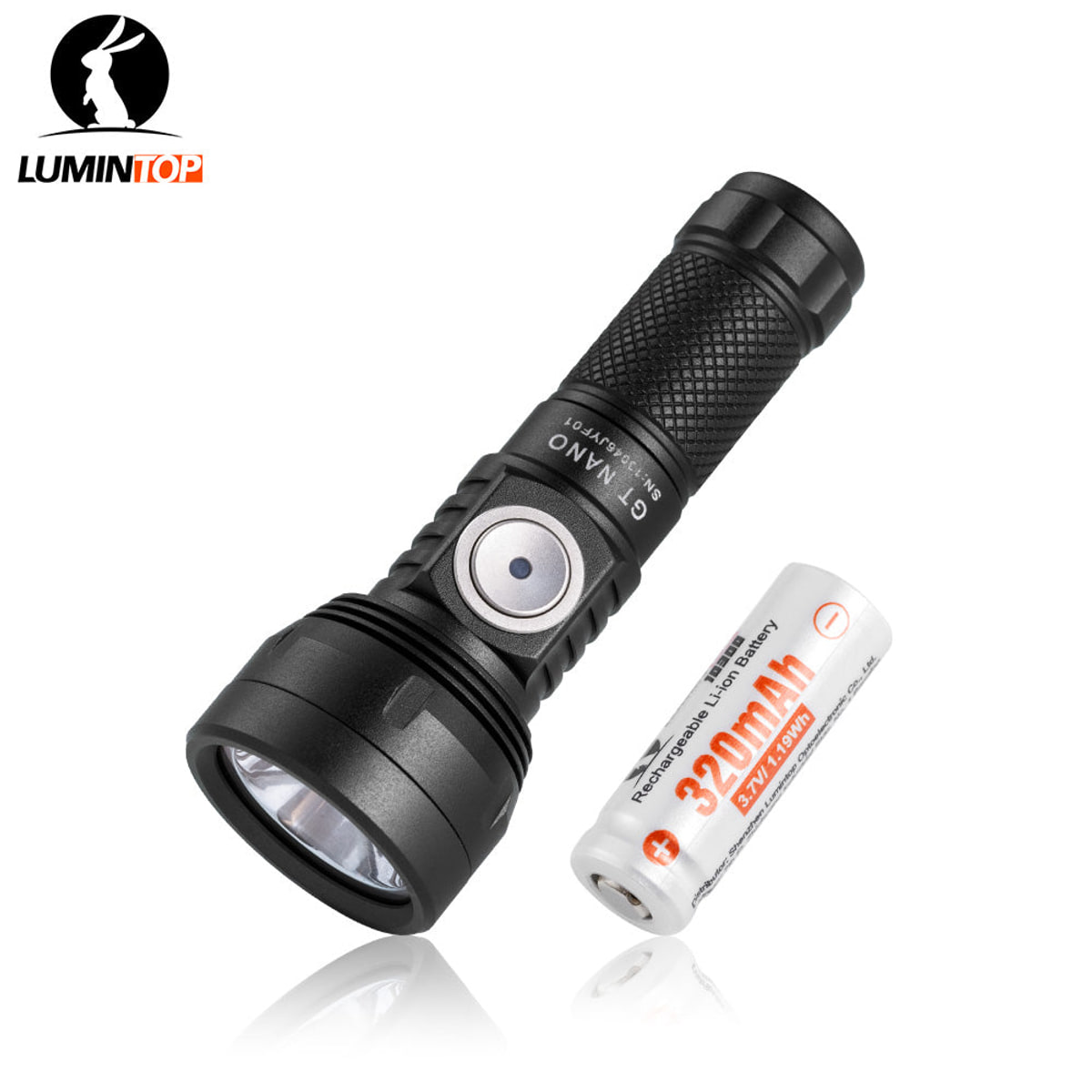
The GT Nano is the smallest thing here and the only keychain light in the group. Lumintop's specification table gives it 720 lumens on Turbo from one 10300 Li-ion cell, 405 meters of throw at 41,000 candela, and a body of 69 by 24 by 14 millimeters at about 30 grams with the cell fitted. The emitter is an Osram NM1, the page rates the light at 9 watts, and it is IPX8 to two meters. Four output rows sit below Turbo: 400 lumens on High, 180 on Med, 31 on Low, and 1 lumen of Moonlight.
The runtime column is where a keychain light tells the truth. Moonlight runs 50 hours. Low runs 4 hours 20 minutes. Turbo runs one minute fifty seconds and High runs one minute plus 53, and the table's own footnote explains those two: runtime on High and Turbo is cumulative because of the overheat protection. So the usable number for a light this size is the 180-lumen Med row at 55 minutes, and the 720-lumen figure is a burst you will feel in your hand after about a minute.
Three of the four headline figures change depending on which part of the store's page you read, and it is worth knowing that before you compare the model to anything. The browser tab title reads "Lumintop GT Nano 3.0 EDC Keychain Flashlight | 500lm, 361m Throw, USB-C", and the meta description behind it says 500 lumens and IP68. The H1 says 3.2 rather than 3.0. The bullets and the specification table both say 720 lumens, 405 meters and IPX8, and the table adds underwater 2m. A shopping result captured in a Google search for the model repeats the 500-lumen, 361-meter version, which shows how far the older figures travel. Go by the table: 720 lumens, 405 meters, IPX8 to two meters, 30 grams with the cell.
Lumintop GT Nano keychain flashlight
- ✓720 lumens on Turbo, 405 m at 41,000 cd (specification table)
- ✓Osram NM1 LED, one 10300 Li-ion cell included, 9 W
- ✓69 x 24 x 14 mm, about 30 g with the cell
- ✓IPX8, submersible to 2 m
- ✓Moonlight 1 lumen for 50 h; Turbo 1 min 50 s
- ✓Two materials, Aluminum or Titanium, across 14 variants
Who it fits: you want a light that stays on a keyring and still reaches the far end of a parking lot, and you accept that the top two rows are bursts. Who should skip it: anyone who needs a light on for an hour at high output, because the 26800 D3 is the light for that, and anyone who wants a copper body, because the meta description offers one and the variant list has only aluminum and titanium.
Lumintop Tool AA 3.0: the dual-fuel EDC
The Tool AA 3.0 runs on a 14500 or an AA, and so does the L5, but Lumintop gives the Tool AA a full column per chemistry instead of picking the flattering one. On a 14500 Li-ion it is 20 lumens on Low, 150 on Med, 500 on High and 900 on Turbo. On an AA it is 4, 30, 150 and 300. Same light, same modes, a third of the peak output.
The runtime columns invert the ranking, which is the part worth reading twice. On the 14500, Low runs 37 hours, Med 4 hours, High 1 hour 10 minutes, and Turbo 3 minutes then 1 hour. On an alkaline AA, Low runs 60 hours, Med 9 hours, High 2 hours and Turbo 45 minutes. On a Ni-MH AA, Low also runs 60 hours and Med stretches to 12. So the 14500 buys you brightness and the AA buys you time, and the choice is a choice, not a compromise. Throw is 138 meters at 4,750 candela from the 14500, and impact resistance is 1.5 meters, where the other tables here state 1.
The provenance on this table is better than the store usually gives. A notice names the three cells behind those columns: a Lumintop 920 mAh 14500, an Eneloop Ni-MH cell, and an alkaline cell. That is the kind of line that makes a dual-chemistry table checkable, and it is also the line most pages leave out. Two details do not line up: the waterproofing row reads IPX 8 with no depth, while the bullets say only water-resistant and marketing copy elsewhere on the store claims IP68 to two meters for thirty minutes. Treat it as sealed against water to an unspecified depth, and do not plan around a number. The bullets give 23.5 grams, the variant record gives 24.
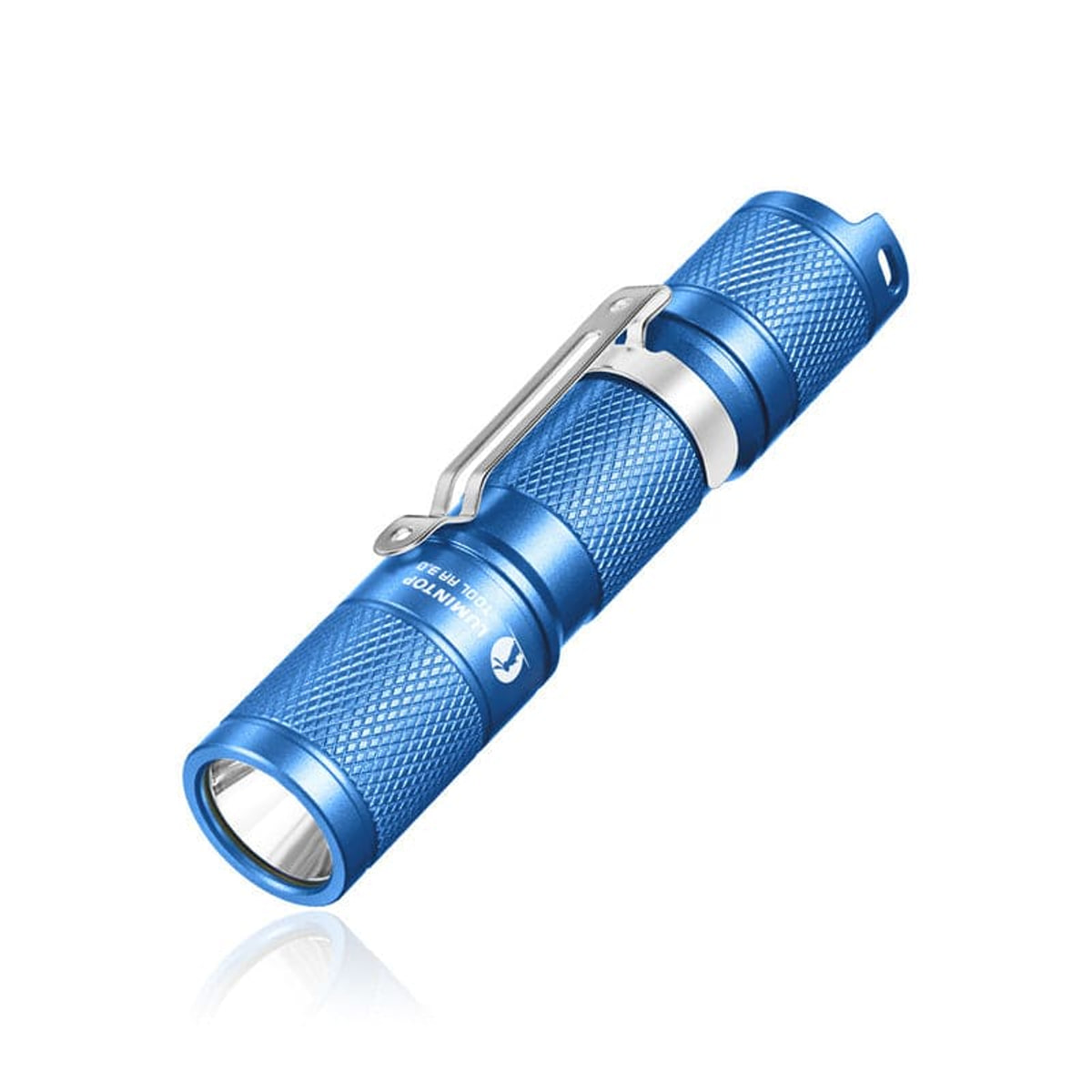
Lumintop Tool AA 3.0 dual-fuel flashlight
- ✓900 lumens on a 14500 Turbo, 300 lumens on an AA
- ✓Low 20/4, Med 150/30, High 500/150, Turbo 900/300
- ✓138 m at 4,750 cd, measured on the 14500
- ✓Runs a 14500 Li-ion, an alkaline AA or a Ni-MH AA
- ✓Low runs 37 h on the 14500, 60 h on either AA
- ✓IPX 8 in the table, with no depth published
Who it fits: you want one pocket light that survives a dead cell, because a shop-bought AA gets you 300 lumens and 60 hours on Low. Who should skip it: anyone who wants an onboard charging port stated plainly, because nothing on the Tool AA page says the body has one, while the D3, F02 and W7 all name USB-C outright.
Lumintop D3: the 26800 all-rounder
The D3 is the light built to run a full working evening without being nursed, and it is the only one with a 26800 cell. Lumintop lists 7,000 lumens on Turbo from an SFN60 LED at 78 watts, 3,000 on High, 1,000 on Med, 200 on Low and 1.5 on Moonlight. Throw is 650 meters at 105,000 candela. The body is 45.5 by 31.5 by 135 millimeters and about 182 grams with the cell excluded, and the same table's battery row reads 26800 Li-ion, included, so the light arrives with a cell the weight figure does not count.
The step-down is steeper than the headline suggests and the table prints it plainly: Turbo holds 30 seconds and then 3 hours 20 minutes, and High holds 50 seconds and then the same 3 hours 20 minutes, with a footnote that the accumulated runtime is due to overheat protection. Moonlight is 1.5 lumens for 30 days. The feature that earns this light its place here is not the output at all: the bullets give it USB Type-C discharge as well as charging, so it will top up a phone from its own cell. That is a real capability in a car kit and it is why the power-bank link below is not a stretch.
Two of the store's own surfaces disagree about this model. The meta description calls it IP68 while the specification table says IPX8 to two meters, and the table is the one that names a depth, so use IPX8. A body image on the product page carries alt text reading 6000 Lumens against a title, a heading and a table that all say 7,000.
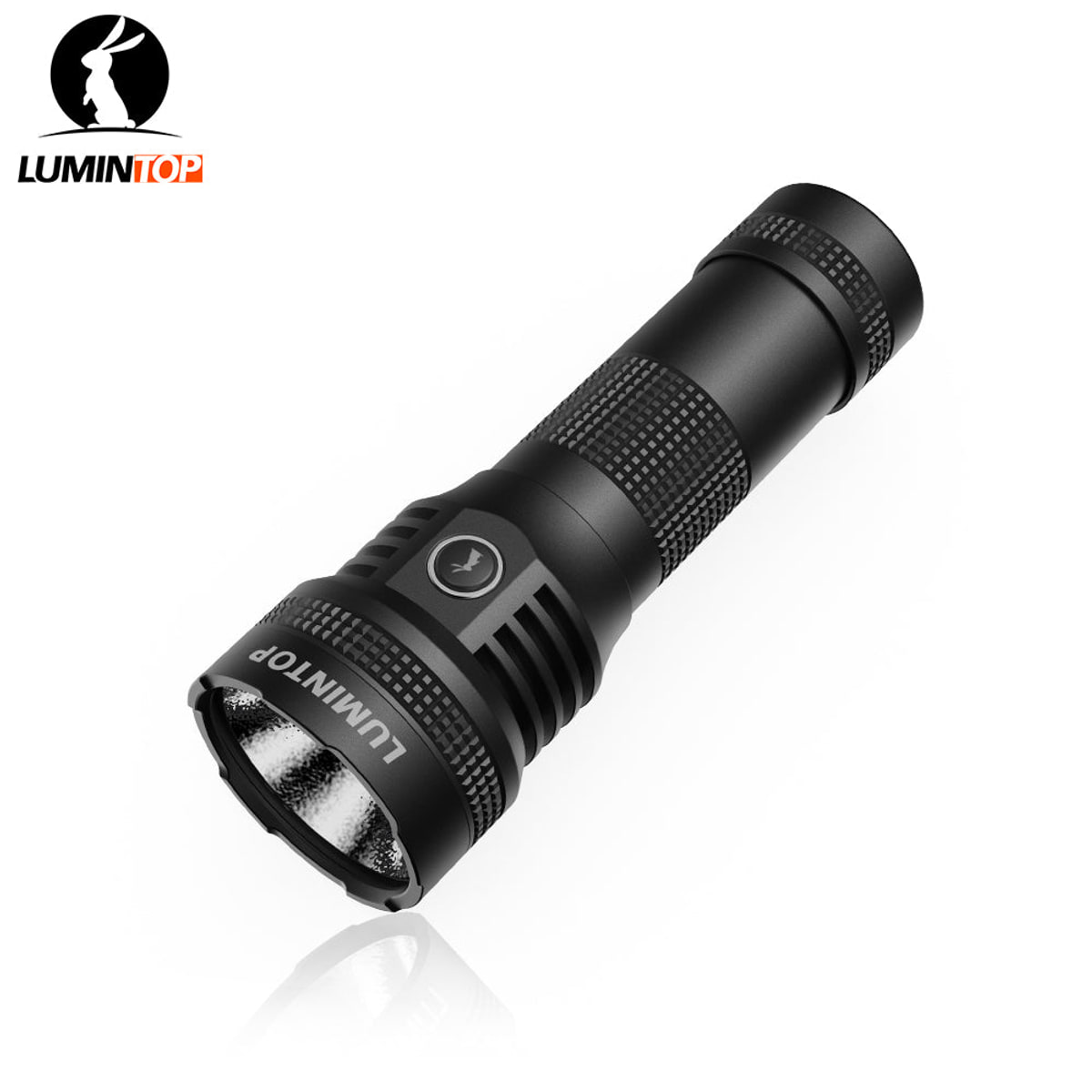
Lumintop D3 all-rounder flashlight
- ✓7,000 lumens on Turbo, 3,000 on High (SFN60, 78 W)
- ✓650 m at 105,000 cd
- ✓One 26800 Li-ion cell included
- ✓USB Type-C charging and discharge
- ✓Turbo 30 s then 3 h 20 min; Moonlight 1.5 lm for 30 days
- ✓IPX8 to 2 m; 45.5 x 31.5 x 135 mm, about 182 g without the cell
Who it fits: you want one light for a car, a loft and a power cut, and the USB-C discharge turns it into a small reserve battery. Who should skip it: anyone who wants a light that disappears into a jeans pocket, because 135 millimeters and 182 grams is a jacket or glovebox light. If you are weighing the phone-charging angle seriously, our rankings of the highest-capacity cells and their airline limits are a better place to compare that feature than a flashlight page.
Lumintop F02: white, UV and RGB in one body
The F02 is the odd one out and that is the reason to include it. It is a flat 71-gram body, 71.5 by 29 by 16 millimeters, carrying two 10300 cells pre-installed and three light sources behind one lens: a white emitter, a 365 nm UV emitter and an eight-mode RGB set, on a main switch and a second side switch. White output steps from 10 lumens of Eco for 20 hours up to 1,000 on Turbo, with 55 on Low, 220 on Med and 450 on High in between. Throw is short, 88 meters at 1,950 candela, which is what a flat wide lens gives you.
The non-white rows are where this light differs from everything else here, and the table gives them with no lumen figure at all. UV runs 4 hours with a dash in the output column. RGB runs 6 hours and RGB blink 12. The side white light is 1 lumen for 5 hours. Those dashes are the correct answer for a UV or RGB emitter, and no number was invented to fill them, which is more than can be said for the page's own meta description.
That description calls the F02 a green LEP, and the specification table's light-source row names a high-performance LED, an RGB LED and a UV LED. There is no laser in the parts list and no LEP anywhere on the table. If you want the LEP experience from this store, it is the Thor Mini or the W7, both further down. The F02 is a flat multi-emitter utility light, and its own table is the authority. Charging is USB-C, about two hours, with red for charging and green for full, and the cells are pre-installed rather than boxed separately.
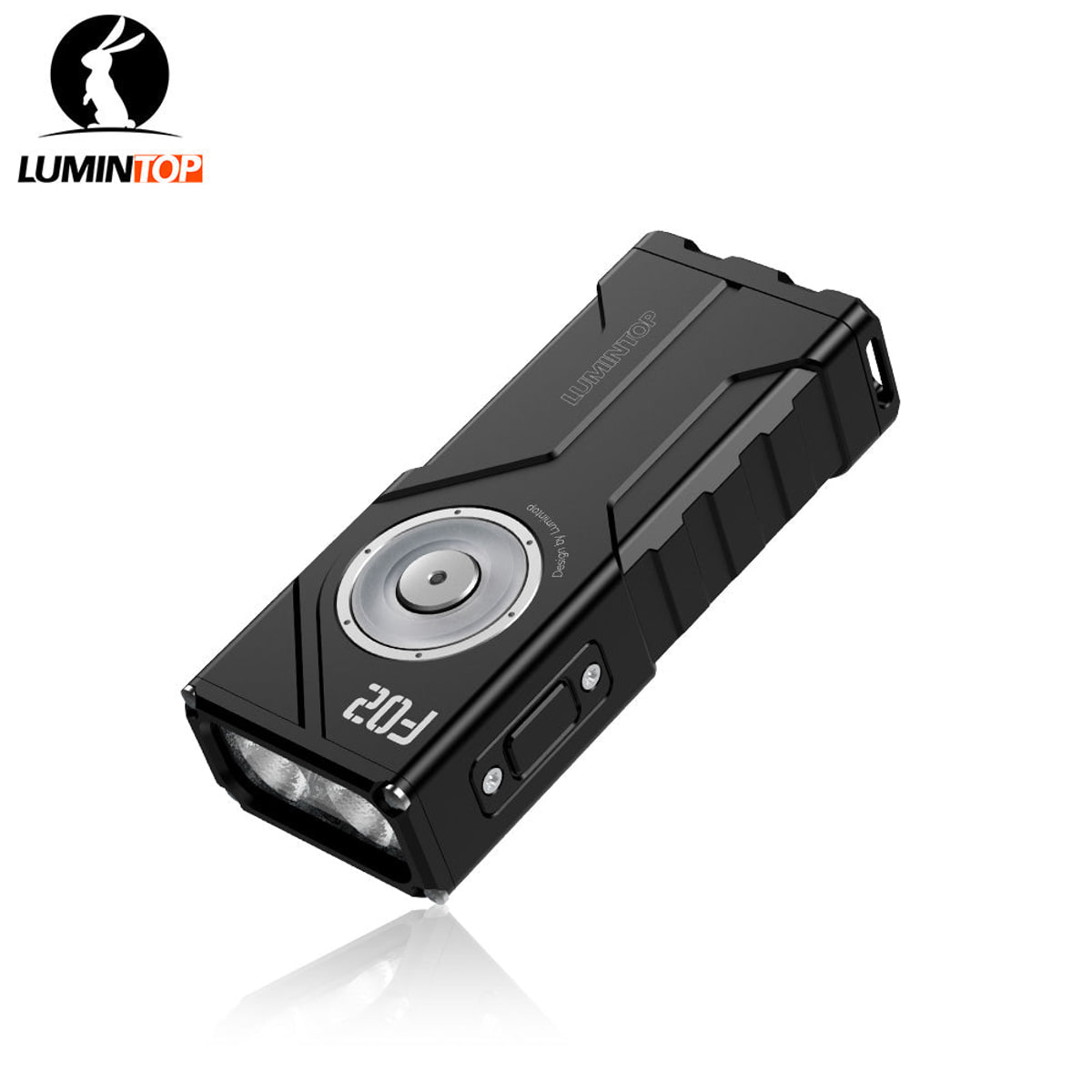
Lumintop F02 multi-emitter flashlight
- ✓1,000 lumens on Turbo, 450 on High, 10 on Eco
- ✓365 nm UV for 4 h and eight-mode RGB for 6 h
- ✓Two 10300 Li-ion cells pre-installed, USB-C, about 2 h
- ✓71.5 x 29 x 16 mm, about 71 g
- ✓88 m at 1,950 cd
- ✓IPX8 to 2 m; anti-reverse, low-voltage and over-heat protection
Who it fits: you want a UV emitter and a white light in one pocket body, or you want the RGB modes for a campsite. Who should skip it: anyone expecting an LEP, and anyone who needs reach, because 88 meters is a bedside number, against the 650 meters the D3 publishes and the 700 of the W7 and the Thor Mini. Eco at 10 lumens for 20 hours is the number that suits it to a bedside or a glovebox.
Lumintop Thor Mini: the pocket LEP
The Thor Mini is the smallest LEP light here and the one that makes the case for the category. Lumintop lists 250 lumens and 700 meters of throw at 122,500 candela from a body 78 millimeters long and 25 wide, on one 18350 cell, and the table has two output levels under that: 50 lumens on Low for an hour and a half, and 250 on High for 90 seconds then 1 hour 20. The lens end carries a glow ring on the bezel and the tail has a glow stripe, both of which are there so you can find the light in the dark. The weight is 60 grams with the cell excluded, and the store's own tile labels that figure as the titanium body.
One thing about this table is worth knowing before you go looking for it: it is not the first image in the description. It sits at the end of the gallery, after the size comparisons and the beam shots, so a reader who stops scrolling reads the bullets and never sees the runtime rows or the candela. The other thing to know is that the weight tile is mislabelled. The light is sold in Black and Green aluminum, while the tile labels its 60 grams as titanium, which means the figure you are comparing is not the figure you would be carrying.
The Black variant shows as unavailable. Green is in stock, so that is the one to look for. The cell is answered on the page, in its own FAQ: the package includes a USB-C rechargeable 18350, and the light has to come apart before that cell goes on a charger. So this is a light you feed rather than one you charge in place. What an LEP gives you that an LED of the same lumen count cannot is a hotspot with almost no spill: 250 lumens pointed at one thing rather than spread over a yard.
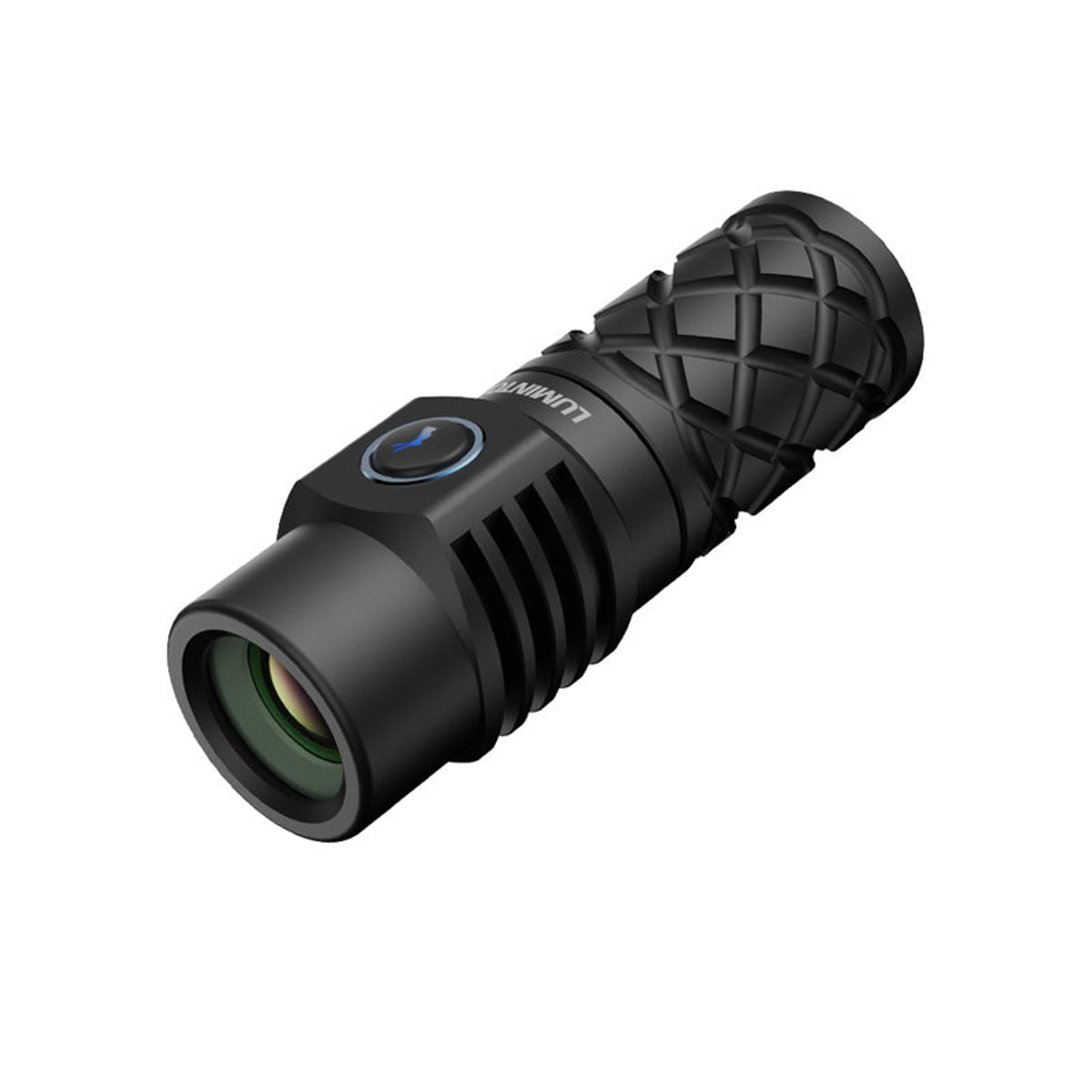
Lumintop Thor Mini LEP flashlight
- ✓250 lumens and 700 m at 122,500 cd
- ✓Low is 50 lumens for 1 h 30 min; High is a 90-second burst
- ✓78 x 25 mm, 60 g with the cell excluded
- ✓One 18350 Li-ion cell in the box, USB-C rechargeable
- ✓Glow ring on the bezel and a glow stripe at the tail
- ✓Green in stock at capture; Black unavailable
Who it fits: you want to put a beam on something far away from a pocket, and you accept 250 lumens because the beam is the point. Who should skip it: anyone who wants to light a room, and anyone who wants a light they can hold at full output for long, because a 250-lumen LEP in a 60-gram body is a short-use tool. If reach at low output is the whole requirement, the W7 below adds flood and red to the same 700-meter spot for a heavier body.
Lumintop W7: LEP plus flood plus red
The W7 is what the Thor Mini becomes when you add a floodlight and a red emitter, and the specification table breaks it into nine rows because the three light sources do not share a brightness ladder. Spotlight runs 60 lumens on Low for 1 hour 20 minutes and 300 on High for 3 minutes plus 1 hour. Flood runs 5 lumens of Eco for 36 hours, 80 on Low for 4 hours, and 320 on High for 3 minutes plus 1 hour 20. Combo, both together, is 550 lumens for 2 minutes plus 50. Red is 40 lumens for 2 hours, SOS 40 lumens for 4 hours, and strobe 200 lumens for 1 hour, which the table spells Srtobe.
Reach is 700 meters at 122,500 candela, and the light-source row explains how one body does both jobs: a white laser emitter plus red and white COB LEDs. That is a different architecture from the F02's three LEDs behind one lens, and it is why the W7's spot and flood are separate modes rather than a zoom. Power is 12 watts from one 18350 cell, the body is 28 by 24 by 80 millimeters, and the OLED display will show battery, output or distance. Waterproofing is IPX8 to two meters.
Weight is the one figure on the W7 page its own surfaces disagree about. The specification table says about 90 grams with the battery, the bullets say approximately 90 grams with battery, and the Shopify variant record carries 110 grams for both colors. The table and the bullets are the surfaces a buyer reads, so 90 is the number to work from, but do not be surprised if the parcel feels heavier. One last detail: the distance cell on the table prints 700 in Chinese characters while every other unit on that table is metric, so read it as 700 meters from the surrounding rows rather than as a typo in the number.
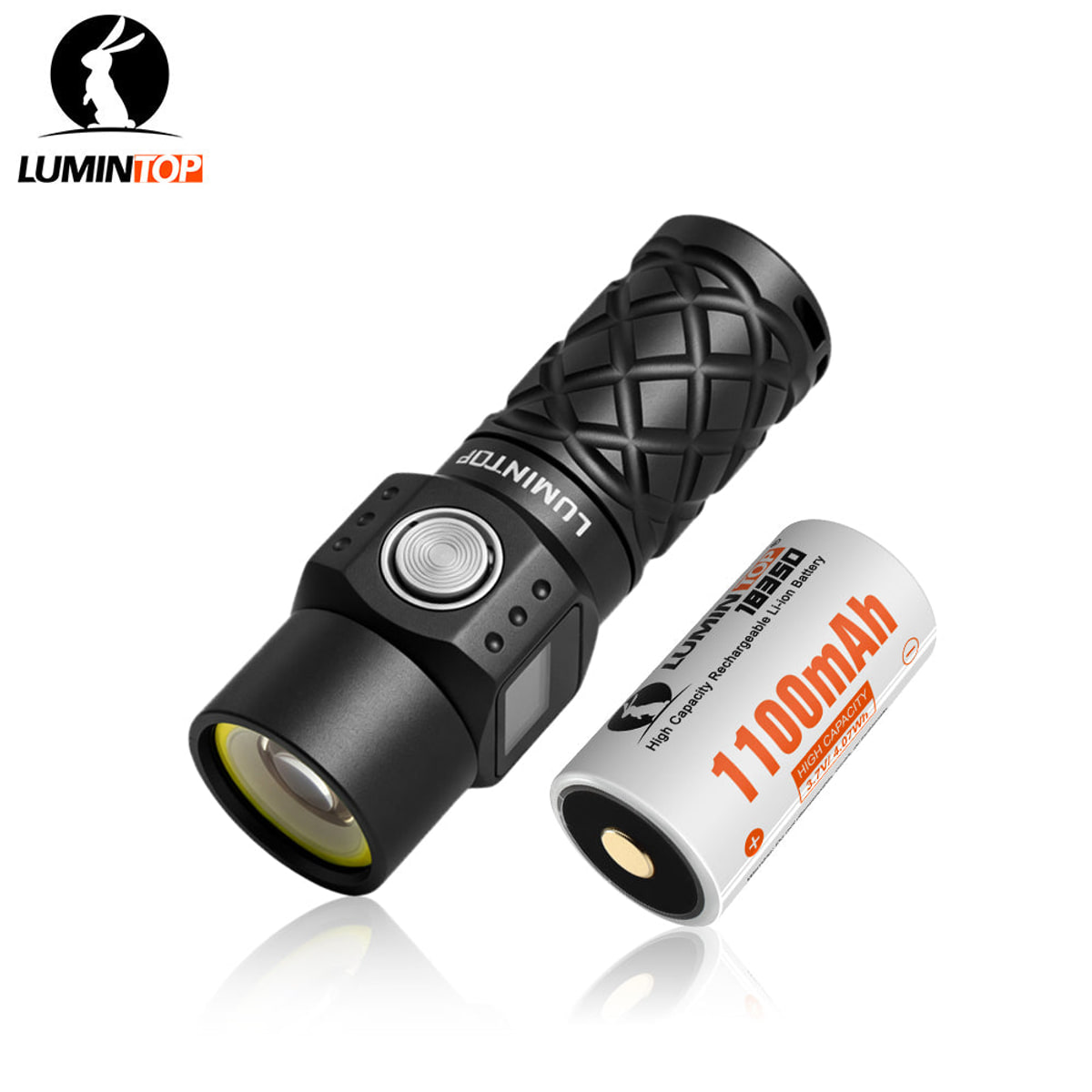
Lumintop W7 LEP flashlight with flood and red
- ✓Spotlight 300 lumens, flood 320, combo 550
- ✓700 m at 122,500 cd
- ✓White laser emitter plus red and white COB LEDs
- ✓One 18350 Li-ion cell; 12 W
- ✓OLED display for battery, output or distance
- ✓About 90 g with the battery in the table, 110 g in the variant record
Who it fits: you want one small light that spots 700 meters, lights a table, and preserves night vision on demand. Who should skip it: anyone who wants a single brightness ladder they can learn, because four ladders on two switches is a light you read the manual for, and the combo row's 2 minutes is a burst not a setting.
Lumintop L5: the right-angle headlamp
The L5 is the only light here that is also a headlamp, and it earns the slot because the holder and strap are part of the package rather than an accessory. The body is a 77.5-millimeter L-shape, 20.5 by 17.0 millimeters across, with the green, silver and blue colour options the variant list carries and an orange cradle in the photograph. It runs to 500 lumens on a 14500, or on an AA where Lumintop quotes up to 40 hours in Eco. Brightness is set by a rotary control with mode memory, and there is a magnetic tailcap for sticking it to a panel.
Throw is the number that tells you what this light is for, and the table gives two of them because the two chemistries differ: 52 meters at 672 candela on the 14500, 31 meters at 240 on an AA. Power is 6 watts. The weight is about 25.6 grams without the battery and without the headband, which is the figure the store prints on its own tile and repeats in the bullets, and it is also why the variant record, which carries zero grams for all three colors, cannot be used to check it. The table's cell row reads 14500 Li-ion or AA, excluded.
The water rating is where the store's pages argue with each other in the most instructive way, because it shows what the two IP digits mean. The specification table reads IP68 and underwater 2m. The gallery icons and the bullets read IPX8 to two meters. The 6 in IP68 is a dust-tightness digit that IPX8 does not carry, so the table is making the stronger claim of the two, and the marketing material is making the weaker one. Buy on the table if dust matters to you and treat the depth, which both agree on, as the reliable part.
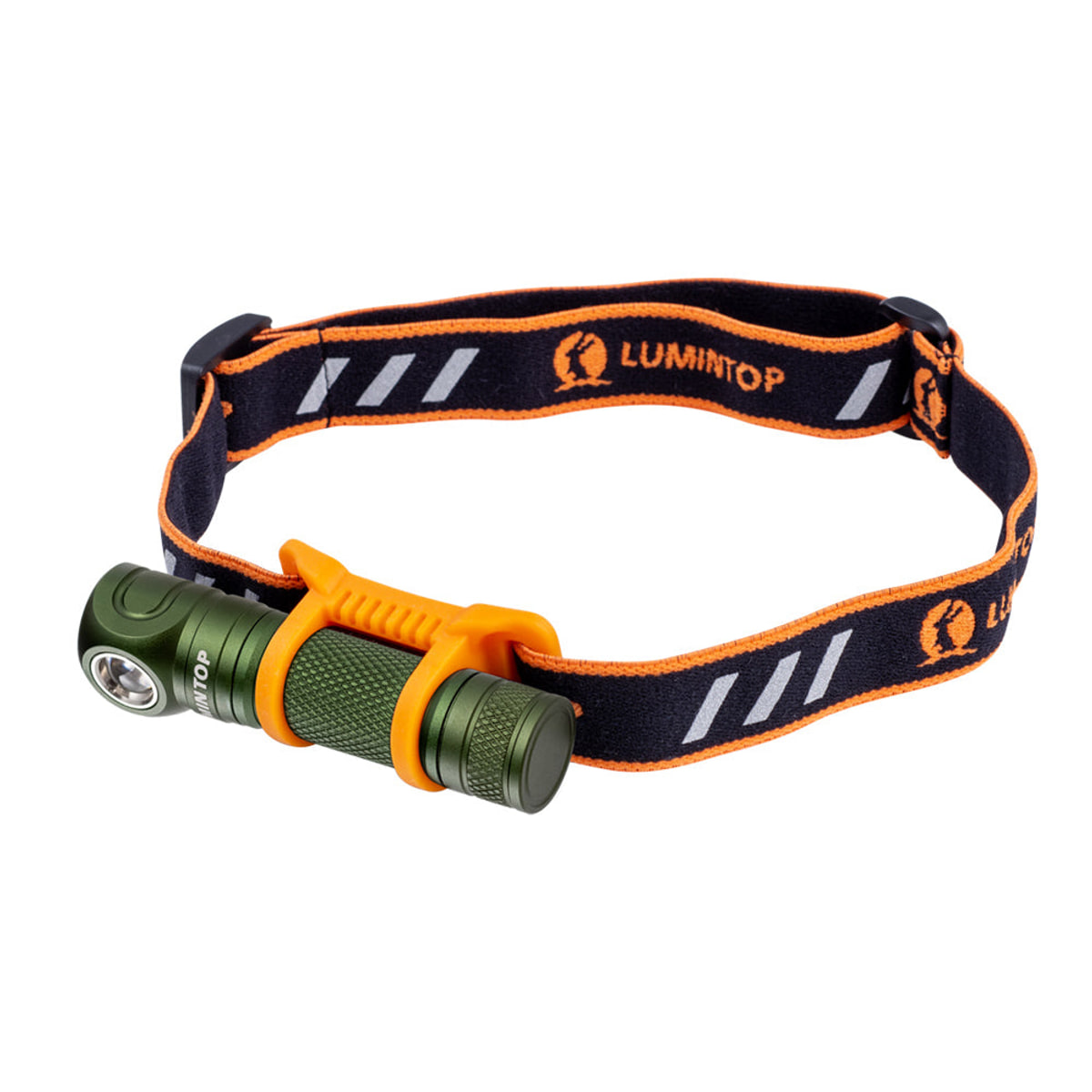
Lumintop L5 headlamp and right-angle flashlight
- ✓500 lumens on a 14500, four levels
- ✓Up to 40 h in Eco on an AA
- ✓52 m at 672 cd on the 14500, 31 m at 240 cd on an AA
- ✓About 25.6 g without battery or headband
- ✓Table says IP68 to 2 m; icons and bullets say IPX8
- ✓Headband and holder included; cell excluded
Who it fits: you want a hand light that becomes a headlamp when you need both hands, for a repair under a sink or a walk with a dog. Who should skip it: anyone shopping for a bed-reading light, because a 25-gram right-angle work light with a 52-meter hotspot is the wrong tool for a book. Our rankings of clip-on and bookmark lights cover that job properly.
Reading a Lumintop spec table
The numbers on these pages live in two places, and each answers a different question. Five of the seven carded models have an empty description field, so everything in it is a picture: the GT Nano, the Tool AA, the D3, the F02 and the Thor Mini. The other two, the W7 and the L5, carry a paragraph of text, and that paragraph gives the peak output, the throw, the weight and sometimes the runtime, which is why a search for a figure hits on those two and on nothing else. Everywhere, the full table is a single image, and on these pages it is usually the last image rather than the first, so a reader who stops scrolling reads five bullets and never sees the runtime rows, the candela figure or the impact rating. Open the last image in the gallery and read it.
The rows follow the ANSI/NEMA FL1 convention, and each one answers a different question.
- ▸Output in lumens, per mode. Read the mode name, not the biggest number.
- ▸Runtime per mode. A value like 1M+50min means one minute at that output and then fifty more at a lower one. It is a step-down, never a range of choices.
- ▸Distance in meters, which is the throw figure the box leads with. Intensity in candela is the same measurement stated in a way you can compare across lens sizes.
- ▸Impact resistance in meters. The Tool AA publishes 1.5; the other six tables all state 1.
- ▸Waterproofing, where IPX8 and IP68 are not the same claim: the 6 is a dust digit and the X is a placeholder, so the two ratings describe different protection even when both say two meters.
- ▸Light source and power, which on this store is where you find out whether a model is an LED, an LEP, or three emitters behind one lens.
Every one of these seven tables carries a footnote, and the footnotes differ in what they admit. All seven say some runtime is cumulative because of thermal protection, which is the sentence that turns a table of impressive numbers into an honest one. Four go further and name the cell the figures were measured on: the Tool AA names three, a 920 mAh 14500, an Eneloop Ni-MH cell and an alkaline cell; the D3 names a 26800; the Thor Mini names an 18350; and the L5 names one 14500 and an AA Ni-MH. The GT Nano, the F02 and the W7 do not name one, saying only that the data may vary with the environment and the battery. Those are the store's own statements about its own measurements, quoted here as the store's. The company's About page adds that its lights have undergone various rigorous tests, which is a claim about the manufacturer and is quoted as such.
Cells, chargers and what ships in the box
Four cell formats cover these seven lights, and which one a model takes decides how you carry it and what you have to buy alongside.
- ▸10300 Li-ion: the GT Nano, which includes one, and the F02, which has two pre-installed.
- ▸14500 or AA: the Tool AA 3.0, which is sold as an option with a 14500 and a magnetic tail cap, and the L5, where the table prints the cell as excluded.
- ▸18350: the W7, whose bullets list one 18350 and weigh the light with it in, and the Thor Mini, whose table prints 18350 Li-ion, excluded, and whose FAQ says the box includes a USB-C cell anyway.
- ▸26800: the D3, which includes one and supports USB-C charging and discharge from the same port.
Charging ports are stated on four of the seven. The GT Nano, the D3, the F02 and the W7 all name USB-C, and the D3 charges and discharges. The Tool AA, the Thor Mini and the L5 do not name an onboard port, and the Thor Mini page answers that in its FAQ by shipping a USB-C 18350 that comes out of the light to charge, so there the charging lives in the cell and not in the body. If a port matters to you, that distinction is worth confirming at checkout, because a light with no onboard port needs a cell with one or a separate charger.
One packaging detail that changes a total: no two of these seven state their cell the same way. The GT Nano says 30 grams with the battery included. The Tool AA names the cell in the option text and then pictures a box holding a sheath, a diffuser and a lanyard, with the cell and the magnetic tail cap sold as separate options. The D3 prints 26800 Li-ion, included, in the battery row and gives 182 grams to the body without it, so the cell ships and the weight does not count it. The F02 says its two cells are pre-installed. The W7 weighs itself with the battery in. The L5 prints 14500 Li-ion or AA, excluded. The Thor Mini prints 18350 Li-ion, excluded, and then answers, in its own FAQ, that the box includes a USB-C rechargeable cell. Read the variant line you are about to order rather than the model page as a whole, since the option text is where this store puts that fact when it puts it anywhere.
Where the store contradicts itself
Every entry below was live on November 21, 2026, each is quoted from the page it names, and none of them is a rounding difference. They are listed because a buyer who notices one of them after paying stops trusting the rest of the page, and because two of them change what you are buying.
- ▸GT Nano, figures: the tab title and meta description say 500 lumens, 361 meters and IP68; the H1 says version 3.2; the bullets and the table say 720 lumens, 405 meters, IPX8 to 2 m.
- ▸GT Nano, materials: the meta description offers titanium, copper and aluminum; the variant list has aluminum and titanium only.
- ▸GT Nano, weight: the variant record gives 30 grams for the standard body, 80 for most extend-tube options and 17 for four of them.
- ▸D3 rating: the meta description says IP68 where the table says IPX8, and the output disagrees too, because a body image's alt text reads 6000 lumens against three surfaces saying 7,000.
- ▸Tool AA, water: the table says IPX 8 with no depth, the bullets say water-resistant, and marketing copy elsewhere claims IP68 to two meters for thirty minutes.
- ▸F02, light source: the meta description calls it a green LEP; the table's light-source row names three LEDs and no laser.
- ▸W7, weight: the table and bullets say about 90 grams with battery, the variant record says 110 grams for both colors.
- ▸L5, water: the table says IP68 to two meters, the icons and bullets say IPX8 to two meters.
- ▸Thor Mini, weight: the tile labels its 60 grams as titanium and battery-excluded, on a light sold in aluminum.
- ▸Returns: the refund policy page says the return window is 14 days, the warranty page says 30 days, and both then cite more than 30 days after delivery in their partial-refund clause.
- ▸Support address: the refund policy page gives ec@lumintop.com, the warranty page and the contact page give cs@lumintop.com.
- ▸Shipping: two live policy pages give different handling and delivery windows, and only one of them carries a weight surcharge and a 60-minute cancellation window.
- ▸Warranty length: the warranty page gives 30 days of replacement, 2 years of free repair and 5 years of parts-charged repair; the About page says repair is free of charge within 5 years.
- ▸FAQ: the store links a FAQs page that returns 200 and renders the words Home FAQs and nothing else.
None of this is a reason to avoid the store; it is a reason to read the specification table instead of the title, and to ask about the return window before ordering rather than after. On this catalog the tab title is the surface that has drifted furthest behind, the specification table is the surface carrying the live figures, and the variant records are worth opening because the color and, on the Tool AA, the cell live there rather than in the table.
Shipping, warranty and returns as written
This is what the store's own pages say on November 21, 2026, quoted rather than paraphrased where the wording matters, because several of these sentences do not survive a summary.
- ▸Shipping, native policy page: free shipping on orders over 69 USD, 4PX as the carrier, dispatch in 3 to 5 workdays after payment clears, about 12 to 25 days in transit from China, and all outgoing packages pre-charged with GST and VAT.
- ▸Shipping, second policy page: free shipping from 69 USD, dispatch in 1 to 3 workdays, 7 to 15 days in transit, an additional charge of 1 USD per 0.1 kg once an order passes 0.6 kg, GT and GT70 orders handled differently because their fee is based on the unit of order rather than on weight, and a 60-minute window to cancel and reorder.
- ▸Address errors: the second page states that a wrong address given by the customer makes the loss the customer's, with no replacement and no refund.
- ▸Warranty: 30 days of free replacement for manufacturing defects, 2 years of free repair with accessories at 1 year and products with built-in cells at 2, then 5 years during which parts are charged. Normal wear, abuse and repair by anyone other than Lumintop or an authorized retailer are excluded.
- ▸Returns: 14 days on the refund policy page, 30 days on the warranty page, and in both cases the item must be unused, in its original packaging, with proof of purchase.
- ▸Refund timing: 15 days to process a refund, and return shipping is the buyer's and is deducted from the refund.
- ▸Support: cs@lumintop.com on the warranty and contact pages, Monday to Friday, 9 to 5 Eastern, with replies within 24 hours according to the shipping policy.
Two of those lines matter more than the rest. The weight surcharge means a multi-light order can cross the free-shipping line and pick up a charge, and the 14-day and 30-day return windows are on two pages of the same store, so the honest reading is that you should confirm which one applies to your order before you place it. Neither page is marked superseded.
Who should buy something else
A brand guide that only recommends the brand is not a guide, so here is the honest boundary. The lights that rank alongside these in search are the Nitecore TINI 3, TIKI and TUP2 on the keychain side, the Fenix E03R V2.0 and E35R for a cylindrical EDC, the Wuben G5 and the RovyVon Aurora A3 Pro in the same pocket-light conversation, and the Acebeam W35 and Weltool W4 PRO when the subject is LEP throw. Each of those has published figures this page has not captured, so none of them is compared here on a number.
What this lineup has that a peak-lumen shopping list does not show you is a published table for every light and a low-output discipline that the tables make checkable: Moonlight at 1 lumen for 50 hours on a keychain light, 1.5 lumens for 30 days on the D3, 5 lumens for 36 hours of flood on the W7, 40 hours of Eco on an AA in the L5. If your use is close work, a walk, a car kit or a power cut, that matters more than a peak figure. If your use is a beam at a distance measured in hundreds of meters and held there, none of these lights is the tool and you should look at the bigger single-purpose throwers.
If what you need is tens of thousands of lumens, a multi-cell pack and a lamp you hold with two hands, this lineup is the wrong shelf. Our IMALENT guide covers that end of the market, from a 200,000-lumen flagship down to pocket EDC, and it applies the same rule this page does: read the runtime row, not the headline.
One pairing worth naming, because it is the one people buy in the same order as a light: a car kit wants a flashlight and a jump starter, and the two fail for different reasons. If you are building that kit rather than buying a light on its own, the jump-starter rankings are the other half of it.
Frequently asked questions
Are Lumintop lights waterproof? Each model publishes its own rating and they are not interchangeable. Five of the seven tables read IPX8, underwater 2m: the GT Nano, the D3, the F02, the W7 and the Thor Mini. The L5's table is the odd one out at IP68 to two meters, while its icons and bullets say IPX8. The Tool AA's table prints IPX 8 and gives no depth. Where the pages disagree it is about the dust digit and the depth, not about whether the light survives water, so read the depth and treat the X in IPX8 as the placeholder it is.
Which Lumintop runs on ordinary AA batteries? Two of the seven. The Tool AA 3.0 takes a 14500, an alkaline AA or a Ni-MH AA and publishes a full column for each, giving 300 lumens and 60 hours on Low from an AA. The L5 takes a 14500 or an AA and quotes 40 hours in Eco on the AA, and its table states that the cell is excluded.
What is the difference between the Thor Mini and the W7? Both throw 700 meters. The Thor Mini does that with a spot beam only, no flood and no red, at 122,500 candela from a 78-millimeter body. The W7 adds a floodlight, a red light, a combined mode at 550 lumens and an OLED display, publishes the identical 122,500 candela, and puts its three light sources on separate brightness ladders. On weight the two are not directly comparable: the W7's 90 grams includes its cell and the Thor Mini's 60 excludes it, so the 30 grams between those figures is not the difference you would feel. The Thor Mini is a pocket spot; the W7 is a pocket spot plus a work light.
Does the D3 charge other devices? Its bullets give it USB Type-C discharge as well as charging, so yes, from its 26800 cell. That is the only model here that claims a power output, and it is the reason a power bank comparison is a fair next click rather than an upsell.
Why does the GT Nano's tab say 500 lumens? Because the browser title and meta description were written for an earlier version and never updated when the light changed, while the bullets and the specification table were. The table says 720 lumens, 405 meters and IPX8, the heading calls it version 3.2 and the title calls it 3.0, and a shopping result still repeats the 500-lumen figures. Assume the table is current and the title is not.
Is the F02 an LEP light? No. Its meta description says a green LEP is part of the package, but the specification table's light-source row names a high-performance LED, an RGB LED and a UV LED, the parts list has no laser, and there is no LEP mode anywhere in its nine-row output table. The LEP lights in this lineup are the Thor Mini and the W7.
Can I return one? Depends which page you read, which is the honest answer. The refund policy page says the window is 14 days, the warranty page says 30, and both then refer to more than 30 days after delivery when describing partial refunds. The item must be unused and in its original packaging, and return shipping is yours and deducted from the refund. Ask before you order.
Do the links on this page change what I pay? No. They carry the store's referral parameter, which tells Lumintop which publisher to credit for the visit. You pay whatever the store shows at checkout, and the parameter has been confirmed to survive the load on every page linked here.
The short version
Seven lights, four cell formats, and one habit that settles all of them: read the specification table on the product page, not the browser title. The GT Nano is the keychain light at 720 lumens and 405 meters, with the oldest figures in its own title. The Tool AA 3.0 runs on a shop-bought AA as well as a 14500, at 900 lumens on the 14500 and 300 on an AA. The D3 is the all-rounder at 7,000 lumens, 650 meters and a 26800 cell that also charges a phone. The F02 is the flat utility light with white, UV and RGB, and it is not an LEP. The Thor Mini is the pocket spot at 250 lumens and 700 meters. The W7 is the same reach with flood, red and an OLED. The L5 is the headlamp at 500 lumens on a 14500, 40 hours in Eco on an AA, and 25.6 grams without either.
Two numbers decide most of these choices and neither appears in a headline. The first is the runtime row for the mode you will leave on, which on every light here is far below the peak. The second is the water rating, where this store publishes three different ones for the same claim and the table is the surface to trust: five tables say IPX8 to two meters, the L5 says IP68 to two meters, and the Tool AA says IPX 8 with no depth. Everything else is a matter of which cell you want to own.