iMarku Knife Collections Explained
iMarku's homepage navigation menu names six knife series and leaves out Chū; the homepage's Collection band carries a Chū card, but the card image's alt text is a cookware label. This article reads the site's copy as printed, including the spots where it disagrees with itself.
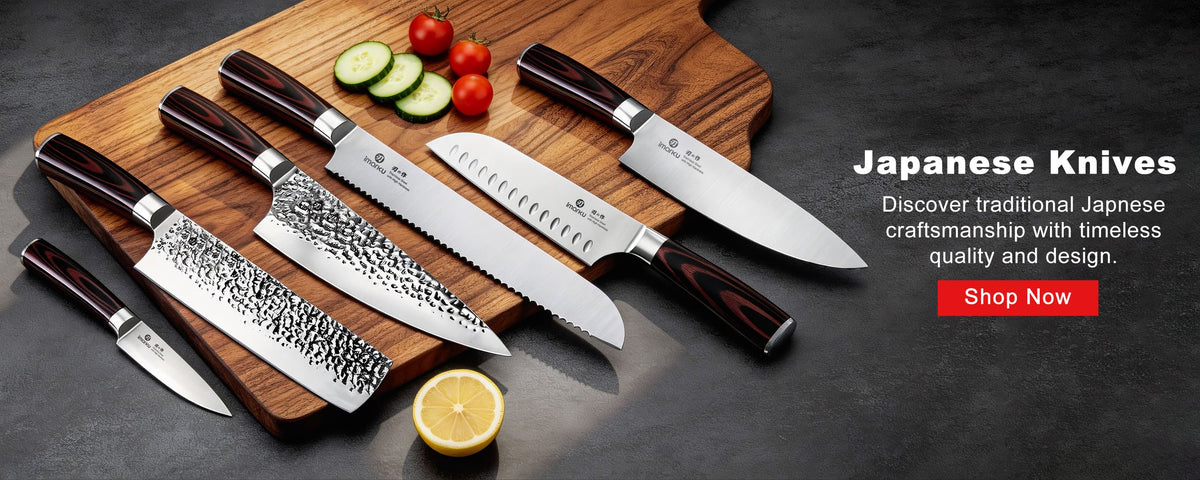
imarku.net gives its knife catalog two front doors: a Shop by Series menu that names six knife lines, and two category menus that split the same catalog into knife sets and single knives. This piece walks both routes, then reads the product page and the brand story that sit behind them, quoting iMarku's copy as printed. Every quote and figure below comes from three imarku.net pages captured on 2026-08-30 (the homepage, the chef's-knife collection listing and the TS01 product page), so sentences about site structure describe those captured pages, not the site as it may stand today.
What imarku.net's own pages show about its knife line structure
The Shop by Series menu lists six knife lines:
- ▸Kyokujin Series
- ▸Tasumi Series
- ▸Sakura Series
- ▸Xuanwu Series
- ▸Katana Series
- ▸Kasumi Series
The category route groups the same catalog across two menus, 'Shop Knife Sets' and 'Shop Single Knives'. The knife-sets menu holds Knife Block Sets, Chef Knife Sets, Professional Knife Block Sets and Steak Knife Sets. The single-knives menu holds Chef Knives, Santoku Knives and Cleaver Knives.
The Collection band and its six cards
Below the menus, the homepage carries a curated band titled 'The Collection'. In the 2026-08-30 capture it showed six iMarku collection cards, labeled Artisan, Xuanwu, Sakura, Katana, Kasumi and Chū.
Chū (ちゅう) is the name the navigation menu leaves out: the Shop by Series list carries six links and none of them is Chū. The Collection band's sixth card is labeled 'Chū(ちゅう)' and links to /collections/chu-series, an address visible in the capture's markup though the linked page itself was never fetched. The card image's own alt text reads 'imarku beast cookware#mb', a cookware label, so whether Chū is a knife line at all is not something these pages establish.
The chef's-knife collection listing: steel, hardness, sizes and balance as iMarku's copy states them
At capture time, the chef's-knife collection listing showed 8 products, a count the page prints in its mobile results header. The listing carries its own sort and filter controls, so its contents can change at any time.
The collection copy describes the knives as high-carbon stainless steel, with blades iMarku rates 'over 56 on the Rockwell scale'. The TS01 product page publishes 59±2 HRC for that knife. The two figures are compatible rather than contradictory: 'over 56' is a range claim and 59±2 HRC is a point claim inside it. Both are iMarku's own figures.
iMarku's collection page calls the 8-inch chef's knife its most popular size, inside a line it describes as ranging from 6 to 14 inches.
Balance is written into the copy as a design priority of the line: balanced weight distribution between blade and handle, and ergonomic design for comfort during extended use.
The Kyokujin series and the TS01 chef knife: specs, intended use, care
The product page for the '8-Inch Precision Chef Knife Japanese Steel for Effortless Gourmet Cutting' opens with a series label above the name: KYOKUJIN SERIES TS01. This product page is the only product page in the capture, which is why it gets a section of its own while the other series do not.
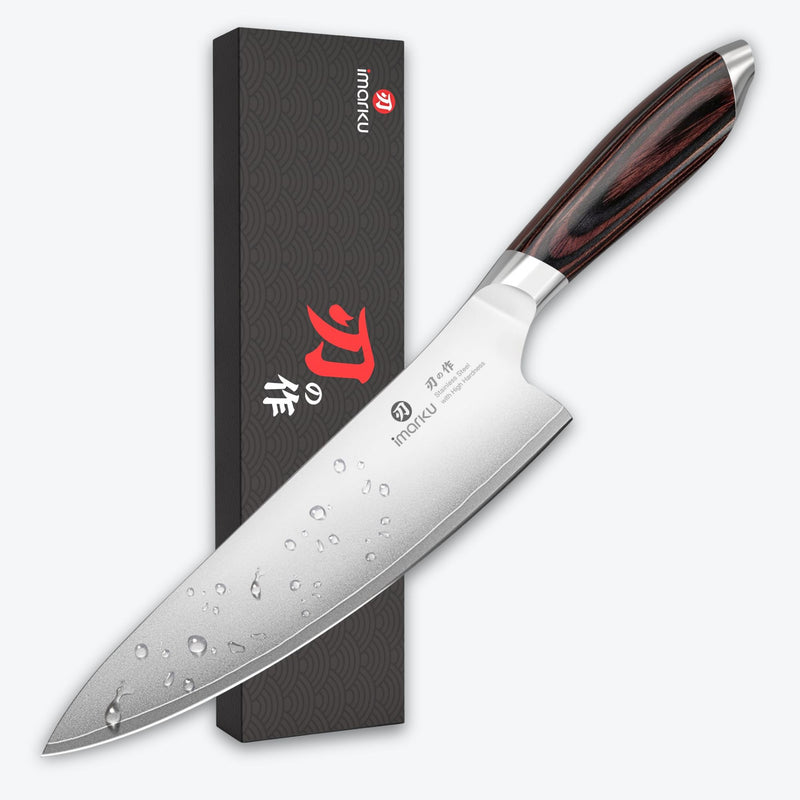
- ▸Blade material: high carbon stainless steel
- ▸Blade length: 8 inches
- ▸Structure: triple layer clad
- ▸Hardness: 59±2 HRC
- ▸Handle material: pakkawood
- ▸Finish: sandblasted matte
- ▸Edge type: double bevel
iMarku's description ties each material to a stated purpose. The triple layer clad structure exists 'for structural stability', the 59±2 HRC hardness is there 'to support edge retention', the sandblasted matte finish works 'to reduce surface resistance during cutting', and the pakkawood handle is 'shaped for balanced handling'.
The stated intended use stays close to the kitchen: a kitchen cutting tool for slicing, chopping and mincing ingredients during everyday food preparation, handling vegetables, meat and herbs, in home and professional cooking environments. That wording is iMarku's own description of what the knife is for.
The care instructions are short. Wash by hand with soap and warm water, rinse, dry with a soft towel. iMarku's own line on the dishwasher: 'Hand washing is recommended and not for dishwashers.'
The seven spec lines above, the intended-use wording and the care terms all print on iMarku's own product page for the TS01. Reading them there puts each quoted figure beside the photo and the rest of the listing.
View the TS01 product page on imarku.netThe brand story iMarku prints: 1949, the forging claims, and the ages it gives the company
The homepage's brand-story band runs under the heading 'A Century of Japanese Bladesmithing'. In it, iMarku says the company was founded in 1949 by a Japanese family of master bladesmiths, and that each knife is crafted through 108 traditional forging steps. The history is the band's own; nothing in the capture corroborates it beyond iMarku's pages.
The process numbers are printed just as flat: premium steel hand-folded 15 times to create 32,768 layers, a clay-coated quenching technique, a 15-degree finished edge angle, and polishing with 3000-grit stones. These are iMarku's published process claims, quoted as printed.
Everything in this section is iMarku talking about iMarku: a 1949 founding, 108 forging steps, 32,768 layers of folded steel, and a company age that changes with the surface you read. The capture carries no outside check on any of it.
How old the company is depends on where you look. The video-section copy says 'over 15 years of experience in craftsmanship and innovation'. The embedded video's structured data says 'more than 13 years'. The brand-story band says 'Founded in 1949'. And the page's JSON-LD structured data carries a foundingDate of '2013'. All four are iMarku's own self-descriptions on the same page; this article reports them side by side and leaves the reconciliation to the company.
Two naming questions iMarku's pages leave open
One series carries more than one name on one page. In the homepage navigation, the link to /collections/artisan-series is labeled 'Tasumi Series'. In the Collection band lower on the same page, the card pointing at that link is titled 'Artisan(たくみ)', and the card image itself is named Takumi_Series_MB_02.jpg with the alt text 'japanese knife of takumi series'. All three are iMarku's own surfaces; this article reports them and draws no spelling verdict.
The TS01's page disagrees with itself about the product's name, too. The browser title tag reads '8 Inch Chef Knife Stainless Steel Kitchen Cutter for Precise Food Prep'. The og:title social-card meta reads '8-Inch Precision Chef Knife Japanese Steel for Effortless Gourmet Cutting', the same name the page body prints. Both are iMarku's own surfaces, so the disagreement gets reported rather than settled.
What a buyer can verify before ordering: warranty, care and the FAQ answers
The policy block on the TS01 product page states the warranty for the whole brand: every iMarku product comes with a 1-year limited warranty, and replacement of defective items is subject to exceptions regarding proper care and use.
iMarku's FAQ on the collection page lists what it says a good chef knife should have. The list is the company's criteria for the category, not measurements of any specific knife on the page:
- ▸A high-carbon stainless steel blade for sharpness and edge retention
- ▸Full-tang construction for stability
- ▸An ergonomic handle that fits comfortably in your hand
- ▸Proper weight and balance for smooth, controlled cutting
- ▸Precise edge geometry, typically 13 to 16 degrees per side
The same FAQ states a chef knife's intended use: a versatile all-purpose knife for chopping, slicing, dicing and mincing vegetables, fruits, meat and herbs. iMarku says it handles 80 to 90 percent of daily cooking tasks; the figure is the company's own, and no method for it appears anywhere in the capture.
On the difference between the two knife types, the FAQ points to blade shape and motion: the chef knife carries a curved blade for a rocking motion, built for chopping and dicing, while the santoku has a shorter, flatter blade with a sheep's foot tip for thin slicing, straight cuts and precision work.
On steel, the FAQ notes that some of iMarku's premium knives use Damascus steel, which the company associates with enhanced hardness and a distinctive blade pattern.
"Hand washing is recommended and not for dishwashers."
iMarku, TS01 Use & Care instructions
That single line is the care routine's headline; the rest is soap and warm water, a rinse and a soft towel. It sits a scroll away from the warranty's 'proper care and use' exception, which makes the two worth reading together before ordering.