Tesla Roadster Finally Flew. So Why Won't It Be Built Until 2028?
Tesla put its second-generation Roadster through a ramp flip and a jump over five of its own cars on October 15, then said production starts in 2028. What the demonstration actually showed, what it did not, and why the dates keep moving.
The car finally flew, but the wait is not over
On October 15, 2026, at SpaceX's test site in McGregor, Texas, Tesla did something it had talked about for eight years: it put the second-generation Roadster on a ramp, had it drive upside down, flip through the air and land on thrusters, then jump over five of its own vehicles. Elon Musk said from the stage that the car goes into production in 2028 - Reuters, CNN and the other outlets watching the stream reported it within minutes.
Both halves of that sentence matter. The demonstration happened. The production date is a statement. Between the car that jumped on Thursday night and the car a buyer would park in a garage stands everything Tesla did not say on stage: no price for any version, no delivery date, no factory commitment beyond Musk's spoken 2028, and no answer for the people who put down $50,000 deposits in November 2017 on a car that was supposed to reach them in 2020. This piece separates what was shown from what was said, and the timeline from the promise.
A note on method, because it shapes every line below: what follows is compiled from Reuters, CNN and Engadget's on-site reporting, Electrek's and TechCrunch's event coverage, Tesla's own posts, the recorded livestream and post-event analysis, all read between October 15 and October 25, 2026. Where a figure is Tesla's claim rather than an independently measured result, the sentence says so.
What actually happened at the reveal
The event ran at night at the McGregor test facility, near Waco, with the launch-countdown staging Musk favors. CNN's report describes the sequence: the Roadster used suction underneath the car to climb a steep ramp, hung upside down at the top, spun off the end, flipped in the air, and used jets of air to slow its landing. Later in the demo it jumped clean over five Tesla vehicles parked side by side - a Cybercab, a Cybertruck, a Semi, a Model Y and a Model 3, per TechCrunch and BGR's event coverage - then used those same rear jets to accelerate to 60 mph on the ground. Reuters counted the same jump more loosely, as "a truck and other vehicles"; both were watching the same night.
Engadget, which had a reporter in the crowd, fills in the details a stream flattens. The ramp is C-shaped, and the car paused at the top, hanging perpendicular to the ground, before repeating the run and flipping off the end. When the door opened, an Optimus robot was sitting in the driver's seat - for show, Engadget reports; the stunts were programmed into the vehicle. Musk told the crowd there was no human driver because, in his words, it was done "to make sure we don't kill anyone." CNN's count matches Engadget's on the hardware: ten nozzles fed by what Musk called ultra high-pressure air tanks.
Musk also told the crowd why they were standing in a field in Texas: "we need an audience to prove that it's not AI or SI." He had a point, and the week that followed proved it twice over - once in his favor, once not. Tesla's own cameras and the crowd around the ramp recorded the run from angles no render could fake. And within five days, a separate video of a Roadster sailing off a city rooftop was circulating on X, captioned "Another rooftop. Another insane Tesla Roadster test." Fact-checkers at Lead Stories ran it through two detection services: Hive Moderation scored it 100 percent likely AI-generated, Sightengine 99 percent. The rooftop video was fake. The ramp video was real. Neither fact says what most people sharing them assumed it did.

Watch: Tesla's official Roadster demonstration (23:21)
Watch Tesla's full October 15, 2026 Roadster demonstration below, including the ramp stunt, vehicle design presentation and acceleration run. Chapters, from the description Tesla itself wrote: ramp demo 6:03, kickflip over the car lineup 10:56, design 12:47, aerodynamics 14:38, 0-60 run 15:58. If you only have two minutes, the ramp chapter holds the moment everything else rests on: a two-seat sports car hanging upside down from a ramp under its own suction, with no driver in it.
Did the Roadster actually fly?
Here is the mechanism, because the honest answer depends on it. Two systems worked together on the ramp. The first is a fan-and-skirt suction system: fans pull air out from a chamber sealed against the ground under the car, and the atmosphere above presses the car down. Musk said on stage that it can pull up to 2 G - meaning the hold, not the engine, is what kept a 3,700-pound-class car stuck to an upside-down ramp. Tesla says the system makes downforce even at zero speed, which is what the stationary hang at the top of the ramp demonstrated.
The second system is the set of cold-gas thrusters. Cold gas means no combustion: high-pressure nitrogen stored in carbon-wrapped tanks, released through nozzles, pushing the car with nothing burning. Lars Moravy, Tesla's vehicle engineering chief, told specialist outlets the Thrust version carries one 200-liter tank rated at 10,000 psi feeding four rear nozzles, and that a full fill is roughly five seconds of use. SpaceX uses the same technology in the same role - Falcon 9's booster pulses nitrogen cold-gas thrusters to flip itself around between separation and landing - which is the actual sense in which the Roadster borrows from SpaceX. The jets that slowed the Roadster's landing are cousins of hardware that steadies a falling rocket, not rocket engines.
So: did it fly? Roger Connor, curator of vertical flight at the Smithsonian's National Air and Space Museum, gave CNN the answer worth keeping: "We're not talking about sustained flight. We are literally talking about hopping." A ramp-assisted flip and a multi-second hop over parked cars is a stunt with a safety team, a closed site and a programmed flight profile - which is exactly what the demonstration was, and what it was honest to show. CNN's own assessment was that the night "certainly didn't have any demonstration of long-range flight." The gap between a jump and a flying car is not marketing spin; it is the difference between falling with style and controlling lift over a distance. No eVTOL company has fully closed that gap, and Connor's point about weight - aircraft want to be light, road cars want crumple zones - is why.
What the demo proved: the suction system holds a car to a surface against gravity, the cold-gas thrusters can rotate and cushion a multi-thousand-pound vehicle in the air, and Tesla can choreograph both reliably enough to do it in front of a crowd. What it did not prove: sustained flight, a street-legal flight system, or that a customer car will do any of this. Tesla itself lists the Rocket version as not approved for public roads.
From 2020 to 2028: the timeline
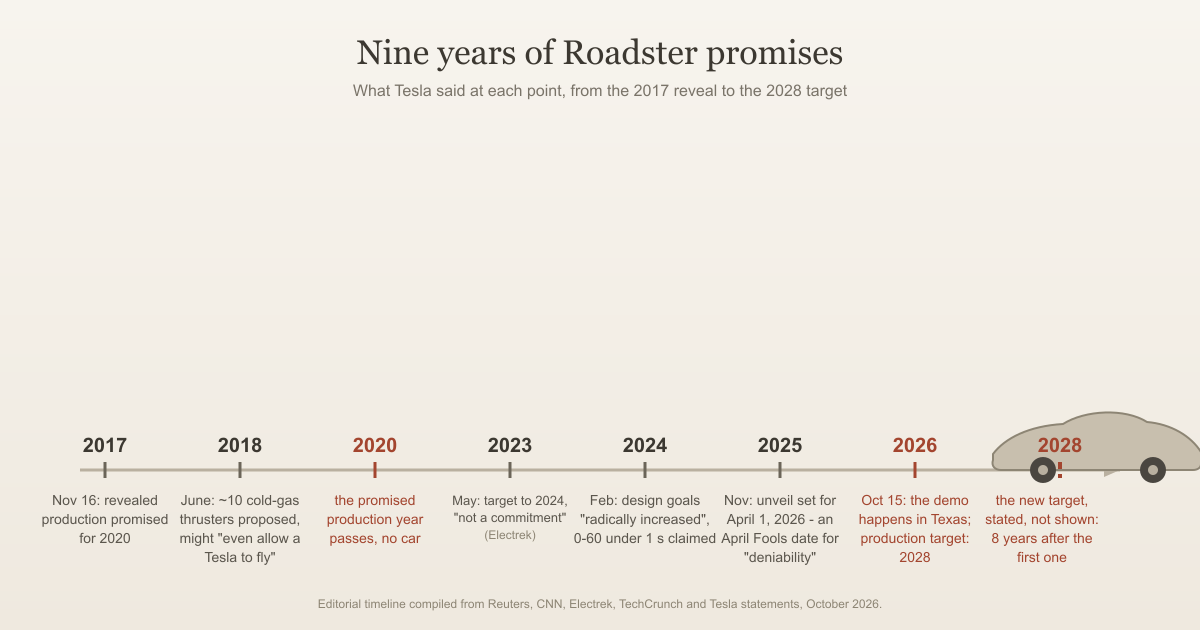
The Roadster's delay record is unusually long even by the standards of this company - Electrek counts at least six production slips and seven unveil dates since 2017 - and it is worth reading in full because the 2028 date is the latest entry in that series. Every dated claim below is sourced to Reuters, CNN, Engadget, Electrek or TechCrunch reporting.
- ▸November 16, 2017: Tesla rolls the red prototype out of a Semi truck at the end of its Semi event in Hawthorne, California. Claimed figures: 0-60 in 1.9 seconds, over 250 mph top speed, 620 miles of range from a 200 kWh pack, four seats, $200,000 base with 1,000 Founders Series cars at $250,000. Musk says customers get it in 2020.
- ▸June 2018: Musk tweets that a "SpaceX option package" will add about ten small rocket thrusters arranged around the car, which might "even allow a Tesla to fly." The thruster tanks replace the back seats - the first sign the four-seat promise would not hold.
- ▸June 2019: Musk tweets that 2.1 seconds to 60 is the base car "before adding rocket thruster option" - the 1.9-second figure quietly softening.
- ▸July 2020: the promised production year arrives with no production. Musk says the car is 12 to 18 months away.
- ▸January 2021: target moves to 2022. September 2021: 2023. May 2023: 2024, with Musk adding that it was "not a commitment" - per Electrek's delay timeline.
- ▸February 28, 2024: Musk says design goals have been "radically increased," claims 0-60 under 1 second, and floats an unveiling by end of 2024. That slips too.
- ▸October 31, 2025: on Joe Rogan's podcast, Musk promises a demonstration by the end of the year. A week later, at the November shareholder meeting, he sets the unveil for April 1, 2026 - and TechCrunch's account of that meeting quotes Musk on why an April Fools date appealed: it offered deniability, and as the quote is carried by Apple Scoop's timeline of the episode, "Like, I could say I was just kidding."
- ▸2026: April 1 passes. March: "late April." April 22 earnings call: "in a month or so." June: The Information reports the demo has slipped to August or later. September 12: Musk sets October 1 at the McGregor test site.
- ▸September 28, 2026: Tesla postpones to October 15, citing severe weather. The forecast for October 1 was genuinely bad - 82 percent chance of precipitation with thunderstorms - and the event genuinely cannot be held indoors. Electrek pointed out the same storm cleared within days, and said outright it was "not buying that this is only about the weather." Both things can be true.
- ▸October 15, 2026: the demonstration happens. Musk says production starts in 2028.
Count it how you like: the car was promised for 2020, and the newest target is 2028 - eight years late if the new date holds. The unveiling itself took nearly nine years from reveal to demonstration. Tesla has built plenty of hard things in that window; the Roadster kept losing the internal priority fight to Model 3 production, then Model Y, then Cybertruck, and lately to robots and robotaxis. None of the 2017 reservation holders has received a car.

The years of thruster promises
The flight talk long predates the flight. Musk proposed the SpaceX option package in June 2018, with thruster tanks in place of the rear seats at 10,000 psi. In 2019 he floated a hover demonstration, and in mid-2019 suggested one might happen around late 2020 - which, like the 2020 production date itself, came and went. In May 2021 he tweeted a 0-100 km/h figure of 1.1 seconds with thrusters. Each statement kept the story alive without ever committing to a demonstration, which is worth holding in mind when weighing the October 15 video: this is the first time any of it was shown in public, eight years after the first claim.
What the new Roadster can actually do - and what is still a claim
Tesla showed three versions on its site the night of the event, and the figures worth quoting are the ones the company itself printed. Performance: two seats, 0-60 in under 1.6 seconds. Thrust: two seats with rear cold-gas thrusters, under 0.9 seconds. Rocket: one seat, ten perimeter thrusters, under 0.59 seconds, invite only, and per Tesla not approved for public roads. On the streamed run the on-screen clock showed 0.81 seconds to 60, which BGR, Engadget and Electrek's live coverage all logged - Tesla's own number, not an independent time. Moravy told Hagerty the combination of suction, thrusters and a roughly one-megawatt powertrain could reach 0.55 seconds, a rollout figure, which is the kind of number you measure rather than the kind you print.
The rest of the sheet reads differently from 2017, and mostly downward. Range: over 300 miles per Tesla - against the 620 promised in 2017, less than half. Top speed: over 230 mph, against 250-plus. Reuters reported Moravy giving those figures with Musk adding from the stage, "Definitely much faster than that. I think you've got to crack halfway to the speed of sound." The four-seat 2+2 cabin is gone; Performance and Thrust seat two, Rocket seats one. The 200 kWh battery claim is gone too - von Holzhausen told MotorTrend the pack is 115 kWh. Battery chemistry and the pre-event promises of 2024 era both moved; the company's published numbers are the ones to hold it to.
One more figure deserves its own sentence because it bounds every thruster claim on this page: five seconds. Moravy told Top Gear that a full 200-liter tank is roughly five seconds of thruster use, spent mostly in the first part of a quarter-mile run. The landing flip, the jump over five cars and the 0.81-second run all fit inside that budget. A buyer imagining repeat flights on a weekend drive is imagining refills Moravy described as taking two to six hours today, with a target of under thirty minutes.
The thrust hardware itself is the part Reuters called the engineering flex. The 0-60 run pushed over 80 kilonewtons through four rear nozzles - Moravy compared it to a single-engine F-16 before afterburner - with the gas leaving the nozzles faster than sound, which is why the plume shows shock diamonds. The valves feeding those nozzles are opened by actuators borrowed from Tesla's Optimus robot, and the left and right feeds are trimmed in real time because, per Moravy, a 10 percent imbalance would put the car into a spin. That is real, unusual engineering, described by the people who built it on the record.
Can you buy or reserve one now?
You can reserve. That is not the same as buying, and the sequence matters. Tesla reopened reservations on about September 20, before the car had been shown: $5,000 on a credit card, described as fully refundable, followed by a $45,000 wire due within ten days - $50,000 total to hold a Performance. After the reveal, Thrust went up at $250,000 to reserve. Electrek noted it was the second time Tesla had collected $50,000 for this car. No purchase price for any version has been announced; the $200,000 figure from 2017 was withdrawn years ago, and Musk in 2023 called the Roadster a "small potato situation" that would not move Tesla's financial needle.
The 2017 cohort's experience is the honest preview of what a reservation is worth. Marques Brownlee said in September 2025 that Tesla had held his $50,000 for eight years, that there was no cancel button in the app, and that Tesla initially offered to return $45,000 and keep the first $5,000 - the remainder arrived after his story spread. Sam Altman posted a bounced refund email and said he was ghosted; Tesla and Musk said he had been refunded. Lawrence O'Connor, who kept his $250,000 Founders reservation from 2017, told CNBC he thinks of it as an interest-free loan to Tesla. None of these people has a Roadster. Tesla's terms, not anyone's article, are what a depositor is agreeing to - read them before wiring.
Engineering breakthrough or spectacle?
The strongest case for breakthrough: fan cars have existed since Chaparral's 2J raced Can-Am in 1970, and Brabham's fan car won a Formula 1 Grand Prix in 1978 before the technology was banned, but fan suction has stayed out of mass-production showrooms - the nearest modern machines are a single-seat track toy (the McMurtry Speirling that set the Goodwood hillclimb record) and Gordon Murray's low-volume T.50 supercar with its fan-driven boundary-layer system. Packaging four 20-kilowatt fans, sealed drop-down skirts, ten thrusters with robot-actuated valves, and a megawatt powertrain into one mass-production car would be genuinely new. The suction system alone, working at zero speed, has obvious value on a heavy EV that needs grip at low speed. Gene Munster of Deepwater Asset Management saw it the other way and said so on X: "an engineering flex with no commercial value beyond embarrassing traditional car makers." Reuters reported that some watchers saw the collaboration as Musk drumming up interest in a merger of Tesla and SpaceX, and that Munster's next post made the same case: "The Roadster event is the latest example of why Elon can't wait to bring (Tesla) and (SpaceX) together."
The strongest case for spectacle: the demonstrated tricks were programmed, performed by a driverless car at a closed site with spectators kept back, with an Optimus robot in the seat for show. Every performance number attached to the car is Tesla's own, measured on Tesla's own clock. The car will not be approved to fly anything on public roads - Tesla says so itself about the Rocket version. And the man setting the 2028 date is the same man whose earlier targets make up the timeline above, a fact CNN stated plainly and the earnings market appeared to agree with: on Tesla's Q3 call six days later, not one analyst asked about the Roadster. Musk volunteered that the demo was "arguably the coolest demo of any product ever," and moved on to robotaxis.
Both readings survive the evidence. The hardware is real and unusual; the demo was genuine; and neither fact makes a 2028 customer car, a price, or a flying production vehicle. The honest position is that Tesla showed a working prototype of a combination no road car has carried, and asked to be trusted on everything else.
Spotting fake Roadster videos
The rooftop clip was the first fake, and it will not be the last, because a real flying-car video is the perfect bait for synthetic ones. Three checks catch most of them. First, source: Tesla's real footage lives on its own YouTube channel and X account, and wire-service footage carries the agency's label; a clip from an unnamed account with a wildfire caption is a claim, not a source. Second, geometry: every real maneuver so far happened at the McGregor test site, on or off a ramp, with barriers and a crowd in frame - a Roadster threading downtown skyscrapers has no plausible site, no audience and no airspace approval, and the two detection services that scored the rooftop clip agreed at 99 to 100 percent. Third, physics: the real car hops for seconds on a tank that holds five seconds of gas. Sustained cruising on video contradicts the hardware Tesla itself describes. None of these checks proves anything alone; AI detectors especially score probability, not truth. Together with a source you can name, they beat sharing first.
What would make the 2028 date believable
Dates in this story have been statements; a date becomes a plan when physical things accumulate against it. Four markers are checkable from the outside, and each one is a story we would cover on its own. A production-intent prototype built on tooling rather than the hand-built demo cars. A factory line assigned to Roadster at Giga Texas, which is where a May 2026 KVUE report out of Austin placed it - reported, not confirmed by Tesla. A stated price, because a car without one is not yet a product. And a delivery date attached to the reservations Tesla is taking now, which is what the 2017 cohort never got. Until those exist, the defensible summary is the one the night itself supplied: the car flew on Thursday. Whether it ships in 2028 is a claim, and its author's record on this exact car is the timeline above.
The last word belongs to the crowd, in a way. Musk told them success was not guaranteed and that they were watching at a safe distance because of it. That was about the ramp. It travels.
Tesla Roadster FAQ
Did the Tesla Roadster really fly on October 15, 2026? It performed a ramp-assisted jump routine at SpaceX's McGregor, Texas test site: it climbed a ramp using fan-driven suction, hung upside down, flipped off the end and landed on cold-gas thrusters, then jumped over five Tesla vehicles. The event happened and was recorded by Tesla and the crowd on site. The Smithsonian's curator of vertical flight characterized it to CNN as hopping rather than sustained flight.
When does the Tesla Roadster go on sale? No date has been given for customer deliveries. Musk said on October 15, 2026 that production starts in 2028. Tesla has promised Roadster production for 2020, 2021, 2022, 2023, 2024 and 2025 at various points since 2017 and delivered none of them; the 2028 statement is the latest in that series.
How much does the Tesla Roadster cost? Tesla has not announced a price for any version. Reservations cost $50,000 for Performance ($5,000 by card, then $45,000 by wire within ten days) and $250,000 for Thrust. The Rocket version is invite-only. In 2017 Tesla quoted a $200,000 base price; that figure was later withdrawn.
Can the Tesla Roadster be driven on public roads while flying? No. Tesla's own site says the Rocket version, the only one with the full ten-thruster flight system, is not approved for public roads. Performance and Thrust are road cars whose thrusters work as acceleration and attitude-control aids; Tesla has published no claim that either is approved for flight of any kind on public roads.
Was the flying Roadster video AI? Both answers went viral, and both were half right. Tesla's own footage of the ramp demo is real, recorded live before an audience and published on Tesla's official channel. The separate video of a Roadster flying off a city rooftop, posted to X on October 20, 2026, is AI-generated: Lead Stories fact-checked it with Hive Moderation (100 percent likely AI) and Sightengine (99 percent). Check the source before sharing either direction.
What happened to people who reserved a Roadster in 2017? Some still hold reservations, including at least one Founders Series holder who told CNBC he considers his $250,000 an interest-free loan to Tesla. Others asked for refunds: Marques Brownlee described an eight-year wait and a refund process with no cancel button, and Sam Altman posted a bounced refund email before his money came back. No 2017 depositor has received a car.
Does the Roadster use actual rocket engines? No. The thrusters are cold-gas: high-pressure nitrogen expanding through nozzles, with no combustion. It is the same technology SpaceX uses for attitude control on Falcon 9, and Moravy described the four rear nozzles producing over 80 kilonewtons on the 0-60 run - fighter-jet-scale force, from tanks rather than engines.
Sources and further reading
The reporting this article is compiled from, each checked against the claims it supports here. Reuters's wire story carries the 2028 statement, the McGregor setting and Moravy's performance figures; a reader-facing copy of the same wire report is carried by US News. Electrek's event coverage covers the kickflip jump and the three trims; its delay timeline counts the six production slips and seven unveil dates; its September 28 piece carries Tesla's weather postponement statement in full. CNN's October 16 News Central transcript preserves the on-air exchange over whether the ramp footage was AI. The event video itself is linked in the Watch section above.
Where to go next
If the Roadster has you thinking about what an EV can actually do to a car budget today rather than in 2028, the practical end of electrification is what this site covers: what the chargers, the hardware and the published specs deliver, read the same way this piece read the demo.
And when a maker announces anything - flight, range, a date - the method worth keeping is the one this story keeps demonstrating: separate the event from the claim, and check both against what the company printed on its own page.