Is Douk Audio Worth Buying? Amplifiers, DACs, Returns and Warranty Explained
Douk Audio and Nobsound are sister brands from the same Shenzhen founders, selling 155 products from tube amps to phono preamps. This guide maps the lineup on the company's own published specs, explains the compatibility pitfalls that catch first-time buyers, and reports the warranty and return terms as the store itself prints them, including where its pages disagree.
What this guide covers
Douk Audio sells budget hi-fi electronics: integrated amplifiers built around vacuum tubes or Class D chips, digital-to-analog converters, headphone amplifiers, phono preamps, and a long tail of selectors, VU meters, bass shakers and cables. Its storefront is titled "Douk Audio & Nobsound," and the two names confuse more buyers than any spec sheet does. This guide explains who the two brands are, what separates the product families, which published numbers drive a real choice, and what the store's own warranty and return pages promise, including the places where those pages contradict each other.
Every figure below is what Douk Audio states on its own product and policy pages, all read on October 13, 2026. JellyReviews has not tested any of this equipment, so nothing here is a listening impression; where a claim is the maker's, the sentence says so.
Affiliate disclosure: JellyReviews may earn a commission when an eligible purchase is correctly attributed through an affiliate link. Attribution is handled by the store's own systems and can change, so no guarantee is implied here.
Who Douk Audio is, and how Nobsound fits in
The two names are sister brands from the same founding team. Douk Audio's about page recounts launching Nobsound in 2013 with a first product, the NS-01G, that the company says sold over 200,000 units in under a year; Douk Audio and a third name, One Little Bear, came later as the group expanded. The story begins, per that page, at the September 2012 Guangzhou International High-End Audio Exhibition, where co-founder Steven Xie decided good sound should not cost what it did. The store's mission line reads "Make HIFI Affordable for All Music Lovers."
Operationally, the about page names two registered entities behind the store: Shenzhen Anba Technology Co., Ltd in Shenzhen, China, and HONGKONG LONGSHENG Import and Export Trading Co., Limited in Tuen Mun, Hong Kong. Support email is nobsound@doukaudio.com, and the store's Facebook link points to facebook.com/nobsound, which tells you the Nobsound name predates the store's current branding. Ampapa appears on the same storefront with its own series of amplifiers and accessories; the store's own banner calls it the "Ampapa Flagship Series".
What that means as a buyer: you are buying from a China-based direct-store operation, shipped from its warehouses, with support run over email and WhatsApp during hours the store's policy pages list as Monday to Friday, 6:00 PM to 9:00 AM Pacific time. The practical consequences of that are in the warranty and shipping sections below.
What the brand actually sells
The catalog is large: 155 products in the store's own product feed on the day this guide was written. The families that matter for a first purchase are four, and the differences between them are the real decision a buyer faces:
- ▸Integrated amplifiers, the box that connects your source to your speakers. Douk splits these between tube designs (the ST-01 hybrid series, where a tube preamp stage feeds a digital power amp) and Class D chip amps built on Texas Instruments' TPA3255 (the A5 line, the Ampapa D1), plus larger Class A units like the Nobsound NS-02G PRO.
- ▸DACs and headphone amplifiers, which turn a digital signal into analog and drive headphones directly. The Q2PRO and the Z1 are the gaming-leaning models; the U2-PRO-FC is a digital interface (a reclocker) rather than a full DAC.
- ▸Phono preamps for turntables, the small box that raises a cartridge's tiny signal to line level. The T12 handles both moving-magnet and moving-coil cartridges and adds a headphone output.
- ▸Accessories: passive preamps and volume controllers, audio selectors, VU meter displays, bass shakers, linear power supplies and cables. The Nobsound VOL-3 passive preamp sits in that accessories bracket, with no amplifier or DAC behind it.
One catalog entry deserves its own warning: Douk sells at least one amplifier listed as "Main Unit Only (Power Supply Not Included)." A buyer who reads the title carelessly can end up with an amplifier and no way to power it. Check the box contents on any model page before ordering.
Choosing between a tube amp, a Class D amp, a DAC and a headphone amp
The four families are not four steps of quality; they are four different jobs, and the first question is which job you need done.
A tube amplifier and a Class D amplifier do the same job: take a line-level signal, make it strong enough to move speaker cones. The trade-offs are physical. Tubes run hot, are fragile, and are consumable: they wear out and get replaced. Class D chips run cool and efficient; the TPA3255 chips in the A5 and Ampapa lines are the same family of chips used across the budget-amp market. Douk's ST-01 PRO is a hybrid: a tube preamp stage in front of a digital power amp, with the tube's stated role being the character of the sound rather than the wattage.
A DAC answers a different question: your computer, TV or game console outputs sound as digital bits, and a DAC converts them to the analog signal your amp or powered speakers need. If your source is a phone or laptop over USB and your speakers are powered, a DAC/headphone-amp unit like the Q2PRO may be the only box you need. If your source is already analog (a turntable without built-in phono stage, a cassette deck), you need a phono preamp or nothing at all, not a DAC.
A headphone amplifier exists because some headphones are hard to drive. Douk's own spec sheets give the numbers: the Q2PRO is rated at 450 mW into 32 ohms for headphones of 16 to 300 ohms impedance, and the T12's headphone output is rated at up to 350 mW into 32 to 200 ohms. Whether those numbers are enough depends on the headphones, and the honest answer is to check the headphone maker's impedance and sensitivity ratings against the amp's output before assuming any amp will drive them.
Five representative models
The five below are picks for distinct jobs from the current lineup, not a ranking. Each carries the specs from its own product page on the store, quoted as the maker states them.
Douk Audio ST-01 PRO: the do-everything hybrid tube amp
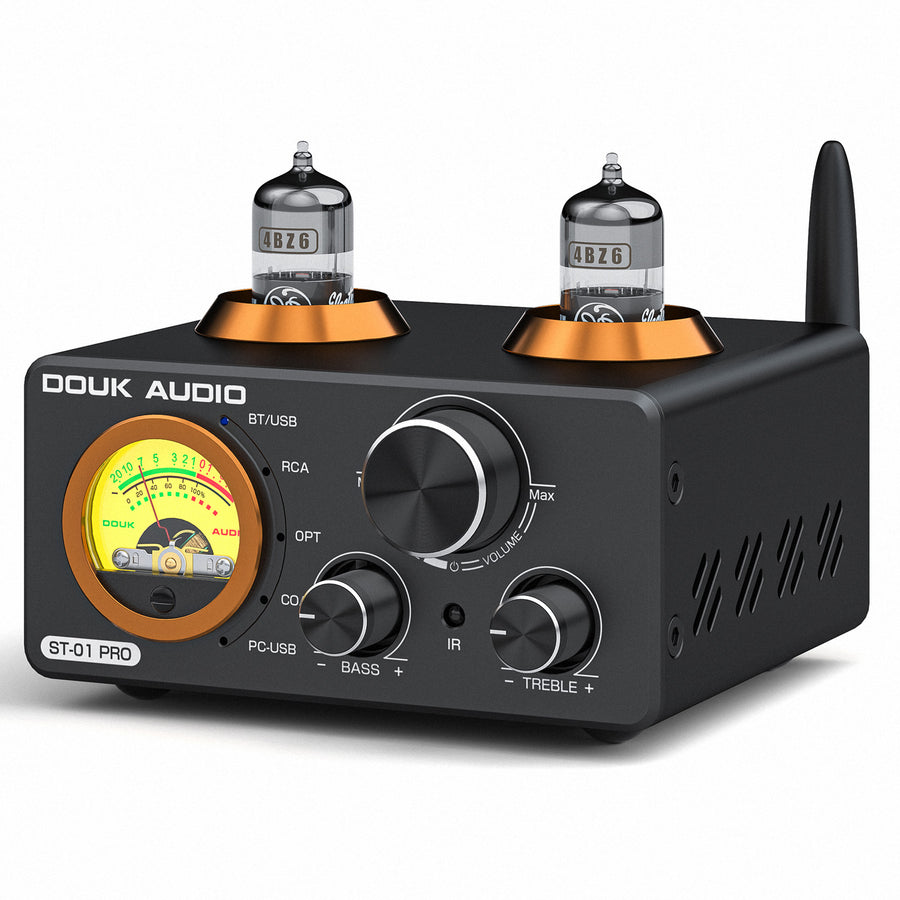
The ST-01 PRO is the hybrid of the five: a vacuum-tube preamp stage with a 100-watts-per-channel (into 4 ohms) power stage behind it, and the widest input set of the five models. The spec sheet lists Bluetooth, PC-USB, coaxial, optical, RCA and even U-disk playback as inputs, with stated sampling ceilings of 192 kHz/24-bit on the coax and optical inputs, 96 kHz/24-bit on USB and 48 kHz/24-bit over Bluetooth. The store states GE 4BZ6 tubes, a frequency response of 20 Hz to 20 kHz (±1 dB), signal-to-noise of at least 98 dB, matched speaker impedance of 3 to 8 ohms, and a shipped weight of 661 grams.
The notable spec here is the input set, not the tube. Among the four other models below, the Q2PRO also has an optical input, and the rest take analog sources or Bluetooth; this is the only one of the five that also takes a coaxial feed and a direct PC-USB connection to a computer or streamer. It is also a speaker amplifier rather than a DAC/headphone unit, so those digital inputs feed speaker outputs, not a headphone jack as the primary output. The trade-off is working voltage: the spec sheet lists DC 18 to 30 volts, meaning the power supply is external, so confirm it is included with the exact variant you order, given the store also sells main-unit-only listings.
Douk Audio ST-01 PRO Bluetooth Tube Amplifier with USB DAC
- ✓Hybrid tube preamp + digital power amp, GE 4BZ6 tubes (Douk Audio)
- ✓Max output 100W + 100W into 4 ohms; matched speakers 3-8 ohms (Douk Audio)
- ✓Inputs: Bluetooth, PC-USB, coaxial, optical, RCA, U-disk (Douk Audio)
- ✓192 kHz/24-bit on coax/optical; 96 kHz/24-bit USB; XMOS XU316 (Douk Audio)
- ✓DC 18-30V external supply; 661 g; 115 x 98 x 54 mm (Douk Audio)
Douk Audio A5 PRO: the straightforward Class D amp
The A5 PRO is the simpler proposition: a TPA3255 Class D board with Bluetooth 5.1 and a stereo RCA input, plus a 3.5mm headphone jack and AUX output. The published footprint is 130 by 112 by 33 millimeters at 525 grams. The page's headline figure is a maximum output of 300 watts per channel into 4 ohms, but the store also publishes a table that matters more, because it states what the amp delivers per power adapter and speaker load, and the adapter is optional: the store sells the unit "with or without power adapter."
That manufacturer-published table, not a measurement by anyone here, reads: with a 32V/5A adapter, 78 watts per channel into 4 ohms (65 into 8); with 36V/6A, 107 watts into 4 ohms; with 48V/5A, 120 watts into 4 ohms (102 into 8); and with 48V/10A, 250 watts into 4 ohms (185 into 8). Every one of those rows sits below the 300-watt headline, which is the chip's ceiling, not a promise your configuration reaches. The practical reading: unless you buy the unit with a 48V/10A supply, a realistic expectation is the row matching the adapter you actually ordered, and if you order without an adapter you must supply your own within the stated DC 24-48V working range.
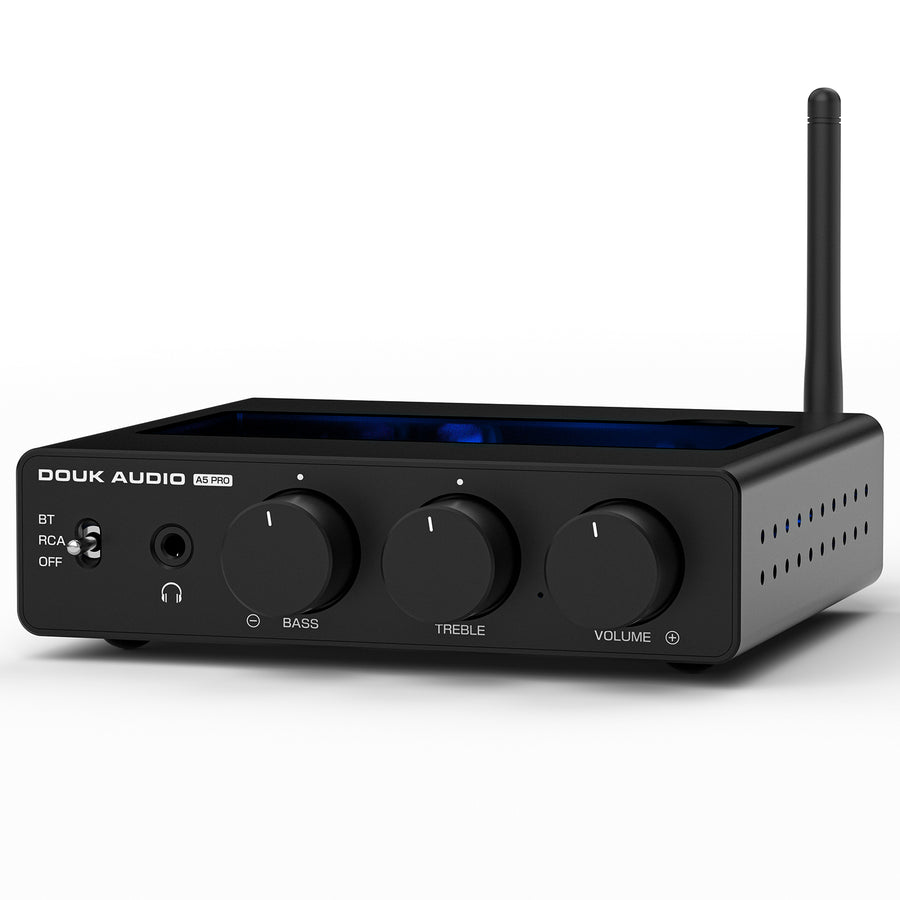
Douk Audio A5 PRO TPA3255 Bluetooth Amplifier
- ✓TPA3255 Class D; headline max 300W x 2 into 4 ohms (Douk Audio)
- ✓Manufacturer output table by adapter (Douk Audio): 32V/5A = 78W/ch @4 ohms; 48V/5A = 120W/ch; 48V/10A = 250W/ch; every row below the headline
- ✓Bluetooth 5.1 and stereo RCA inputs; headphone out 500 mW into 32 ohms; AUX out (Douk Audio)
- ✓Power adapter optional: with or without, 32V/5A or 48V/5A; working range DC 24-48V (Douk Audio)
- ✓130 x 112 x 33 mm; 525 g (Douk Audio)
Douk Audio Q2PRO: the gaming DAC and headphone amp
The Q2PRO is a desktop DAC and headphone amplifier aimed at gamers: the store lists an ESS9039Q2M DAC chip, USB-C, optical and microphone inputs, and outputs on optical, stereo RCA and a 3.5mm headphone jack. Stated figures include up to PCM 192 kHz/32-bit input, a signal-to-noise ratio of at least 117 dB, total harmonic distortion plus noise of 0.0009 percent, headphone output of 450 mW into 32 ohms for headphones of 16 to 300 ohms, and a bass adjustment range of plus or minus 12 dB. Power is a 5-volt, at-least-2-amp supply.
One ergonomic detail from the store's own warm-tips section is worth knowing before you buy: the unit has two microphone jacks, and when both are connected only the left one is active. It is a two-player convenience with a one-player rule.
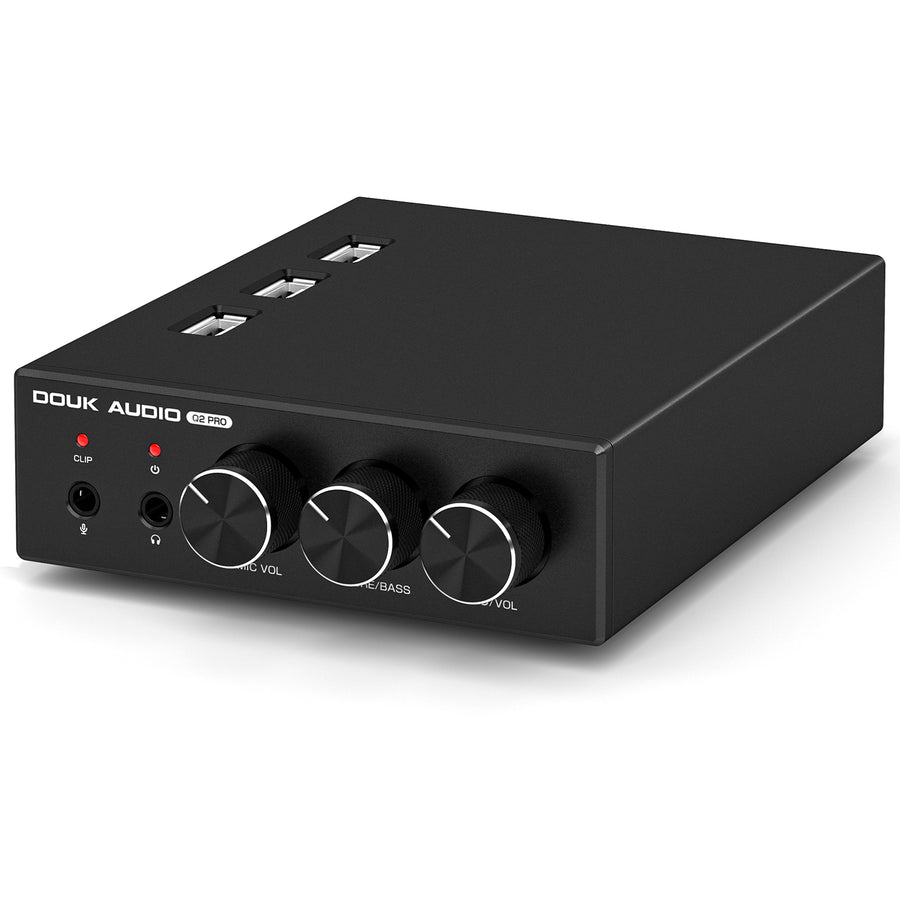
Douk Audio Q2PRO Gaming DAC and Headphone Amp
- ✓ESS9039Q2M DAC; up to PCM 192 kHz/32-bit (Douk Audio)
- ✓Headphone out 450 mW into 32 ohms; headphones 16-300 ohms (Douk Audio)
- ✓Inputs USB-C, optical, microphone; outputs optical, RCA, 3.5mm (Douk Audio)
- ✓SNR at least 117 dB; THD+N 0.0009 percent (Douk Audio)
- ✓Dual mic jacks, left jack takes priority when both are connected (Douk Audio)
Nobsound NS-02G PRO: the full-size Class A amplifier
The NS-02G PRO is the largest unit below and the only one here with an AC mains input in its own spec sheet: the store states single-ended Class A operation with RMS output of 30 watts per channel into 8 ohms or 42 watts per channel into 4 ohms, two groups of RCA inputs, banana speaker outputs, total harmonic distortion of at most 1 percent, and an AC input of 100-120 or 220-240 volts. The store also publishes the size in both millimeters (457 x 310 x 140 mm) and inches (12.99 x 8.27 x 2.76 in), and those two figures do not agree: 457 mm is 18 inches, not 12.99. Take the metric figure as the published one, treat the inch conversion as unverified, and check physical fit before ordering if the unit must fit a specific shelf or rack.
Class A is a design choice with a real cost. Class A amplifiers keep their output devices conducting through the whole signal cycle, which is why the maker's design claim is low distortion and why the running cost is real: this unit's spec sheet states power consumption of up to 120 watts, an upper-bound rating rather than a measured constant draw, but high idle consumption and noticeable heat are inherent to the topology, and this is the heaviest unit here at 5.6 kilograms. Its manufacturer-published output is 30 watts RMS per channel into 8 ohms; whether that drives your speakers to your satisfaction depends on the speakers' sensitivity and your room, so check both rather than relying on any comfort guarantee from this guide. It is not the box for insensitive planar headphones or bare-wire subwoofer duty, and the spec sheet does not claim otherwise.
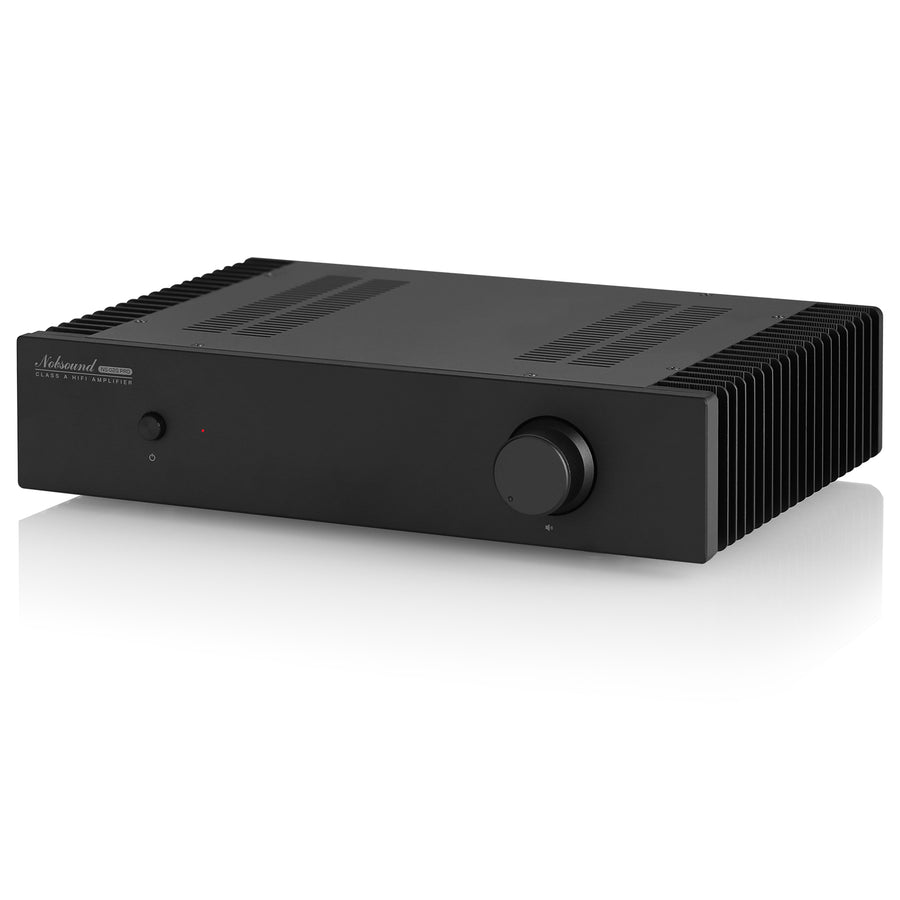
Nobsound NS-02G PRO Single-Ended Class A Stereo Amplifier
- ✓Single-ended Class A; RMS 30W x 2 into 8 ohms, 42W x 2 into 4 ohms (Nobsound)
- ✓Two RCA input groups; banana speaker outputs (Nobsound)
- ✓THD at most 1 percent; SNR at least 86 dB A-weighted (Nobsound)
- ✓AC 100-120 / 220-240 volts input; power consumption stated up to 120 W (Nobsound)
- ✓Published size 457 x 310 x 140 mm (the page inch conversion disagrees; check fit); 5.6 kg
Douk Audio T12: the turntable companion
The T12 is a tube phono preamp for turntables, covering both moving-magnet and moving-coil cartridges, with stated gain of 45 dB for MM, 58 dB for MC and 10 dB for line-in. The spec sheet lists a 6J5B-Q vacuum tube with a 120-volt DC anode supply, input impedance of 47 kilohms for MM and 150 ohms for MC, two RCA outputs plus a 3.5mm headphone output rated at up to 350 mW into 32-to-200-ohm headphones, and a maximum output level of 8 volts RMS into 600 ohms.
The MC support is the distinguishing spec, and it needs a caveat the spec sheet cannot settle for you: MC cartridge output varies widely between models, and both the gain and the loading must match the cartridge for the stage to work well. The T12's published 58 dB of MC gain and 150-ohm MC loading suit some moving-coil cartridges and not others, so check your cartridge's output voltage and recommended load against those figures before ordering. And know which cartridge type your turntable has at all: the MM and MC modes differ in gain and impedance, and using the wrong mode is a setup error to avoid, not a damage risk.
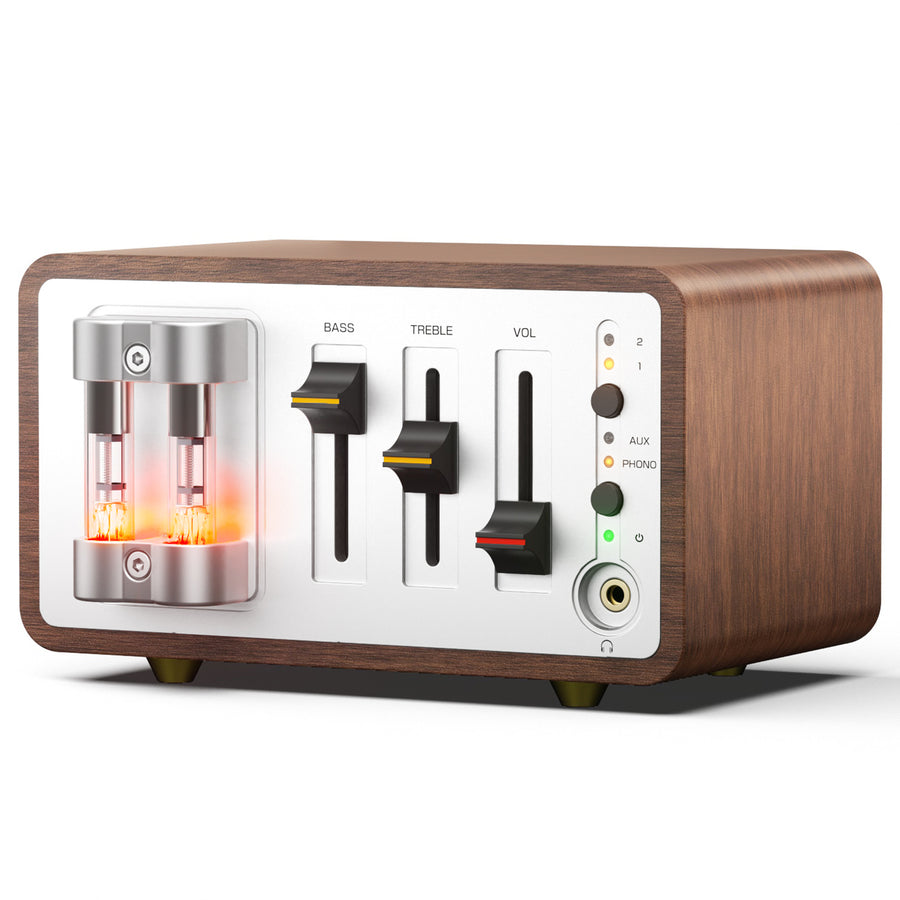
Douk Audio T12 Tube Phono Preamp MM/MC with VU Meter
- ✓Phono input for MM (45 dB gain) and MC (58 dB gain) cartridges (Douk Audio)
- ✓6J5B-Q vacuum tube at 120 VDC anode (Douk Audio)
- ✓Line-in gain 10 dB; input RCA line or PHONO (Douk Audio)
- ✓Outputs 2 x RCA + 3.5mm headphone, up to 350 mW into 32-200 ohms (Douk Audio)
- ✓Input impedance MM 47 kilohms; MC 150 ohms (Douk Audio)
Compatibility pitfalls that catch first-time buyers
Budget hi-fi fails more often at the connections than at the electronics. Five pitfalls account for most bad first purchases in this category:
- ▸Passive versus powered speakers. An amplifier like the ST-01 PRO or A5 PRO exists to drive passive speakers with speaker-wire connections. Powered (active) speakers have their own amplifier inside and take a line-level or 3.5mm input; plugging them into a speaker amplifier can damage both. The A5 PRO's AUX output and the Q2PRO's RCA output are the line-level routes to powered speakers.
- ▸Headphone jack is not a speaker output. The headphone jacks on the Q2PRO (450 mW) and T12 (350 mW) cannot drive passive speakers, and the speaker outputs on the amplifiers cannot safely drive headphones. The spec sheets state the matched impedance for each; read them.
- ▸Phono vs line level. A moving-coil cartridge's tiny output needs the high-gain MC mode; plugged into a line input it may come out too quiet to use. A line source plugged into the T12's PHONO input will overload it (the sheet caps input at 1.5 Vrms). The T12 has a switchable PHONO/line input, so it covers both, but the switch position matters.
- ▸Power supply included or not. Several Douk amplifiers run on external DC supplies (the ST-01 PRO states DC 18-30V), and the store sells at least one amplifier as a main unit without one. Confirm "power supply included" on the exact variant.
- ▸Impedance matching. Douk states matched speaker impedance of 3-8 ohms on the ST-01 PRO. A 2-ohm load (some high-output speakers) falls outside that; the store does not promise stable operation below 3.
What you can and cannot infer from the specs
The published figures are real constraints worth using: wattage into a stated ohm load tells you whether an amp drives your speakers; SNR and THD figures tell you the designer cared about noise and distortion; sampling-rate ceilings tell you what a DAC will accept from a source. Douk's sheets publish all of these for every model in this guide.
What they cannot tell you is how anything sounds. Frequency response, SNR and THD describe the box's electrical behavior, not whether you will enjoy the result, and no spec sheet predicts tube wear, switch reliability or how a unit behaves after a year. This guide cites no independent measurements of these five models, because none that met this guide's evidence bar was found: JellyReviews has not tested this equipment, and repeating other people's listening conclusions without being able to evaluate them would be borrowing a verdict, not reporting one.
Warranty, returns and support: what the store's pages actually say
Douk Audio's own policy pages disagree on one material point, and this guide reports the disagreement rather than quietly picking the friendlier number. The dedicated warranty page guarantees "worry-free ownership for 24 months from your purchase date," covering manufacturing defects with free repair, replacement units, and two-way shipping for covered repairs, and excluding accidental damage, DIY modifications, environmental damage and misuse. The store's Shopify refund-policy page, by contrast, states "free return or full refund within 30 days and 1-year warranty for all items you bought."
So the warranty term is printed as both 24 months and 12 months on the same store, and this guide cannot tell you which governs an order; a conflicting pair of official pages is exactly the situation to take to the merchant before you pay. Both sides of each conflict are linked below: the warranty page and the Shopify refund policy for the warranty term, the detailed returns page and the second returns page for the return conditions, and both shipping pages for delivery speed and duties.
The returns picture is the same story in more detail. The store's detailed returns page (the one the support menu links) requires return requests within 30 days of delivery, prior authorization, and the item shipped back within 7 days of approval or the return may be cancelled; items must arrive in good condition with all original packaging and accessories; original shipping fees, duties and taxes are non-refundable; and refunds go back to the original payment method after inspection. A second returns page on the same store promises "free return or full refund within 30 days" with 2-business-day processing, without the authorization and 7-day-shipment requirements. The detailed page is the operative one as far as this guide can tell, but the store prints both.
Shipping terms also differ between the store's two shipping pages. One states processing no later than the next business day, estimated international delivery of 2 to 8 business days, shipping to nearly 200 countries, and that duties, taxes and customs fees are included in the checkout total. The other, the one the footer links, states that packages under 2 kg go by airmail in roughly 10 to 25 days, heavier packages by DHL, UPS or FedEx in about 5 to 8 days, processing typically within 1 to 2 business days, and that the store disclaims responsibility for import duties and customs delays. The delivery speed and who pays duties are therefore both printed two ways. Confirm the terms that apply to your country at checkout.
The about page names the founding story, the two operating entities, and the Nobsound relationship quoted above.
Read the about pageThe DoukCredits loyalty program, briefly
The store runs a points program worth knowing about only because it changes the arithmetic for repeat buyers: the program page states one dollar spent earns one point (with multipliers on new releases and a monthly members day), and redemption converts a thousand points into a ten-dollar value in vouchers, discounts or free accessories. That is the program's stated conversion, not a promise your account sees it applied automatically; check the terms in the store's own program page if the discount matters to your decision. A first-time buyer should not weight any of this heavily.
A buyer checklist before you order
- ▸Decide the job first: drive passive speakers (integrated amp), drive hard-to-drive headphones (headphone amp), convert a digital source (DAC), or raise a turntable signal (phono preamp).
- ▸Check speaker type and impedance against the amp's stated matched impedance range; check headphone impedance and sensitivity against the stated output power.
- ▸Confirm "power supply included" on the exact variant; the store sells main-unit-only listings.
- ▸Match the phono preamp to your cartridge: MM and MC have different gain and impedance requirements, and the T12 covers both but the switch position matters.
- ▸Re-read the warranty and return terms on the store's own pages before ordering, and note the 24-month versus 1-year conflict this guide reports; ask the store which applies if it matters.
- ▸Check the shipping page that applies to your region for realistic delivery expectations and who pays duties.
Frequently asked questions
Are Douk Audio and Nobsound the same company? They are sister brands from the same founders. The about page recounts founding Nobsound in 2013 and launching Douk Audio and One Little Bear later; both names sell through the same doukaudio.com storefront, the support email is nobsound@doukaudio.com, and the store's Facebook link points to facebook.com/nobsound.
Is Douk Audio a Chinese brand? The about page names two operating entities: Shenzhen Anba Technology Co., Ltd in Shenzhen, China, and HONGKONG LONGSHENG Import and Export Trading Co., Limited in Hong Kong. Products ship from the company's warehouses; the support hours listed are Monday to Friday, 6:00 PM to 9:00 AM Pacific time.
How long is the Douk Audio warranty? The store prints two terms. The dedicated warranty page guarantees 24 months from purchase date for manufacturing defects; the store's refund-policy page states 1 year. Which applies to an order is not settled by the store's public pages, so confirm before ordering if the difference matters to you.
Can Douk Audio amplifiers power bookshelf speakers? Yes, the speaker-output amplifiers are designed for passive speakers. Douk states matched speaker impedance of 3 to 8 ohms on the ST-01 PRO. Powered speakers need a line-level connection (the A5 PRO's AUX output or a DAC's RCA output), not a speaker-amp connection.
Do Douk Audio amplifiers come with a power supply? Some do and some do not. The store lists at least one amplifier as "Main Unit Only (Power Supply Not Included)", and models like the ST-01 PRO run on an external DC 18-30V supply. Confirm the box contents on the exact product page before ordering.
What is the difference between the ST-01 PRO and the A5 PRO? The ST-01 PRO adds a vacuum-tube preamp stage and a much wider input set (USB, coaxial, optical, U-disk, Bluetooth, RCA) in front of a 100W-per-channel power stage. The A5 PRO is a TPA3255 Class D board rated up to 300W per channel into 4 ohms with Bluetooth 5.1 and RCA in. The ST-01 PRO is the one to shortlist if you want digital inputs without a separate DAC; the A5 PRO is the simpler speaker amp.
Does the T12 work with moving-coil cartridges? It supports them, per the store's spec sheet: 58 dB of stated MC gain against 45 dB for MM, and 150 ohms of MC loading against 47 kilohms for MM. Whether it suits your specific cartridge depends on that cartridge's output voltage and recommended load, which vary between MC models; check them against the published figures before ordering.
The verdict
Douk Audio is worth shortlisting if your budget hi-fi plan needs a specific box doing a specific job: a hybrid tube amp with digital inputs, a Class D speaker amp, a gaming DAC, or a phono preamp that handles moving-coil cartridges. The specs the store publishes are detailed enough to check compatibility before buying, including a per-adapter output table on the A5 PRO that tells you what the amp delivers in the configuration you actually order. What the store does not make easy is the after-sale picture: the warranty term is printed two ways (24 months and 1 year), the returns requirements are printed two ways, and the shipping pages disagree about delivery speed and who pays duties. None of that is a reason not to buy; it is a reason to confirm the terms that will apply to your order before you do.