EINSTAR 3D Scanner Buying Guide: Handheld, Standalone, and Laser Models Explained
A plain-language guide to the EINSTAR lineup from published specifications: handheld versus standalone workflows, infrared versus laser scanning, what the spec sheet actually means, and what to check before you order.
What this guide covers
This guide explains the current EINSTAR scanner lineup as EINSTAR presents it: the product pages, published spec sheets and store policies across the brand's five storefronts (www, global, US, UK and EU), all observed on 2026-09-19. It covers the four models EINSTAR lists as available on all five stores, what infrared versus laser scanning means on a spec sheet, and which workflow each model serves.
Nothing here is a hands-on test. JellyMark has not scanned with these devices, so no sentence below reports how one of them performed in use. Every figure is what EINSTAR publishes, and where its own pages disagree, this guide says so.
Affiliate disclosure: JellyMark may earn a commission when an eligible purchase is correctly attributed through an affiliate link. Attribution is handled by the store's own systems and can change, so no guarantee is implied here.
The EINSTAR lineup at a glance
EINSTAR is the 3D scanner brand of Shining 3D, and its own site sells nine scanners today. This guide covers four, the ones EINSTAR files in its Handheld and Standalone collections: the EINSTAR 2 and the EINSTAR Rockit under Handheld 3D Scanners, the EINSTAR VEGA and the EinScan Rigil under Standalone 3D Scanners. A wider catalog sits outside this guide: the EinScan SE V2 and SP V2 desktop scanners, the EinScan Trak, a tracking system EINSTAR describes as wireless and marker-free, and the EinScan Rigil Lite, a lighter Rigil configuration.
All four spotlighted models are listed as available on all five EINSTAR storefronts as of 2026-09-19. "Listed as available" is the precise statement: stock moves, and each store serves its own region. The original EINSTAR, the first-generation handheld, still has a live product page on all five stores, but availability splits: purchasable on the www and US stores, shown as sold out on Global, UK and EU.
Laser, infrared, and the three job types
Two light sources run through this lineup, named per mode on every spec sheet. Laser HD modes project blue laser lines: 17 parallel lines on the EINSTAR 2, 19 plus 19 crossed plus 7 parallel on the Rockit, 25 plus 25 crossed plus 7 parallel on the Rigil. IR Rapid modes switch to an infrared VCSEL projector, and the VEGA runs infrared only, with no laser at all.
Three job shapes cover the family, and the catalog sorts by them: a handheld, PC-connected workflow (you scan with the device in your hand while EINSTAR's software runs on a computer), a standalone workflow (the scanner carries its own compute, screen and storage, so scanning needs no computer), and a laser detail workflow (the Rigil's crossed-line laser mode is the only one in the family that publishes a volumetric accuracy figure, which matters when the object is larger than the scanner's field of view).
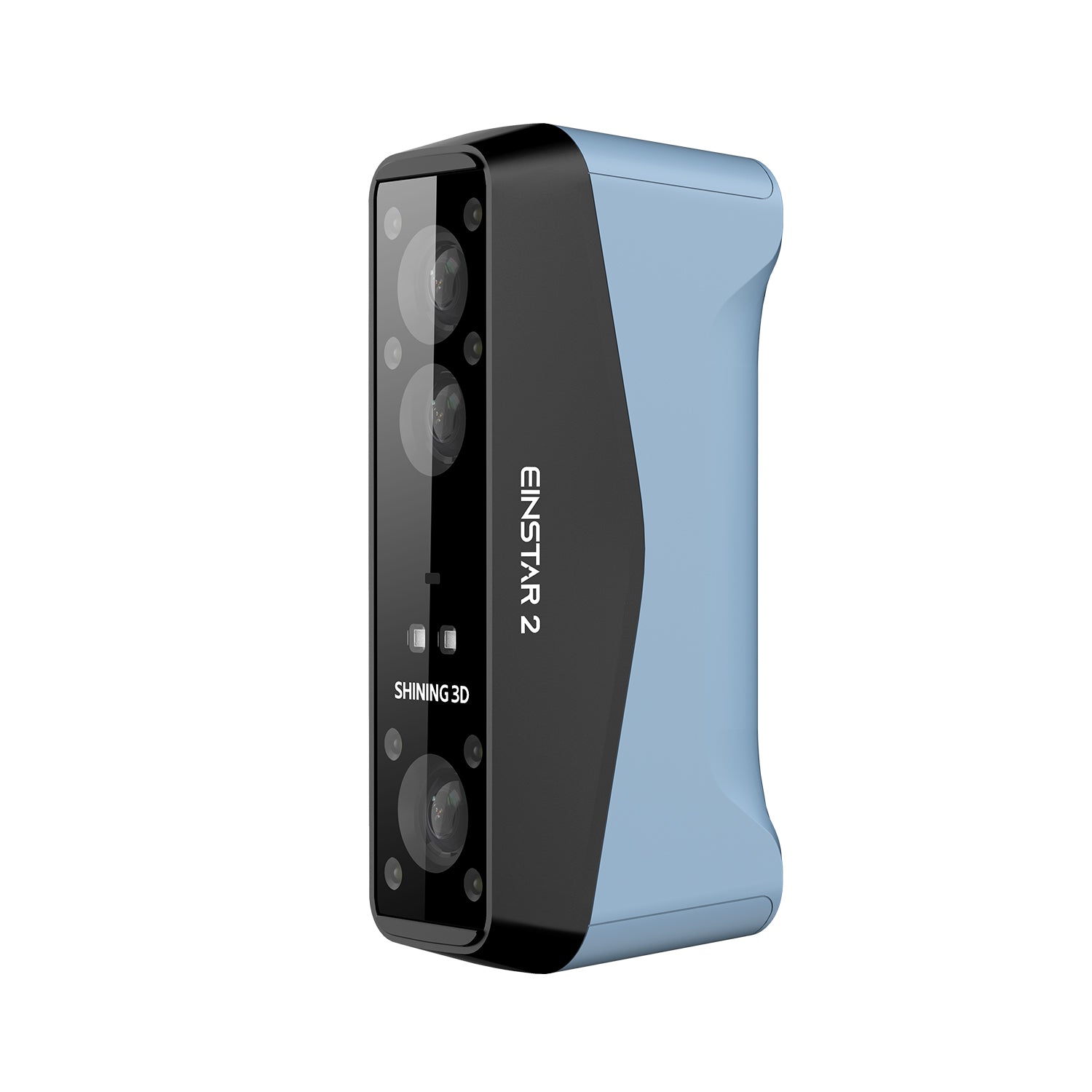
EINSTAR 2: the two-mode handheld
The EINSTAR 2 is the entry point of the handheld collection, presented by EINSTAR with the tagline "Still EINSTAR, Even Better". It is a 420 g (about 0.92 lb) handheld with a built-in battery and a USB-C interface, and its published sheet names two modes: Laser HD and IR Rapid. Per mode, the table gives: resolution of 0.05 to 10 mm in Laser HD and 0.2 to 10 mm in IR Rapid; scan speed up to 2,500,000 points per second in Laser HD and up to 4,800,000 in IR Rapid; working distance of 100 to 600 mm in Laser HD, widening to 160 to 1400 mm in IR Rapid; and a maximum field of view of 490 x 580 mm against 1170 x 1385 mm. Laser HD aligns with global markers; IR Rapid adds features, texture and hybrid. Minimum scan volume: 10 x 10 x 10 mm.
EINSTAR Rockit: the pocket-sized handheld
The Rockit is EINSTAR's palm-sized handheld, taglined "Rock-it in Your Pocket". EINSTAR publishes its weight as 420 g on the product page and 425 g on the specs page (about 0.93 and 0.94 lb, battery included) - a two-surface disagreement the site does not reconcile, so both figures are worth knowing. It shares the EINSTAR 2's two-mode structure with a denser laser setup: 19 plus 19 crossed laser lines plus 7 blue parallel lines in Laser HD, and the same IR VCSEL source in IR Rapid.
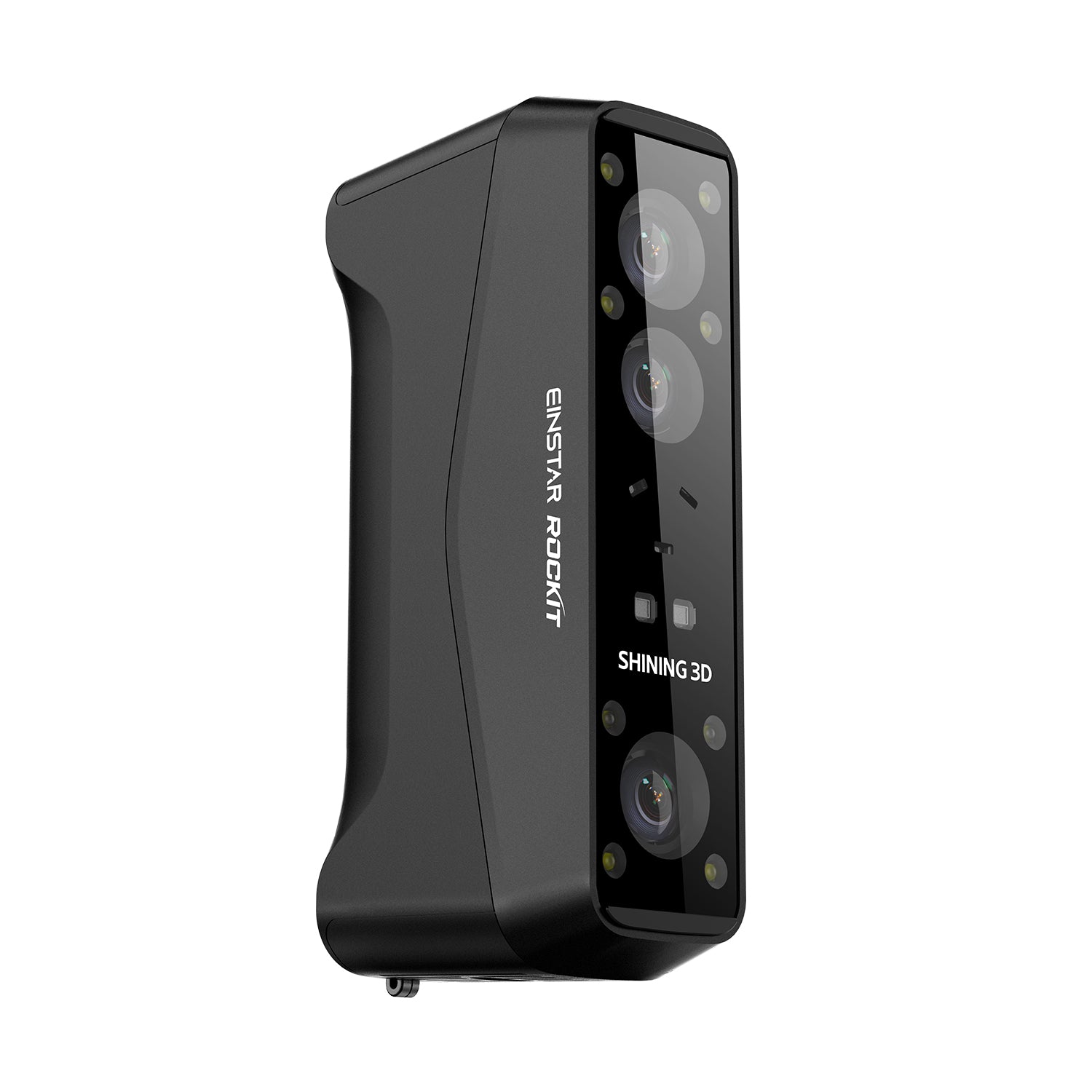
Its table gives resolution of 0.05 to 10 mm (Laser HD) and 0.2 to 10 mm (IR Rapid); scan speed up to 2,800,000 points per second in the laser mode and up to 4,800,000 in IR; working distance of 100 to 600 mm with the crossed 19 plus 19 lines, 100 to 400 mm with the 7 parallel lines, and 160 to 1400 mm in IR Rapid; and a 5 x 5 x 5 mm minimum scan volume, the smallest published of the four spotlights. Its texture camera is listed at 5 MP.
EINSTAR's marketing describes "marker-free laser scanning in both crossed and parallel lines" for this model and says it "also supports marker-based alignment": marker-free is presented per mode, not as a universal promise. The Rockit FAQ adds the note worth reading before you order: "If you want smooth marker free laser scan experience 64GB RAM is necessary."
EINSTAR VEGA: the standalone all-in-one
The VEGA is the only spotlight that scans without a computer at all. EINSTAR tags it "Wireless All-In-One 3D Scanner", and its sheet carries the line "No computer required for 3d scanning operation": the body packs an 8-core CPU, 32 GB of memory, a 512 GB SSD, a 6.4-inch touchscreen, Wi-Fi 6 and a built-in battery.
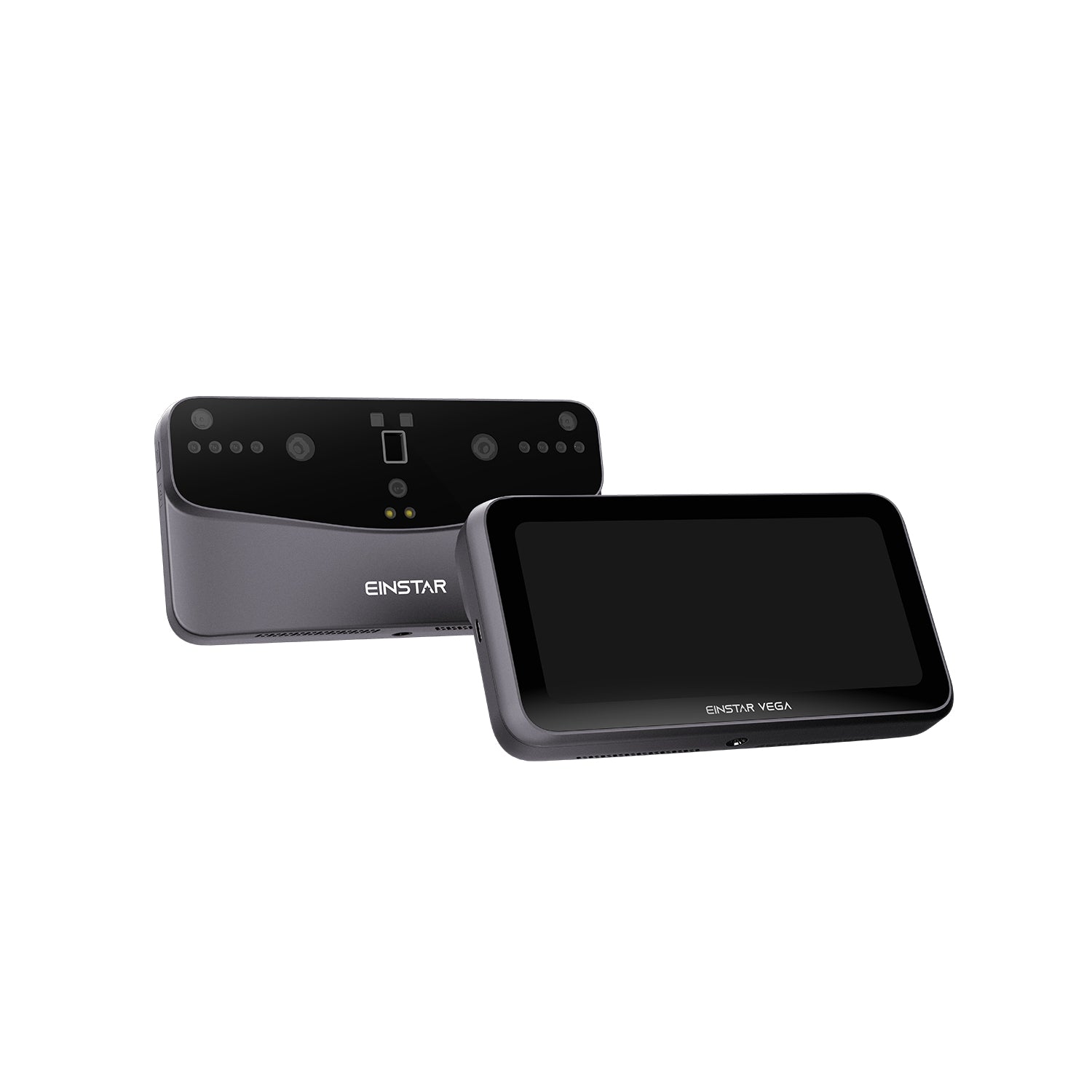
The VEGA has no laser mode. Its two scan modes are both infrared: HD Mode with an infrared MEMS source, Fast Mode with an infrared VCSEL source. Its sheet publishes point distance (0.05 to 3 mm in HD mode, 0.5 to 10 mm in Fast mode) where the other three publish resolution. Elsewhere on the sheet: capture frame of up to 15 fps in HD and 20 fps in Fast; working distance of 100 to 350 mm in HD and 270 to 1500 mm in Fast; alignment via features, texture, markers or hybrid; a 48 MP color camera; and an "Outdoor Scan: Yes" field. Body weight is 535 g (about 1.2 lb) regular edition, 643 g (about 1.4 lb) for what EINSTAR calls the limited edition. Its protection grade is IP50, and EINSTAR's FAQ is explicit about what that is not: "It has an IP rating of 5.0 and is not waterproof."
Because the VEGA scans standalone, PC requirements apply to a different step: EINSTAR's StarVision program handles data processing on a computer, with Windows 10/11 64-bit and macOS listed, an Intel i7 and 32 GB of RAM recommended.
EinScan Rigil: the tri-mode laser
The Rigil is the tri-mode laser scanner of the standalone collection. EINSTAR's www store calls it "The Tri-Mode Laser 3D scanner" in its page title, and the Global store's title goes further with "World's First Tri-Mode Laser 3D Scanner" - that "world's first" is EINSTAR's own claim about its own product, quoted here rather than asserted. The three modes are three published light-source configurations: 25 plus 25 crossed blue laser lines and 7 blue parallel lines, both under the Laser HD mode, plus an IR VCSEL source under IR Rapid.
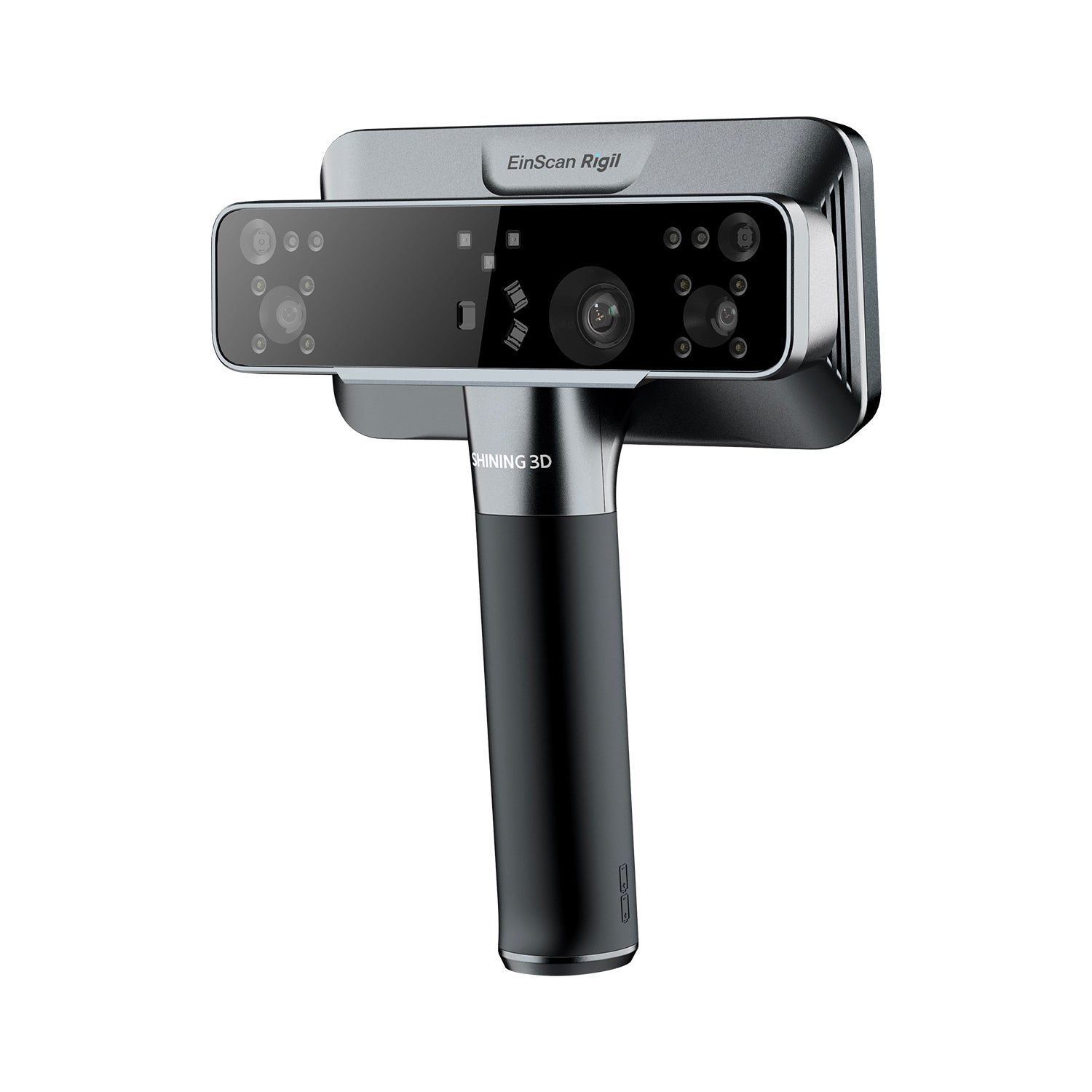
Work modes are the other half. The sheet lists Wireless Standalone first, then "For extra computing resource: PC-Wireless" and "PC-Wired", so the Rigil scans standalone like the VEGA and can hand the job to a computer when you want more compute. Scan speed by config: up to 4,800,000 points per second with the 25 plus 25 lines, 1,620,000 with the 7-line config, and up to 16,000,000 in IR Rapid. Resolution is 0.05 to 10 mm in Laser HD and 0.2 to 10 mm in IR Rapid, with working distance of 170 to 550 mm and 160 to 1500 mm respectively.
The Rigil is the only spotlight whose sheet publishes volumetric accuracy: "up to 0.04 + 0.06 mm/m" in Laser HD and "up to 0.1 + 0.4 mm/m" in IR Rapid, as the published table prints it. Volumetric accuracy describes how error behaves on a larger object, and it is not the same measurement as resolution. The body weighs 870 g (about 1.9 lb) with batteries, and its battery row is printed as "5500mA*2" on the product page and "5500mAh*2" on the specs page - a spelling split the site does not reconcile.
Rigil software is EXScan Rigil, which EINSTAR describes as free and covering "the full professional workflow from scanning and editing to export". Its recommended (not minimum) Windows configuration: an i7-13700H or above, an RTX 3060 Laptop GPU or above with at least 8 GB VRAM, 64 GB of RAM, USB 3.0 and Windows 11 64-bit; no minimum row is published.
How to read a 3D-scanner spec sheet
Four terms look interchangeable on a product card and are not: resolution, point distance, volumetric accuracy, and accuracy. On the surfaces checked for this guide, EINSTAR publishes resolution (0.05 to 10 mm in the laser modes of the handhelds and the Rigil), the VEGA publishes point distance (0.05 to 3 mm in HD mode) instead, and only the Rigil publishes volumetric accuracy, as a two-part figure. Single-shot accuracy as a standalone row is not published by any of the four on the surfaces checked, so no figure appears here for it.
Scan speed needs unit discipline. Frames per second is a frame rate; points per second is a data throughput, and the spec tables print points per second while some marketing copy prints fps. The EINSTAR 2's 90 fps is body copy; the Rockit's 90 fps is qualified "with marker alignment" in EINSTAR's own copy; the VEGA's 15 and 20 fps come from a spec-table field EINSTAR calls Capture Frame. Quote the unit the surface printed.
Working distance and field of view are separate rows: how far from the object the scanner is designed to operate, versus how wide the capture area is at that distance. "Marker-free" is always per mode: the IR modes list features, texture and hybrid alignment, while the laser modes center on markers. Laser class is Class 2 on the handhelds and Class II on the Rigil's laser mode, the same low-power class; none of these sheets claims eye-safety testing beyond the published class.
PC and software requirements
Scanner, software and operating system stay in fixed pairs, per the surfaces checked: EXStar Hub for the EINSTAR 2 and the Rockit, StarVision for VEGA processing, EXScan Rigil for the Rigil. Do not assume one installer covers the family.
The handhelds' Windows requirement starts at Windows 11 64-bit, 32 GB of dual-channel DDR5 RAM (minimum, 64 GB recommended), an RTX 3060 Laptop GPU or above and a 13th-gen Intel i7; the Rockit FAQ's 64 GB line for marker-free laser scanning sits on top of that. Mac support is listed as macOS Tahoe 26.2, 16 GB minimum on M1 or M3, 24 GB recommended on M3 Pro and above. The Rigil publishes a recommended Windows build (64 GB RAM, 8 GB VRAM, i7-13700H or above) and no minimum. StarVision's requirements are the lightest: Windows 10/11 or macOS, an Intel i7 and 32 GB recommended.
EINSTAR renders some of its PC-configuration pages client-side, so requirements may load after the page does, and published tables change without notice. Check the current system requirements before ordering: treat 32 GB of RAM as the realistic entry point for the handhelds, 64 GB for marker-free laser scanning.
Which workflow matches you
- ▸Mostly at a desk with a capable Windows PC nearby: the EINSTAR 2 is the entry handheld, its laser mode pairing the tighter working distance (100 to 600 mm) with the detail-oriented resolution row.
- ▸Pocket-sized, smallest detail work: the Rockit's 5 x 5 x 5 mm minimum scan volume is the smallest published of the four, with the 64 GB RAM caveat in its own FAQ for marker-free laser scanning.
- ▸No computer where you scan: the VEGA is the standalone all-in-one, with on-device processing, a touchscreen and a 48 MP color camera, at the cost of no laser mode and point distance rather than a resolution row.
- ▸Laser mode over larger objects, or compute handed to a PC when useful: the Rigil's three light-source configurations, standalone-or-PC work modes and published volumetric accuracy sit at the detail-oriented end of the portable lineup.
Buying through EINSTAR
Shipping policies share core wording across the region stores - orders processed in 1 to 3 business days, transit of 3 to 7 days, 4 to 10 business days estimated total, remote areas adding 1 to 3 days, no weekend or holiday shipping - but fee tables differ by surface, and the US store publishes a materially shorter policy of its own. At research time, the pages stated no free-shipping threshold anywhere.
Returns run on one window across all five storefronts, stated identically: 14 business days from the date you receive the item, unused, in the same condition and original packaging. For a change of mind you pay return shipping; when the error is EINSTAR's, Shining 3D covers it. The policy clock: review within 3 business days, product sent within 5 business days of confirmation, refund within 5 business days after inspection. No restocking fee is listed.
Warranty lives on a page of its own. As worded at research time: 1 year on new EINSTAR and EinScan hardware, extendable to a maximum of 3 years only within 60 days of the warranty starting, with a paid "Peace of Mind" upgrade reaching the same maximum and adding Express Replacement. The US store's warranty page lists six months for refurbished units, which cannot be extended. The clock starts at first activation, falling back to the shipment date when there is no activation record or invoice. Covered claims exclude misuse, wear and tear, and environmental damage.
Two clocks in two documents must not be merged: the return window is 14 business days from receipt, and the DOA (dead on arrival) window is 14 days after arrival and is the one case where Shining 3D covers shipping both ways. Support contacts on the site include +1-888-597-5655 for the Americas and einstar_shop@shining3d.com for returns and refunds.
What to verify before you order
- ▸Confirm the model's current spec sheet on the store that serves you. Figures here were observed 2026-09-19, and EINSTAR edits its pages without notice.
- ▸Check system requirements for the exact model against your computer: EXStar Hub for the EINSTAR 2 and Rockit, StarVision for VEGA processing, EXScan Rigil for the Rigil, and the 32 GB versus 64 GB RAM question for marker-free laser scanning.
- ▸Read the two clocks in the policies: the 14-business-day return window from receipt, and the 14-day DOA window from arrival, which is the case where both-way shipping is covered.
- ▸Confirm the warranty start rule and the extension window: the clock starts at first activation, and the 3-year extension is only available within 60 days of the warranty starting.
- ▸Check availability on the store that serves your destination, not on another store. The original EINSTAR is the live example: purchasable on the www and US stores, shown as sold out on Global, UK and EU.
If you plan marker-free laser scanning with a handheld, read the Rockit FAQ line before ordering: "If you want smooth marker free laser scan experience 64GB RAM is necessary."
Frequently asked questions
Do I need a computer to scan? The VEGA scans fully standalone - its sheet states "No computer required for 3d scanning operation", and StarVision is the PC side for processing. The EINSTAR 2 and the Rockit run scanning through the EXStar Hub desktop software, so they assume a computer with the published requirements. The Rigil scans standalone or in PC-wireless and PC-wired work modes.
Is scanning marker-free? It depends on the mode. The IR Rapid modes list features, texture and hybrid among their alignment options, and EINSTAR's Rockit marketing says the laser mode runs marker-free in crossed and parallel lines while also supporting marker-based alignment. No "no markers ever" claim exists across the lineup, and none is made here.
Is the EINSTAR waterproof? No. The VEGA sheet lists an IP50 protection grade, and EINSTAR's FAQ states it "is not waterproof"; IP50 is a dust-protection grade, not a waterproofing claim.
Can these scanners be used outdoors? The sheets publish light conditions rather than a blanket answer: the EINSTAR 2 and Rockit list outdoor operation below 110,000 lux in the laser mode and below 70,000 lux in IR mode, and the VEGA sheet carries an "Outdoor Scan: Yes" field.
What about the original EINSTAR? It remains listed on all five storefronts, purchasable on the www and US stores and shown as sold out on Global, UK and EU, with the EINSTAR 2 presented by EINSTAR as its successor ("Still EINSTAR, Even Better").
Which file formats do these export? The EINSTAR 2, Rockit and Rigil list STL, OBJ, PLY, 3MF and ASC; the VEGA lists PLY, STL, OBJ and ASC.