ATK Gear Buying Guide: Gaming Mice, Hall Effect Keyboards, and What to Know Before You Buy
ATK Gear sells lightweight gaming mice and Hall Effect keyboards direct from its own store. This guide walks the current catalog on published specs, store policies, and what to verify before you order.
What ATK Gear is
ATK Gear is a Hong Kong-registered brand (ATK GEAR GLOBAL LIMITED) that sells gaming peripherals directly from its own store. The catalog centers on gaming mice and Hall Effect keyboards, with mouse pads and a few accessories around those. ATK dates its start to 2023, when it launched the ATK68 and ATK75 Hall Effect keyboards, and it names esports players among its partners, including Aspas on keyboards and Chronicle on mice.
This guide is built from what ATK publishes: product pages, specification tables, and store policies. Jellymark does not run a testing lab, so nothing here is a hands-on verdict. Where ATK makes a claim, it is attributed to ATK; where the guide gives advice, it is about what to check before you order.
What ATK sells
- ▸Mice: wireless gaming mice under the Dragonfly A9 and Blazing Sky F1 family names, each sold in several configurations
- ▸Keyboards: Hall Effect (magnetic switch) keyboards in compact layouts, including the RS6 Air and RS7 Air
- ▸Mouse pads: a category in its own right on the store navigation
- ▸Headphones: listed under a secondary nav entry, with far less surface than the mice and keyboards
- ▸Software: ATK HUB, the configuration app the keyboard pages point to for remapping and rapid-trigger settings
Two brand names show up around this catalog. ATK and VXE are sibling lines: ATK's own footer lists VXE Official as another storefront, and VXE mice such as the Dragonfly R1 are sold on atk.store as well. Keep both names in mind when you search, because the same family of lightweight mice appears under both.
Jellymark participates in ATK's affiliate program. If you buy through an ATK link on this page, Jellymark may earn a commission at no extra cost to you. The links point you to the store so you can check current availability; they do not change what the store charges.
Explore the ATK catalog: the current lineup, configurations and store policies all live on atk.store.
Explore ATK GearFour products worth knowing
These four come from the store's own merchandising: each has a collection on the home page, which makes them a fair map of what ATK sells rather than a ranking. They are presented as catalog entries, not as verdicts.
ATK Dragonfly A9 Ultimate: a mouse family with a weight ladder
The A9 is ATK's flagship mouse family, and the name covers several configurations sold in one listing. Weight is the quickest way to tell them apart: the spec table lists 55+/-3 g for the Ultra Max 2.0 and Ultimate tiers, 47+/-3 g for the Air and Air+ tiers, and 39+/-3 g for the Mini and Mini+ tiers. The Ultimate we researched runs 125 x 63.5 x 40 mm (about 4.9 x 2.5 x 1.6 inches), with the Mini shorter at 118.4 x 61.2 x 38.6 mm. The shape is symmetrical, and ATK describes the fit as medium-to-large hands for claw, palm or fingertip grips.
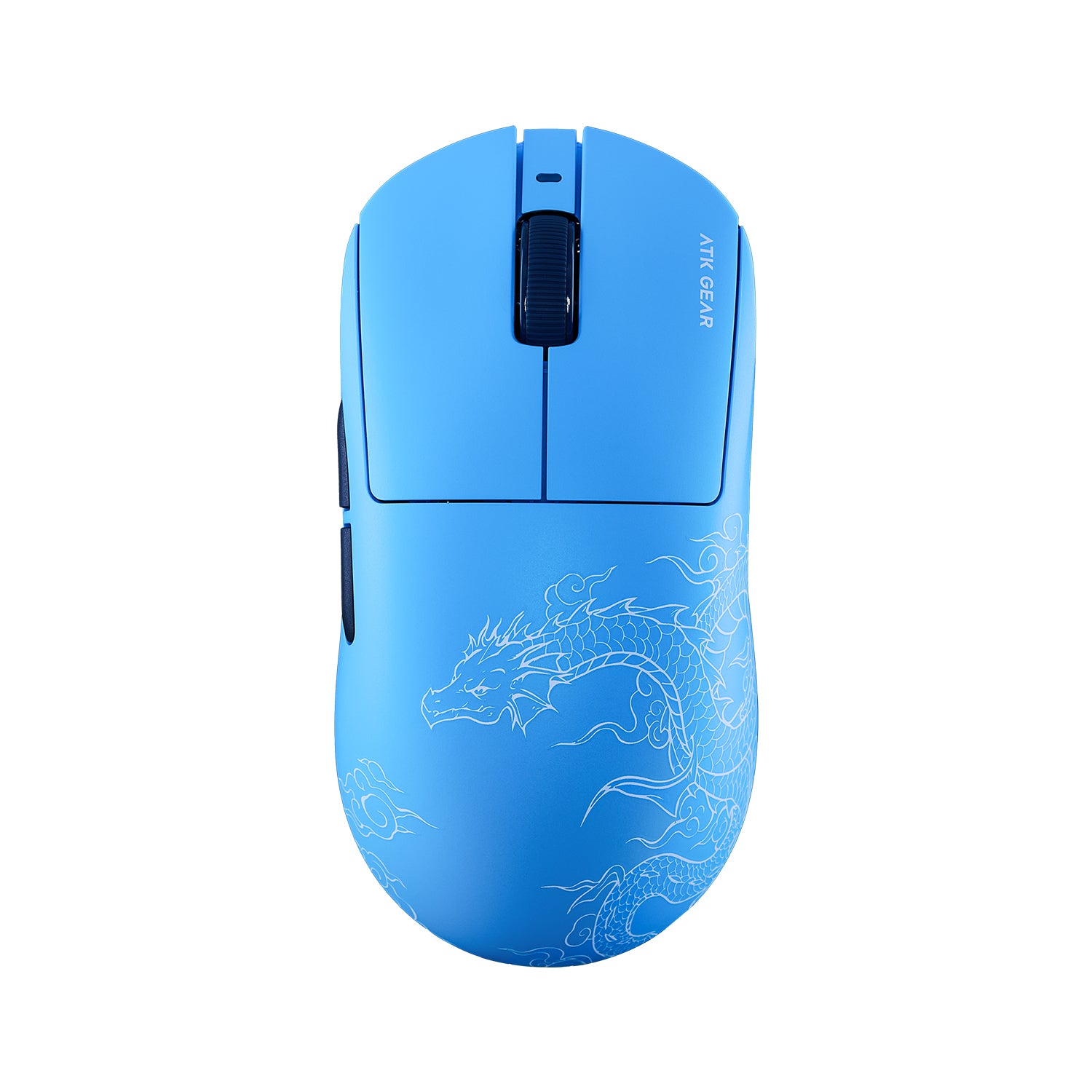
Connectivity, battery and internals all change by variant. The researched Ultimate configuration lists 800 mAh and up to 800 hours at 1 kHz polling; other A9 configurations carry their own battery figures, so check the variant before you assume a number. The sensor does not line up one-to-one either: the Ultra Max 2.0 uses the PAW3950 Ultra, the researched Ultimate configuration is listed with the PAW3955 Master, and the switch family differs across tiers (ATK names Lightblade, Custom Optical and Swiftlight). The spec table lists polling up to 8,000 Hz, and ATK publishes system requirements for it: an Intel Core i7-9700K or AMD Ryzen 7 3700X or newer, a 240 Hz or faster display, a GTX 1080 / RX 5700-class GPU and 16 GB of RAM. Read that note before you pay for a polling rate your PC cannot feed.
Who it fits: buyers who want one mouse family with a choice of weight tiers, and who read the variant line before ordering. What to verify before you buy: which tier you are ordering, whether that tier offers Bluetooth (the Ultimate+ configuration is listed with it, not every tier is), and the battery figure ATK currently lists for that exact variant.
ATK Blazing Sky F1 V3: the small esports shell
The F1 V3 is the small end of ATK's mouse range and the one the store frames around esports. The spec table lists 37+/-3 g; the marketing copy rounds that down to as little as 36 g and notes the number excludes the mouse skates, so the spec table figure is the one to compare. Dimensions are 118.2 x 62.4 x 38.8 mm (about 4.7 x 2.5 x 1.5 inches), the shape is symmetrical, and ATK describes the fit as small-to-medium hands for claw or palm.
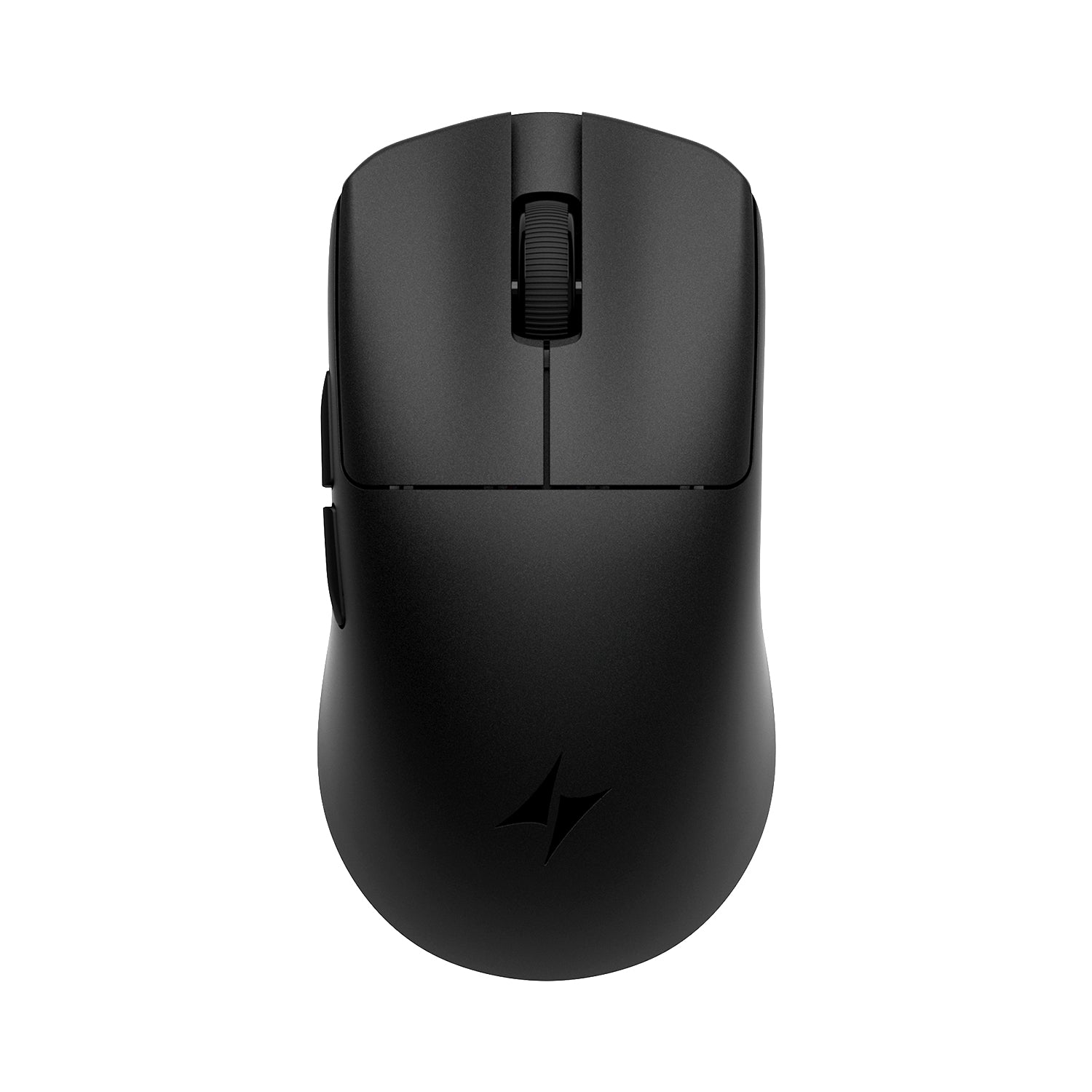
The V3 we researched is a wired-or-2.4 GHz mouse: the listing lists no Bluetooth. If Bluetooth matters, check which F1 configuration you are looking at, because ATK's own collection material ties Bluetooth to selected F1 V2 configurations instead. Battery is 300 mAh with 300 hours listed at 1 kHz polling, the sensor is the PAW3955 Master with a 10-50,000 DPI range listed in 1-DPI steps, and polling goes up to 8,000 Hz like the A9. A LEVIATAN co-branded version exists with its own artwork.
Who it fits: buyers who want a small, light shell, do not need Bluetooth, and accept a 300-hour battery class as the trade for the weight. What to verify: that the listing is a V3 (the family name covers several revisions) and that the colorway you want is in stock.
ATK RS6 Air: the 65% Hall Effect keyboard
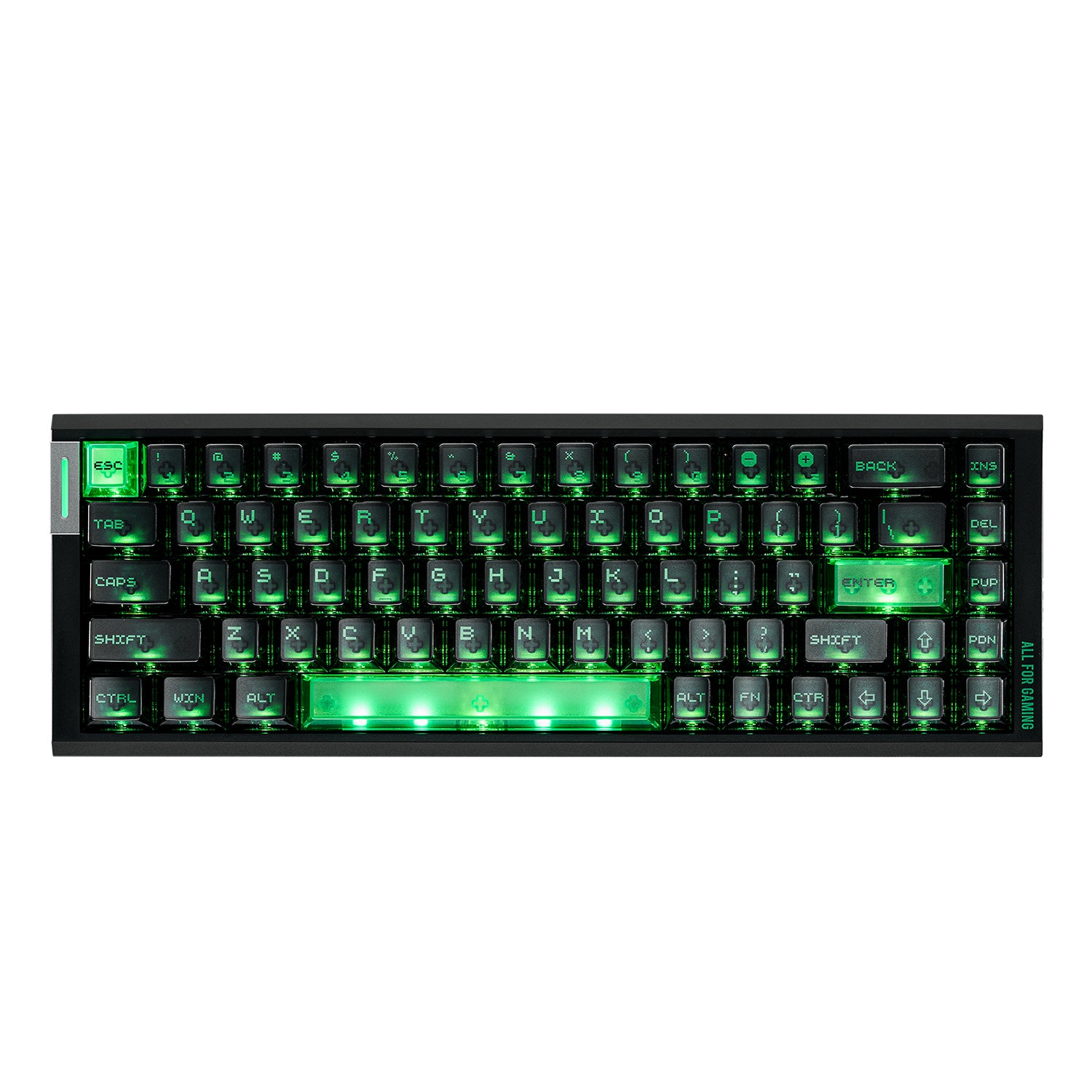
The RS6 Air is a 65% ANSI keyboard with magnetic (Hall Effect) switches. A 65% layout drops the function row and the number pad and keeps the main block, the arrows and a few extras; ATK's listing describes it that way, and the configuration is wired only, which removes one whole class of question before you order. The spec table gives 8,000 Hz polling, a rapid-trigger window of 0.001 to 3.3 mm adjustable in 0.001 mm steps, and a scan rate the table labels as N-Key at 32 kHz with an Extreme mode at 256 kHz.
The case is ABS plastic, the keycaps are frosted PC in a Cherry profile, and ATK lists two magnetic switch families for this board, Zenith and Iceblade, both rated at 3.3 mm total travel with 35+/-5 gf actuation force. It comes in White, Black and Pink colorways, with a Lake Green version tied to the Aspas edition. The listing also tells you exactly what ships in the box: the keyboard, a 1.5 m USB-C cable rated for 8 kHz, four spare switches, keycap and switch pullers, three extra contrast keycaps, a spacebar dampening foam, two stickers, a warranty card and the manual.
Who it fits: buyers with a clean desk who want the compact width, live in the function layer rather than the F-row, and are fine with a cable. What to verify: that 65% covers the keys you use daily (there is no dedicated F-row and no numpad), and which switch family the variant you order carries.
ATK RS7 Air: 75% with the F-row back
The RS7 Air is the RS6's bigger sibling: a 75% ANSI layout that keeps a full F-row and the arrows while still dropping the number pad. It is also wired only, on the same magnetic switch core: 8,000 Hz polling, rapid trigger from 0.001 to 3.3 mm in 0.001 mm steps, and the same 32 kHz / 256 kHz scan-rate bracket in the spec table. The case is ABS with aluminum accents, the keycaps are the same frosted PC Cherry profile, and the switch selector on the listing names the Lucidblade and Iceblade families.
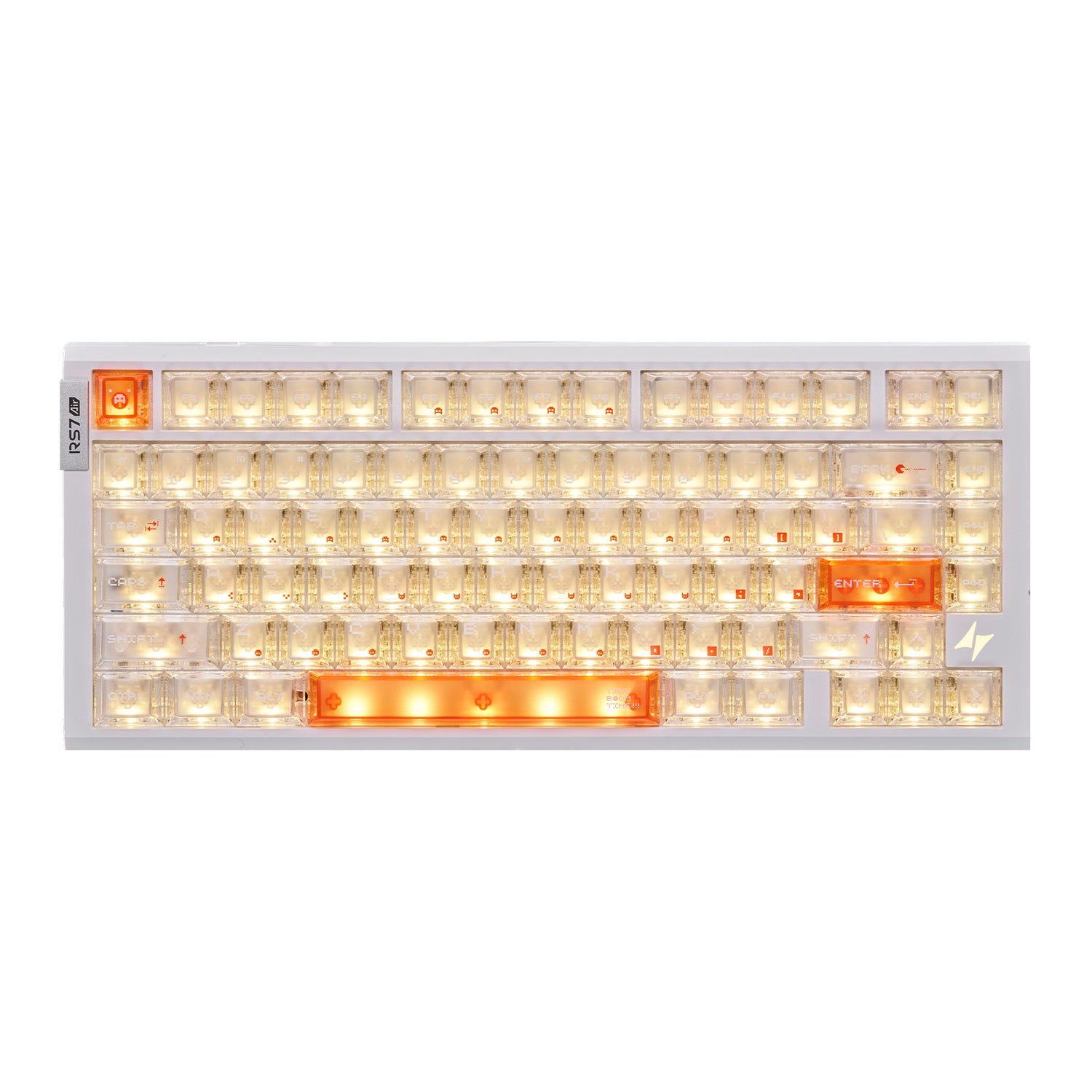
Where the two differ on paper is features and box contents. ATK's RS7 listing names RT (rapid trigger), SOCD, MT and TGL toggles, an adjustable deadzone and key remapping through the ATK HUB software. The box list is close to the RS6's: the keyboard, a 1.5 m 8 kHz USB-C cable, switch and keycap pullers, three extra contrast keycaps, four spare switches, a spacebar foam, two stickers, a warranty card and the manual. Both the RS6 Air and the RS7 Air list hot-swap and N-key rollover as yes.
Who it fits: buyers who want the F-row for non-gaming work and a compact footprint without giving up the arrows. What to verify: that 75% has the keys you actually use (the numpad is gone), and which switch family the variant selector shows for the colorway you pick.
How to choose an ATK mouse
The questions that send you to the right tier are size, weight and connectivity.
- ▸Size: measure your hand against the dimensions, not the marketing name. The A9 family fits medium-to-large; the F1 V3 is the small-to-medium shell. Compare the numbers against a mouse you already own if you can.
- ▸Weight: every A9 tier publishes a figure (about 39/47/55 g, +/-3 g depending on tier) and so does the F1 V3 (37+/-3 g per the spec table). The weight buys the same thing in every category: less mass to move. Nothing else changes because of the number.
- ▸Connectivity: check the variant line. The F1 V3 we looked at lists no Bluetooth (selected F1 V2 configurations do); on the A9, Bluetooth appears on specific configurations such as Ultimate+. If Bluetooth is a requirement, find the variant that lists it.
Polling rate is where buyers overspend. The A9 spec table lists up to 8,000 Hz, but ATK's own system note for 8 kHz demands a specific class of PC and display, quoted in the A9 section above. A 1 kHz wireless connection is an ordinary figure for a gaming mouse; read the requirement before you treat a higher number as free performance. The same goes for sensor generations: the PAW3950 Ultra and PAW3955 Master are the two sensors ATK lists across the A9 tiers, and sensor differences are the last thing to decide on. A mouse that does not fit your hand is wrong no matter which sensor it carries.
The current mouse lineup, configurations and availability live on the ATK store.
Browse ATK Mice & KeyboardsRS6 Air or RS7 Air: picking a layout
The two keyboards share a platform on paper: magnetic switches, 8,000 Hz polling, rapid trigger in 0.001 mm steps, wired connection. The decision is the layout.
- ▸Choose the RS6 Air (65%) if you want the shortest keyboard and live in the function layer: no F-row, no numpad, arrows and navigation kept.
- ▸Choose the RS7 Air (75%) if you use the F-row daily: media keys, shortcuts, games that bind to F-keys. The numpad is still gone, so if you enter numbers for a living, neither of these is the board for you.
Both are wired only in the listings we researched. If wireless is a requirement, neither is the target; check what ATK currently lists rather than assuming a wireless version exists. Rapid trigger itself deserves one honest sentence: it lets the keyboard register a release as soon as the switch lifts off its actuation point, using the magnetic field rather than a physical contact. ATK sets the rapid-trigger window at 0.001 to 3.3 mm in 0.001 mm steps. It is a configurable setting, not a measurable performance promise, and the latency figures ATK lists in the spec tables (for example 0.08 ms) are the maker's numbers, not an independent measurement.
Both list hot-swap switches and N-key rollover, and both ship the spare switches, pullers and extra keycaps in the box, so the deciding input is which layout your hands and your software need. If you are choosing between the two blind, the F-row is the safer default for general work; the 65% is the one for a narrowed desk.
Buying from the ATK store
ATK sells direct from atk.store, and the store page states the terms in one place, which makes the ordering questions answerable. The summary below is what ATK publishes today; policies can change, so check the store at order time.
- ▸Shipping: ATK says orders are processed within 48 business hours, with standard delivery listed at 3-16 days and express at 1-4 days. US addresses appear in the worldwide footprint. The store notes that standard shipping is tax-inclusive for most countries, with duties and taxes otherwise on the buyer.
- ▸Warranty: a 12-month limited warranty from the purchase date, covering manufacturing and workmanship defects. ATK lists the exclusions explicitly: accessories in the box, wear, accidental damage and software-only issues are not covered, and the warranty is void on unauthorized repair or modification.
- ▸Satisfaction guarantee: 30 days to report an issue, with video evidence required before a refund or exchange; ATK's page says claims are reviewed within 5-10 business days and replacements are brand new.
- ▸Returns: a 7-day window from confirmed delivery for unused products with all accessories, return shipping on the buyer, and refunds processed around 10 business days after receipt. Returns apply to atk.store purchases only.
- ▸Payments: cards, PayPal, Google Pay and Apple Pay, with Klarna and Afterpay listed as region-dependent.
One thing to know in advance: the links in this guide carry ATK's referral parameter for its affiliate program, and ATK documents a 14-day cookie window for attribution. The parameter does not change the price the store shows you; it tells ATK which publisher to credit. If you start from a linked page and then browse product pages, the attribution stays with your session, because the store keeps the referral in a cookie.
Frequently asked questions
Is ATK the same as VXE? No, they are sibling lines. ATK's own footer lists VXE Official as another storefront, and VXE mice such as the Dragonfly R1 are sold on atk.store. You will see both names around the same family of lightweight mice.
Are the RS6 Air and RS7 Air wireless? No. The listings we researched describe both as wired only. If wireless matters, check what ATK currently lists; do not assume a wireless variant exists.
Does ATK sell lightweight mice? Yes, by the published numbers: the spec tables list 37+/-3 g for the F1 V3 and 39+/-3 g for the A9 Mini tier, with the A9 family running up to 55+/-3 g across its upper tiers.
Which A9 variant should I choose? The variant line decides. Weight tiers span about 39/47/55 g (+/-3 g) across the Mini, Air and Ultimate families; battery and connectivity differ per configuration, and Bluetooth appears on specific configurations such as Ultimate+. Pick the tier for the weight, then confirm the connection options on that exact variant.
Does the referral link change the price? No. The link carries attribution for ATK's affiliate program, with a 14-day cookie window; the price is whatever the store shows.
What does ATK publish for warranty and returns? A 12-month limited warranty from purchase (with the accessories and wear exclusions listed), a 30-day satisfaction guarantee and a 7-day returns window, all for atk.store purchases. Those are the terms ATK publishes; check the store page at order time, since policies can change.