HomeCategoriesHomeSpace Heaters
Home · Household essentials, appliances & upgrades

The best space heaters of 2026

The DREO Atom One earns our top spot among 12 electric space heaters for its 1500W PTC ceramic element, 70-degree oscillation, and a price the premium brands cannot touch.

We compared 12 electric space heaters on the specs their makers publish and the certifications they actually hold: wattage tiers, ETL listing, tip-over and overheat cutoffs, thermostat type, oscillation, and cabinet design. Our audience is renters, home-office workers, and parents who need targeted supplemental heat without spiking the utility bill. We prioritized models with ETL certification, dual heat settings under 1500W, and safety sensors the maker will stand behind in writing. We also weighed the real-world annoyances owners keep raising: cord length, remote responsiveness, and how warm the cabinet gets.

Last updated
July 13, 2026
How we rank: published specs, third-party certifications, and what verified buyers report.
§ 01 · Top 5 Rankings

Our top 5 picks for space heaters

As an Amazon Associate I earn from qualifying purchases.

#1
EDITOR'S CHOICE
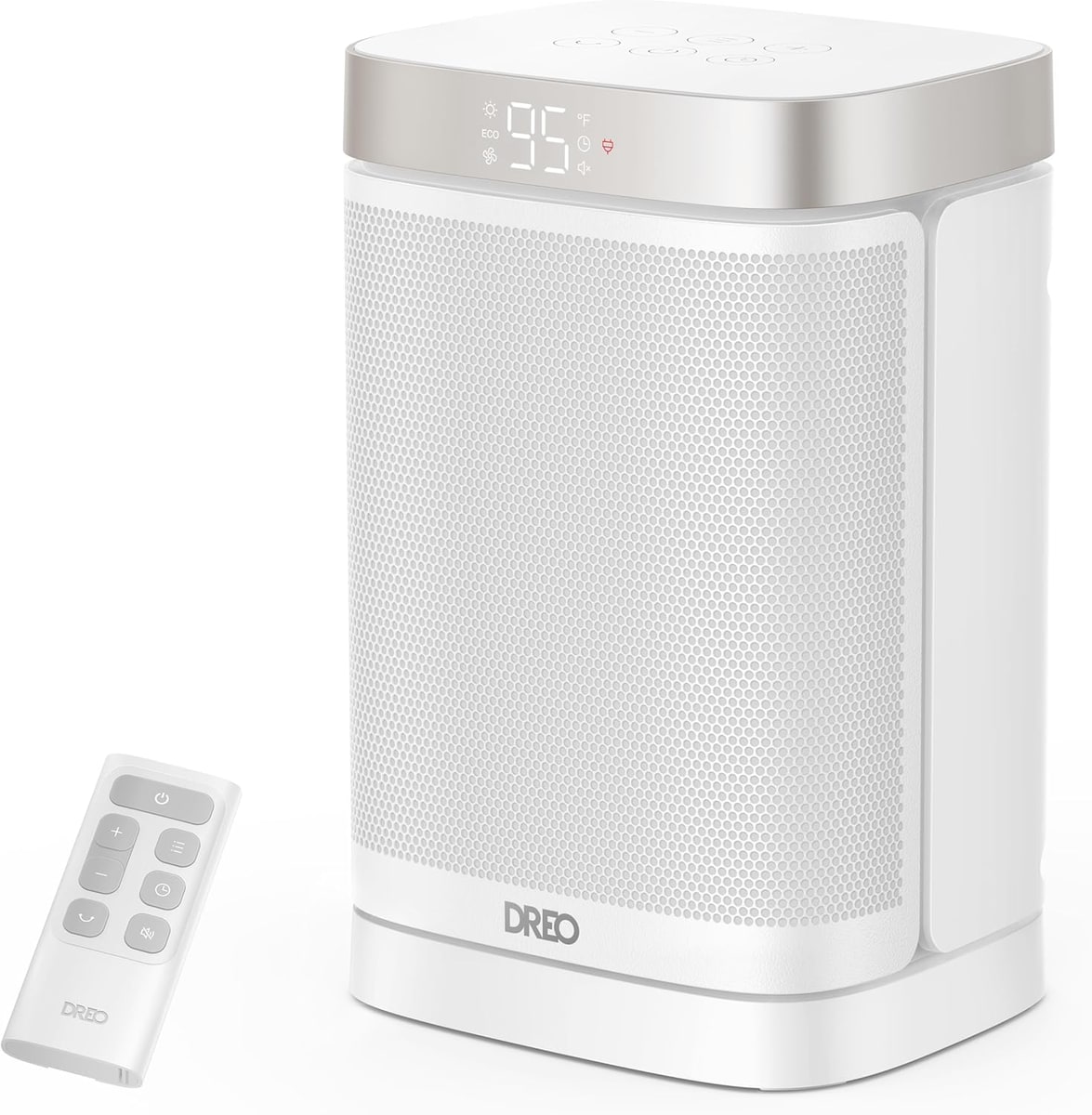
DREO Atom One Space Heater with Remote 70-Degree Oscillating Ceramic
Zoom
DREO

DREO Atom One Space Heater with Remote 70-Degree Oscillating Ceramic

9.3/10JellyReviews Score

The DREO Atom One pairs a 1500W PTC ceramic element with a 70-degree oscillating base, which is the combination that heats a room rather than a spot in front of it. PTC ceramic ramps in seconds, and the four modes (High, Low 900W, ECO, Fan Only) let you drop the draw well under 1500W once the room is warm. A 12-hour timer and a remote come in the box. It has both a tip-over switch and an overheat cutoff. It costs a fraction of what the Dyson HP07 does, and at 1500W it does the same core heating job.

Pros
1500W PTC ceramic element, the fastest-ramping element type at this wattage
70-degree oscillation spreads heat across a room instead of aiming it at one spot
Four modes (High 1500W, Low 900W, ECO, Fan Only) let you drop the draw well below 1500W
Remote and 12-hour timer included in the box
Cons
6-foot power cord is short for behind-couch placement
Display stays faintly lit even in sleep mode
Where to buy
Amazon
Check Price
We may earn a commission from this link.
#2
PREMIUM PICK
Dyson Purifier Hot+Cool HP07 Air Purifier Heater and Fan
Zoom
Dyson

Dyson Purifier Hot+Cool HP07 Air Purifier Heater and Fan

8.9/10JellyReviews Score

The Dyson Purifier Hot+Cool HP07 is the only model here that doubles as a sealed HEPA H13 air purifier and a cooling fan. Dyson rates the filter to capture 99.95% of particles down to 0.1 microns, a tighter spec than the 0.3 micron HEPA standard most filters quote. Its thermostat holds a set temperature instead of swinging around it, and the Air Multiplier design moves air with no exposed blades. The sticker is steep and the replacement filters are a recurring cost, but for an allergy sufferer in a 250 to 400 sq ft room it replaces a heater, a fan, and a standalone purifier with one 18.9-pound tower.

Pros
Sealed HEPA H13 filter rated to capture 99.95% of particles down to 0.1 microns
Thermostat holds a set temperature instead of cycling between too hot and too cold
Air Multiplier design blows air with no exposed blades and no buffeting
Three modes (Heat, Cool, Purify) replace three separate appliances in one 18.9-pound tower
Cons
By far the most expensive of the five
Replacement HEPA filters are a recurring cost
Where to buy
Amazon
Check Price
We may earn a commission from this link.
#3
BUDGET PICK
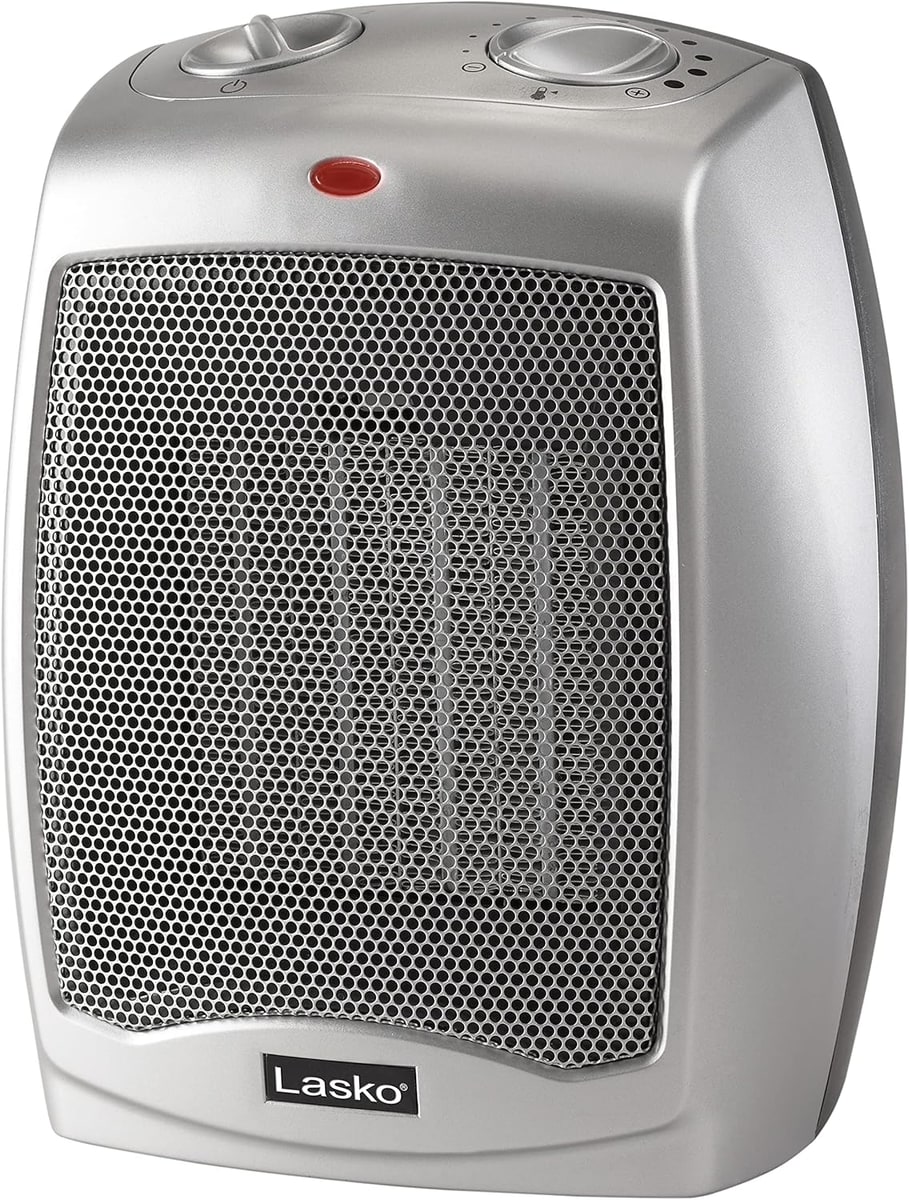
Lasko 754200 Desktop Electric Ceramic Space Heater
Zoom
Lasko

Lasko 754200 Desktop Electric Ceramic Space Heater

8.5/10JellyReviews Score

The Lasko 754200 is the cheapest heater here that still clears the safety bar. Its 1500W ceramic element heats up in seconds, which is what ceramic is for. The 9.2-inch body fits in a desk corner. Two heat settings (1500W high, 900W low) plus a fan-only mode cover the seasons. There is no oscillation, no remote, and no timer, so it heats a 70-degree cone in front of it rather than a whole room. ETL certification and a 3-year warranty, the longest in this group, back the build.

Pros
The cheapest of the five
1500W high and 900W low settings, plus a fan-only mode for the shoulder seasons
9.2-inch footprint fits in a desk corner
ETL certified with a 3-year warranty, the longest in this group
Cons
No oscillation, heats only a 70-degree cone
Manual dial controls only, no remote or timer
Where to buy
Amazon
Check Price
We may earn a commission from this link.
#4
QUIET PERFORMER
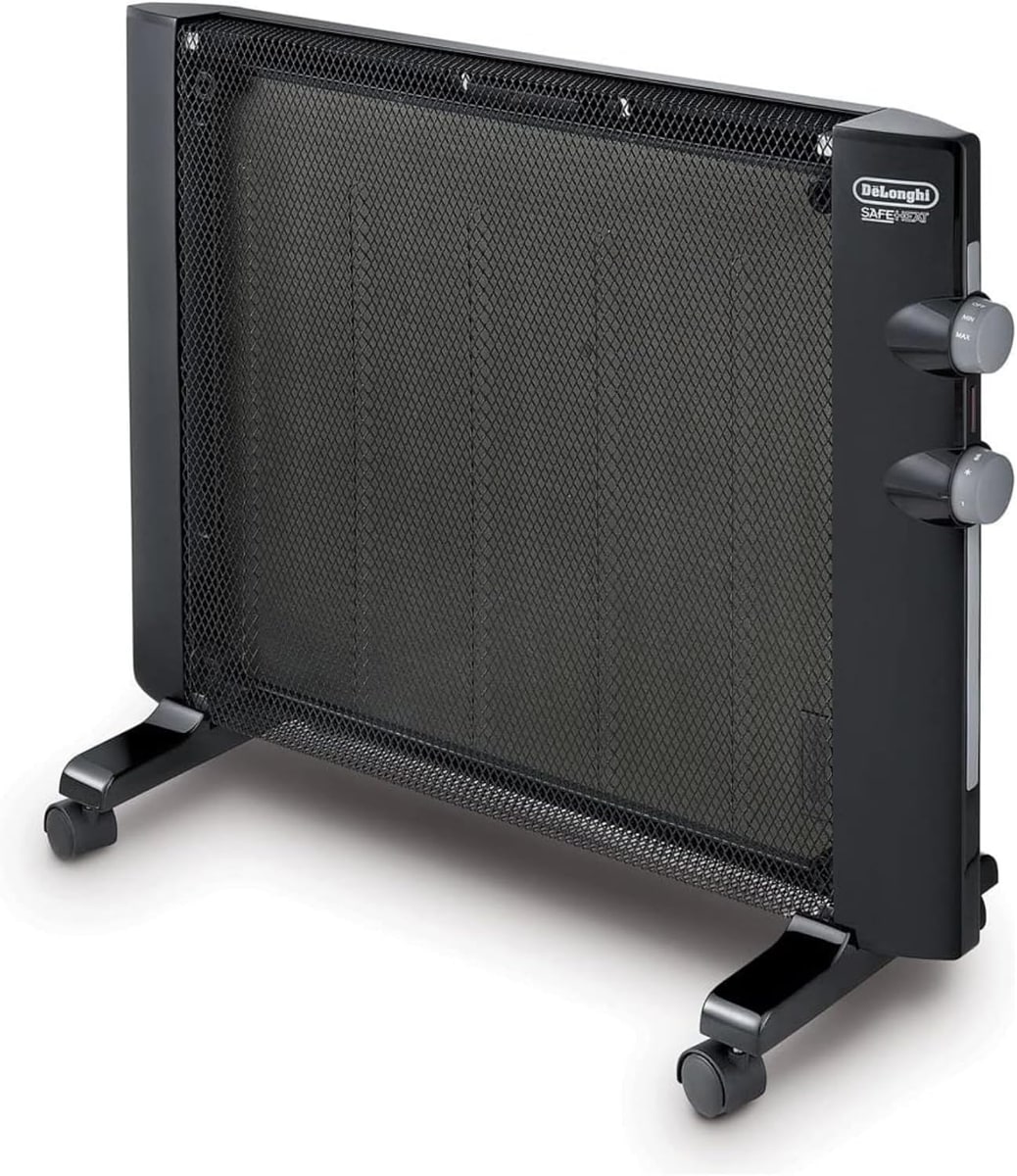
DeLonghi HMP1500 Mica Panel Space Heater 1500W
Zoom
DeLonghi

DeLonghi HMP1500 Mica Panel Space Heater 1500W

8.4/10JellyReviews Score

The DeLonghi HMP1500 uses micathermic panel heating instead of a fan, so it makes no fan noise at all. That is the entire reason to buy it. The 1500W element is the same wattage ceiling every heater on a US wall outlet runs into, but panel heating delivers it as radiant warmth across a large surface rather than as a jet of hot air, so the surface stays cooler than an exposed ceramic outlet. Wall-mount brackets ship in the box, and the 10.1-pound body sits flat against a wall in 4 inches of depth. There is no remote and no timer, only an analog thermostat, which cycles on a wider swing than a digital one. Best for bedrooms and nurseries where fan noise is the thing you are trying to avoid.

Pros
Micathermic panel has no fan at all, so it makes no fan noise
Panel heating spreads heat over a large surface, so that surface runs cooler than a ceramic outlet
Wall-mount hardware included and the 10.1-pound body tilts flat in 4 inches of depth
1500W element, the same wattage ceiling every heater on a US wall outlet runs into
Cons
10.1-pound panel is awkward to carry between rooms
No remote, no timer, analog thermostat only
Where to buy
Amazon
Check Price
We may earn a commission from this link.
#5
BEST FOR FLOORS
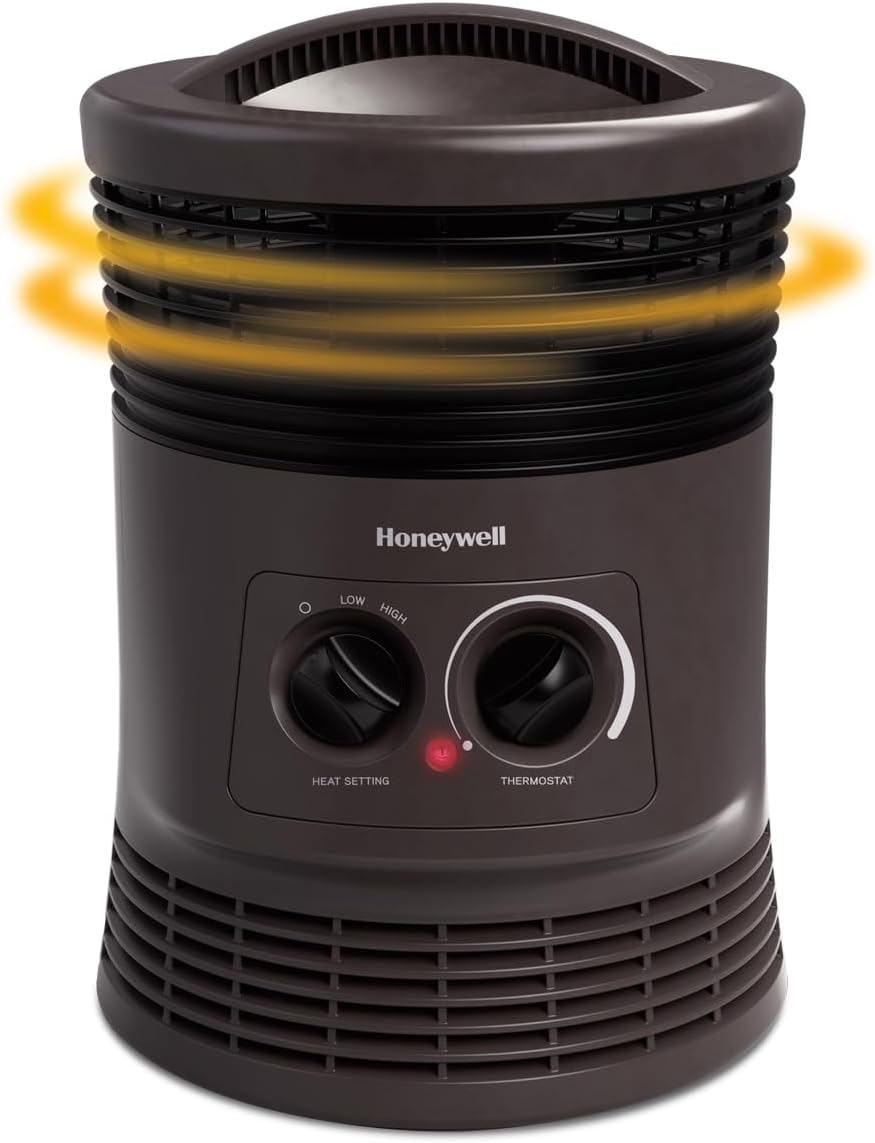
Honeywell HHF360V 360 Degree Surround Fan Forced Heater
Zoom
Honeywell

Honeywell HHF360V 360 Degree Surround Fan Forced Heater

8.2/10JellyReviews Score

The Honeywell HHF360V pulls air in from every side and pushes it out a top vent, so it warms the air around it rather than firing a cone across the room. The adjustable thermostat holds a setpoint instead of cycling on a crude switch. Two heat modes (1500W high, 750W low) and a fan-only setting cover three seasons. The 7.2-pound body has a carry handle, and it has a tip-over switch and an overheat cutoff. It is fan-forced, so it is loud on high. Best for basements and home gyms where airflow matters more than quiet.

Pros
360-degree air intake pulls from every side instead of one face
Adjustable thermostat rather than a fixed high and low switch
Tip-over switch and overheat shutoff
Two heat settings (1500W, 750W) plus fan-only mode cover three seasons
Cons
Fan-forced design is loud on high
No oscillation, intake pulls in floor-level dust
Where to buy
Amazon
Check Price
We may earn a commission from this link.
§ 02 · Side-by-side comparison

Compare all 5 at a glance

RankProductBrandScoreBest for
#1DREO Atom One Space Heater with Remote 70-Degree Oscillating CeramicDREO9.3EDITOR'S CHOICE
#2Dyson Purifier Hot+Cool HP07 Air Purifier Heater and FanDyson8.9PREMIUM PICK
#3Lasko 754200 Desktop Electric Ceramic Space HeaterLasko8.5BUDGET PICK
#4DeLonghi HMP1500 Mica Panel Space Heater 1500WDeLonghi8.4QUIET PERFORMER
#5Honeywell HHF360V 360 Degree Surround Fan Forced HeaterHoneywell8.2BEST FOR FLOORS
§ 03 · Buying guide

How to choose the right space heater

01Match Wattage to Room Size (Not Bigger)

Electric space heaters cap out at 1500W because that is the safe limit on a standard 15-amp US circuit at 120V. A 1500W unit delivers about 5,120 BTU/hr, enough for a 150 to 250 sq ft room with average insulation. Going larger does not exist on a standard plug, so do not trust marketing that claims 5,000W heaters running on wall outlets. The rule of thumb that holds up is 10 watts per square foot, which puts a 1500W heater at roughly 150 square feet of primary heat and up to 250 square feet of supplemental warmth.

For rooms under 120 sq ft, a 750W low setting is plenty and uses half the power. The DREO Atom One and Honeywell HHF360V both offer dual-wattage modes that cut consumption in low mode. For 350 sq ft or larger, expect to layer a heater with another unit rather than relying on one. Avoid oil-filled radiators if you need fast heat, since they take 20 to 30 min to ramp up versus 90 sec for ceramic PTC elements.

02Safety Sensors That Actually Matter

Tip-over switches and overheat sensors are non-negotiable. The way to check them is not a review claim, it is the certification: an ETL or UL listing requires both sensors to be present and independently tested, and the mark is printed on the box. The Lasko 754200 carries one. The DeLonghi HMP1500 has no tip-over switch at all, because it is designed to be wall-mounted, so it relies on overheat protection alone.

Cool-touch cabinets matter if kids or pets are nearby. A panel heater like the DeLonghi HMP1500 spreads its heat over a large surface, so that surface stays far cooler than the outlet of a fan-forced ceramic heater, which concentrates it into a small jet. Bathrooms require an IP24 or higher water-resistance rating, which is printed on the box, and none of the five heaters here carries one. Always plug a heater directly into a wall outlet, never into an extension cord or a power strip.

03Noise, Thermostats, and Real Energy Costs

Noise matters more than most buyers expect, and it comes from the fan, not from the element. Fan-forced ceramic heaters like the Honeywell HHF360V are the loudest here. A mica panel like the DeLonghi HMP1500 has no fan at all, which is exactly why it is the option for a nursery. If you plan to sleep with the heater on, buy the one with no fan, or run a fan-forced model on its lowest setting.

Thermostat quality varies. A digital thermostat (DREO Atom One, Honeywell HHF360V) holds a setpoint closely; a cheap analog dial (Lasko 754200) swings several degrees around it. If steady temperature matters to you, read the control type off the spec sheet before buying.

§ 04 · FAQ

Questions about space heaters

At the US average electricity rate of $0.16 per kWh, a 1500W heater running 8 hours per day costs $1.92 per day or about $58 per month. Running it 24 hours would cost $5.76 per day or $173 per month. ECO modes and dual-wattage settings can cut that 30 to 45%.

Only models with an IP24 or higher water-resistance rating belong in a bathroom, and the rating is printed on the box and in the manual. None of the five heaters in this guide carries one. Plug a bathroom heater into a GFCI outlet, mount it high on a wall, and keep it 3 feet from any water source.

Both convert 100% of electricity to heat, so efficiency is identical at the meter. The difference is delivery. Ceramic PTC elements heat a room in 90 sec but cycle on and off, while oil-filled radiators take 25 min to warm up and then hold heat longer after shutoff. For quick bursts, ceramic wins. For all-day warmth, oil-filled uses fewer cycles.

Most ceramic space heaters run 3 to 5 years with daily winter use. Fan motors fail first, usually around 4,000 hours of operation. PTC ceramic elements themselves last 10,000 hours or more. The Lasko 754200 ships with a 3-year warranty, the longest in this group. Dust buildup cuts lifespan 20 to 30%, so vacuum intake vents monthly.

The verdict

For most buyers the DREO Atom One is the right pick: a 1500W PTC ceramic element, a 70-degree oscillating base, and four modes, for a fraction of what the Dyson HP07 costs. If you want one appliance for heat, cooling, and air purification, the HP07 justifies its premium with sealed HEPA H13 filtration. The Lasko 754200 covers a desk or a small room for the least money. The DeLonghi HMP1500 wins for nurseries because it has no fan at all. The Honeywell HHF360V suits basements where airflow beats quiet.

This page contains affiliate links. We may earn a commission when you click through and make a purchase. This never affects our rankings.